
The Automation of Feature Engineering with LLMs
Traditionally, building effective classification models has been a labor-intensive process, heavily reliant on manual feature engineering. This involves a deep understanding of the domain, considerable trial-and-error, and significant developer time to extract relevant signals from raw data. The goal is to transform unstructured or semi-structured data into a format that machine learning algorithms can readily consume and learn from. This often means creating new variables, or 'features,' that capture specific characteristics of the data pertinent to the classification task. For example, in sentiment analysis, features might include the presence of positive or negative words, the count of exclamation marks, or the length of a review. This process is critical; the quality of features directly dictates the performance of the model. A model with poorly engineered features will likely perform suboptimally, regardless of its underlying architecture.
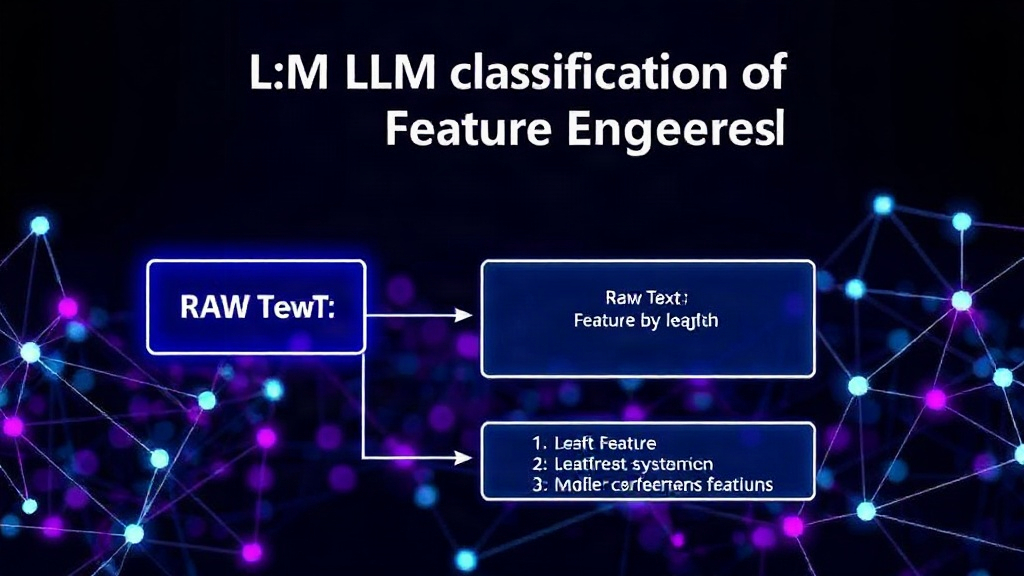
However, the advent of large language models (LLMs) is fundamentally changing this paradigm. LLMs, with their vast pre-training on diverse text data, possess an inherent ability to understand context, semantics, and nuances in language. This capability can be leveraged to automate the extraction of meaningful features, effectively turning the classification problem into a feature extraction problem. Instead of a data scientist manually crafting features, an LLM can be prompted to identify and output specific pieces of information that are indicative of a particular class. This shifts the focus from 'how do I engineer features?' to 'how do I prompt an LLM to extract the right features?'
Consider a scenario where you need to classify customer support tickets into categories like 'billing issue,' 'technical problem,' or 'feature request.' A traditional approach would involve identifying keywords, analyzing sentence structure, and potentially using rule-based systems or training a separate model to extract these signals. With an LLM, you can simply provide the ticket text and a prompt instructing the model to output a structured representation of the ticket's intent. For instance, a prompt might read: "Given the following customer support ticket, extract the primary issue and categorize it as 'billing,' 'technical,' or 'feature request.' Output your answer in JSON format with keys 'issue_summary' and 'category'." The LLM then acts as a sophisticated feature extractor, directly providing the structured data needed for a downstream classifier, or even performing the classification itself.
LLM Capabilities Beyond Simple Classification
The utility of LLMs in this context extends beyond simple, single-label classification. LLMs can be prompted to extract multiple features simultaneously, providing a richer feature set than might be feasible with manual engineering. For example, in analyzing product reviews, an LLM could be asked to extract not only the overall sentiment (positive, negative, neutral) but also specific aspects being discussed (e.g., 'battery life,' 'screen quality,' 'customer service'), the sentiment towards each aspect, and any suggested improvements. This multi-faceted extraction capability allows for more granular and informative feature sets, which can lead to more sophisticated downstream models. This is akin to having an expert analyst read every review and provide a detailed report, rather than just a simple thumbs-up or thumbs-down.
Furthermore, LLMs can handle complex and ambiguous language that often trips up traditional feature engineering techniques. Idioms, sarcasm, and domain-specific jargon can be challenging to encode into rules or simple statistical features. LLMs, due to their extensive training data, are generally adept at interpreting such linguistic complexities. This means that even with noisy or informal text, LLMs can still produce relevant and accurate features. This robustness is a significant advantage, especially when dealing with user-generated content or real-world data streams.
The process can be iterative. An initial LLM-generated feature set might be used to train a model. The performance of this model can then inform further prompt engineering or even guide the selection of which LLM-extracted features are most predictive. This feedback loop allows for continuous improvement, much like traditional feature engineering, but with the LLM handling the heavy lifting of data transformation.
The Shift in the ML Workflow
This shift from manual feature engineering to LLM-driven feature extraction has profound implications for the machine learning workflow. Developers and data scientists can now spend less time on the tedious, often unglamorous task of feature creation and more time on higher-level activities such as problem definition, model selection, evaluation, and deployment. The ability to quickly iterate on prompts and extract features for new classification tasks means that the time-to-insight and time-to-deploy can be significantly reduced.
This also democratizes certain aspects of ML. While deep expertise in LLM prompting is still valuable, it lowers the barrier to entry for creating effective classification systems compared to the specialized knowledge required for expert feature engineering. For teams with limited resources or domain expertise, LLMs offer a powerful shortcut to building capable models. It's like moving from hand-tuning an engine to simply pressing a button and having the car optimize itself.
However, it's crucial to recognize that this is not a complete replacement for all forms of feature engineering. For highly specialized domains or when dealing with structured numerical data, traditional methods may still be superior or more cost-effective. Moreover, the quality of LLM-extracted features is highly dependent on the prompt design and the capabilities of the LLM itself. Poorly designed prompts can lead to irrelevant or inaccurate features, just as poorly engineered manual features would. Careful evaluation and validation of LLM-generated features remain essential.
Unanswered Questions and Future Directions
What remains to be fully explored is the optimal way to integrate LLM-generated features into existing, complex ML pipelines. While LLMs can extract features, understanding how these abstract, semantically rich features interact with more traditional, mathematically defined features is an ongoing area of research. Will ensemble methods combining both types of features yield the best results? What are the computational costs associated with generating features on-the-fly versus pre-generating and storing them? The efficiency and scalability of LLM-based feature extraction for massive datasets also present challenges that need robust solutions.
Additionally, the interpretability of models built on LLM-extracted features is a critical concern. If an LLM generates features that are difficult for humans to understand, the resulting model's decisions may become opaque. Developing methods to interpret and explain these LLM-derived features will be key to building trust and ensuring responsible AI deployment. The current trend suggests a future where LLMs are not just tools for generating text or understanding language, but foundational components for building and optimizing machine learning models across a wide array of classification tasks.