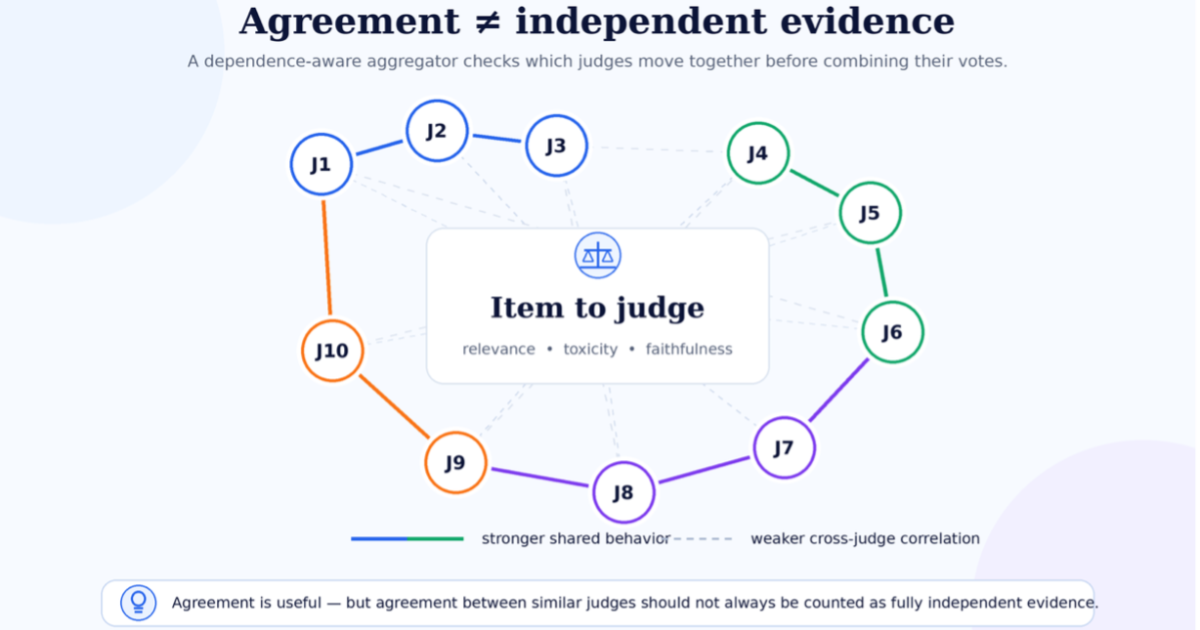
The Illusion of Consensus
Large Language Models (LLMs) are increasingly deployed as tools for information retrieval, content generation, and even decision support. A common assumption, or perhaps a hopeful heuristic, is that if multiple independent LLMs arrive at the same answer, that answer is likely correct. This perceived consensus can lend a false sense of confidence to the outputs. However, new research from Amazon Science challenges this notion directly, demonstrating that agreement among LLMs does not reliably correlate with factual accuracy.
The study, titled "When LLM judges agree, should we believe them?", probes the phenomenon of LLM agreement and its implications for trust and reliability. The core finding is that LLMs can exhibit strong agreement on incorrect information, a phenomenon that could lead users to accept misinformation as fact simply because it appears to be widely endorsed by AI systems. This is particularly concerning in domains where factual accuracy is paramount, such as education, healthcare, or legal research.
Think of it less like a panel of expert judges deliberating to find the truth, and more like a chorus of students who have all copied the same incorrect answer from a flawed textbook. The students might all recite the same wrong fact with perfect unison, but that doesn't make it right. This research suggests LLMs can fall into a similar trap, amplifying errors through collective agreement rather than correcting them.
Investigating LLM Agreement Patterns
The researchers designed experiments to systematically evaluate the relationship between LLM agreement and factual correctness. They presented LLMs with a variety of questions, including factual queries and subjective prompts, and analyzed the degree of consensus across different models. The key takeaway is that while LLMs can agree on many outputs, this agreement is often superficial and does not indicate a deeper understanding or grounding in truth. In many cases, the models are likely converging on the same statistically probable, but factually inaccurate, responses based on patterns in their training data.
This convergence on error is a critical vulnerability. If a single LLM produces a factual error, it's an isolated incident. If multiple LLMs, often trained on different datasets or using slightly different architectures, all produce the same error, it suggests a systemic issue. It could indicate that the error is prevalent in the training data, or that the models share a common algorithmic bias leading them to similar erroneous conclusions. The danger lies in the user's interpretation: faced with a unanimous AI verdict, a human is less likely to perform independent verification, thus cementing the misinformation.
The implications extend to the development of LLMs themselves. If the evaluation metrics for these models do not rigorously distinguish between consensus and correctness, developers might inadvertently optimize for agreement rather than accuracy. This could lead to models that are highly predictable in their errors, but not necessarily more truthful.
Why Agreement Fails as a Trust Signal
Several factors contribute to why LLM agreement can be misleading. Firstly, LLMs are trained on vast datasets that inevitably contain factual inaccuracies, biases, and outdated information. If a piece of misinformation is widespread online, it's highly probable that it will appear in the training data of multiple LLMs. When prompted, these models may simply retrieve and reproduce this prevalent falsehood, leading to agreement.
Secondly, LLMs often share similar architectural designs and training methodologies. Even with different datasets, commonalities in model architecture (like the Transformer architecture) and the underlying principles of how they process information can lead to similar failure modes. They might learn to associate certain concepts or facts in the same incorrect ways.
Thirdly, the very nature of how LLMs generate text—predicting the next most probable token—can lead to a form of
