Beyond Text Prediction: The Agent's Core Loop
The term "agent" in the context of large language models (LLMs) has become a nebulous catch-all. Yet, at its heart, the distinction is simple and powerful: an LLM on its own is a sophisticated text predictor. It takes text input and generates text output based on its training data. This means it cannot access real-time information, verify facts against current data, or execute actions in the external world. Its knowledge is a snapshot, frozen at the moment its training concluded.
An agent transforms this static capability into dynamic action by integrating the LLM with a system of tools. This integration isn't merely about giving the LLM access to information; it's about enabling it to decide when and how to use that access. The core mechanism involves a feedback loop: the LLM is presented with a set of functions (tools) it can invoke. These tools might be designed to read files, query databases, interact with APIs, or perform complex calculations. The LLM’s task is to reason about a user’s request, determine if it needs external information or action, select the appropriate tool, execute it, and then process the tool's output. This output is fed back into the LLM, allowing it to decide if its goal is met or if further tool use is necessary.
This iterative process—decide, tool-call, observe, repeat until goal achieved—is the fundamental architecture of any system that qualifies as an LLM agent. Variations exist in how this loop is implemented, how tools are selected, and how the LLM's reasoning is structured, but the underlying principle remains constant. Without this loop, a model is simply a text generator; with it, the model gains the capacity to interact with and influence its environment.
The Anatomy of a Tool-Calling LLM
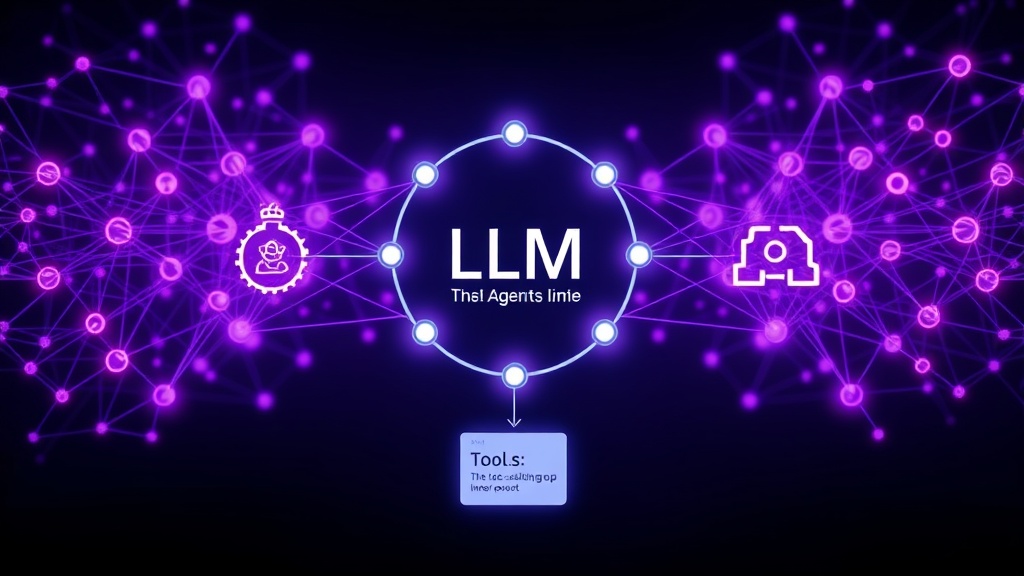
To understand what separates an agent from a plain LLM, consider the components that enable this interaction. At a minimum, an agent system comprises:
- The Large Language Model (LLM): This is the reasoning engine. It receives the user's prompt, analyzes it, and decides on a course of action. Its ability to understand context, plan, and generate coherent instructions for tools is paramount.
- Tools: These are external functions or services that the LLM can call. Examples include:
- Information Retrieval Tools: Web search engines, database query interfaces, document readers. These allow the LLM to fetch current or specific data not present in its training set.
- Action Execution Tools: APIs for sending emails, scheduling meetings, controlling smart devices, or interacting with other software systems. These enable the LLM to perform tasks in the real world.
- Computational Tools: Calculators, code interpreters, or specialized solvers. These offload complex calculations or symbolic manipulations that LLMs are not optimized for.
- The Orchestration Loop: This is the critical component that manages the interaction between the LLM and the tools. It typically involves:
- Prompting the LLM: The system structures the user's request and the available tool descriptions into a prompt that guides the LLM to make a decision.
- Tool Selection and Argument Generation: The LLM outputs a structured request, specifying which tool to use and what arguments to pass to it.
- Tool Execution: The orchestration layer parses the LLM's output, calls the specified tool with the provided arguments, and captures the tool's return value.
- Feedback to the LLM: The tool's output (or an error message) is fed back to the LLM, often as part of a new prompt, allowing it to continue its reasoning process.
- Termination Condition: The loop continues until the LLM determines that the task is complete and provides a final answer to the user.
This structured interaction is what grants an LLM agency. It’s not about the LLM’s internal knowledge but its ability to leverage external resources dynamically to achieve a goal. Think of it less like a student taking a test with only their textbook knowledge, and more like a researcher with access to a library, a lab, and a network of colleagues they can consult.
The Power of Iteration: Why the Loop Matters
The iterative nature of the agent loop is what unlocks complex problem-solving. A single LLM call can only go so deep. If a user asks, "What is the weather like in London tomorrow and can you book me a table for dinner at an Italian restaurant near the British Museum if it’s going to rain?" a non-agent LLM would struggle. It might tell you the weather based on its training data (likely outdated) and then state it cannot perform the booking or check for rain.
An agent, however, would break this down:
- Call Weather API: The LLM decides it needs current weather data for London tomorrow. It calls a weather API tool.
- Receive Weather Data: The API returns "Tomorrow: 15°C, 80% chance of rain."
- Reason about Rain: The LLM processes this: "It's going to rain."
- Call Restaurant Search API: Based on the rain and the user's preference for Italian, it calls a restaurant search API, specifying "Italian," "near British Museum," and perhaps a time.
- Receive Restaurant Options: The API returns a list of restaurants with details.
- Select and Book: The LLM picks one, calls a booking API, and confirms the reservation.
- Formulate Final Answer: The LLM synthesizes all information: "The weather tomorrow will be 15°C with an 80% chance of rain. I have booked you a table at [Restaurant Name] for [Time]."
Each step is a distinct LLM inference, feeding into the next. This multi-step reasoning allows agents to tackle problems that are far beyond the capabilities of a standalone LLM, mimicking a human’s ability to gather information, plan, and execute in a sequence.
What Isn't an Agent?
It's crucial to distinguish true agents from systems that merely present LLM outputs. If a system simply takes an LLM's response and then a human manually performs an action based on it, that's not an agent. Similarly, LLMs that have been fine-tuned on specific datasets for particular tasks (like summarization or translation) are still not agents if they lack the ability to dynamically call external tools and loop through their execution. The defining characteristic is the autonomous, programmatic interaction with external environments via a defined set of tools, driven by the LLM's reasoning within an orchestration loop.
The landscape of AI is rapidly evolving, and the definition of an "agent" will likely continue to be refined. However, the core concept of an LLM empowered to interact with the world through tools, guided by an iterative reasoning loop, provides a solid foundation for understanding these increasingly capable AI systems.