Lisp Org Parser: PEG Trumps Regex for Structured Text to HTML
A custom Lisp parser built with Parsing Expression Grammars (PEGs) offers superior flexibility and maintainability over traditional regex for handling complex Org-mode syntax.
By NowRift Editorial|Updated 26 Sept 2026
The Limits of Regex for Org-mode
Org-mode, Emacs's ubiquitous outlining and note-taking system, relies on a rich, hierarchical syntax for its power. While regular expressions are often the go-to tool for text pattern matching, they quickly become unwieldy when applied to deeply nested and context-dependent structures like Org-mode. A common challenge arises when trying to parse and convert this structured text into other formats, such as HTML. Traditional regex-based parsers struggle with the inherent ambiguities and recursive nature of Org-mode syntax, leading to brittle solutions that are difficult to extend or debug.
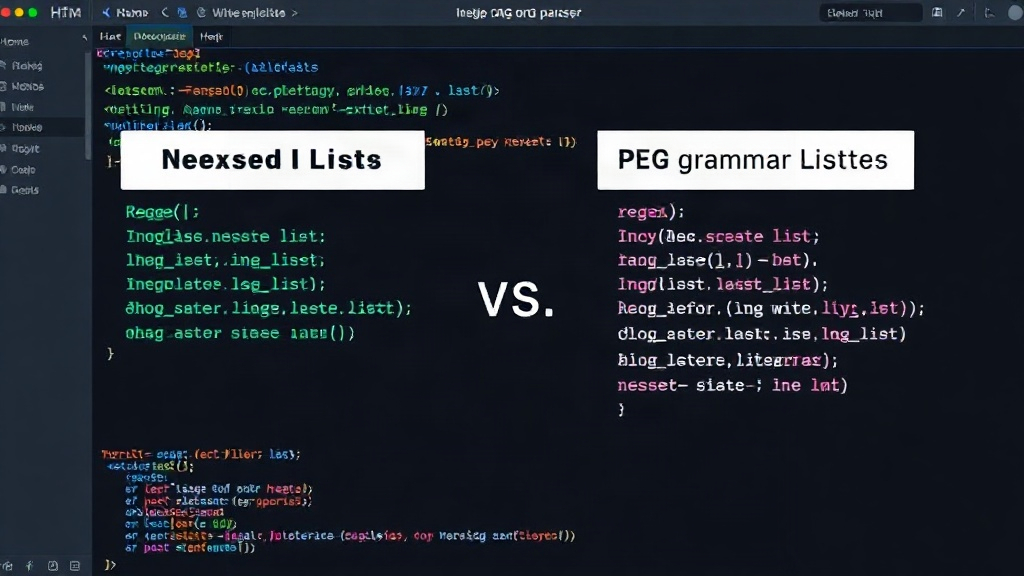
Consider the task of parsing a simple Org-mode list. A regex might handle a single level of indentation, but as nesting deepens, or when mixing list types (ordered and unordered), or incorporating other inline elements like links or bold text within list items, the regex becomes a monstrous, unmanageable beast. Each new syntax element or edge case often requires a complete overhaul of the existing pattern, a process prone to introducing subtle bugs and breaking existing functionality. This fragility is a significant barrier for developers wanting to build robust Org-mode processing tools.
The author of the original blog post encountered these limitations when developing a custom Org-mode parser in Lisp. The desire was to create a flexible and maintainable system capable of handling the full spectrum of Org-mode syntax, from basic headings and lists to more complex structures like tables, footnotes, and inline images. Regex, despite its widespread use, proved inadequate for the task. The decision was made to explore alternative parsing techniques, leading to the adoption of Parsing Expression Grammars (PEGs).
Parsing Expression Grammars: A Better Fit
Parsing Expression Grammars offer a fundamentally different approach to defining language syntax. Unlike context-free grammars, which can be ambiguous, PEGs are inherently unambiguous. They define a sequence of matching rules that are applied sequentially. If a rule fails, the parser backtracks, but it never commits to a parse that could lead to ambiguity. This deterministic nature makes PEGs exceptionally well-suited for parsing structured data with recursive elements, such as programming languages or complex markup formats like Org-mode.
A PEG is composed of a set of rules, each defining how to recognize a specific part of the input. These rules use operators like sequence (`/`), choice (`|`), repetition (`*`, `+`), and negation (`!`, `&`) to build up complex patterns. For example, an Org-mode list item might be defined recursively: an item starts with an item marker (like `-` or `*`), followed by the content, which itself can contain nested lists. A PEG can express this recursive structure elegantly and efficiently.
The author's implementation leverages Lisp's metaprogramming capabilities to define the PEG grammar. Lisp's macro system allows for the creation of domain-specific languages (DSLs) that closely mirror the PEG notation, making the grammar definition itself readable and maintainable. This approach contrasts sharply with the often cryptic and unreadable nature of complex regex patterns. The resulting parser is not only more robust but also easier to understand, modify, and extend as the Org-mode specification evolves.
Building the Org Parser in Lisp
The project involved several key steps. First, defining the PEG grammar that accurately captures the nuances of Org-mode syntax. This is an iterative process, requiring a deep understanding of Org-mode's specification and common usage patterns. The grammar covers elements like headings, lists (ordered, unordered, nested), paragraphs, links, images, footnotes, tables, and inline formatting (bold, italic, verbatim). Each element is defined as a distinct rule within the PEG, allowing for modularity and clear separation of concerns.
Second, implementing the PEG parser itself in Lisp. This involves creating functions that interpret the grammar rules and traverse the input string. Lisp's functional nature and powerful list-processing capabilities are well-suited for this task. The parser generates an Abstract Syntax Tree (AST) that represents the hierarchical structure of the Org-mode document.
Third, developing an exporter that traverses the AST and generates the target output format, in this case, HTML. This exporter translates the nodes of the AST into corresponding HTML tags. For instance, a heading node in the AST becomes an `
`, `
`, etc., tag in HTML. A list node becomes a `
` or `` with nested `
` elements. This separation of parsing and rendering ensures that the parser can be reused to generate other formats (e.g., Markdown, PDF) without re-implementing the core parsing logic.
Advantages Over Regex for Org-mode
The primary advantage of using PEGs over regex for Org-mode parsing lies in maintainability and expressiveness. Regex solutions for complex grammars tend to become unmanageable. They are notoriously difficult to debug, especially when dealing with backtracking or intricate lookarounds. Every change risks breaking unrelated parts of the pattern. PEGs, with their structured, rule-based definition, are far more transparent. Developers can inspect individual rules, understand their behavior, and confidently make modifications.
Furthermore, PEGs naturally handle the recursive nature of structured text. Org-mode lists can contain other lists, which can contain more lists, and so on. Expressing this kind of recursion with regex is either impossible or leads to extremely convoluted patterns that are practically unmaintainable. PEGs, on the other hand, define recursion as a first-class concept, making the grammar definition intuitive and direct.
The Lisp implementation further amplifies these benefits. Lisp's inherent support for symbolic computation and macros allows the PEG grammar to be defined in a highly declarative and readable manner. This DSL-like approach to grammar definition means that the code defining the parser's behavior is closer to the abstract grammar itself, reducing the cognitive load for developers working on the system. For anyone needing to process structured text formats with significant depth and complexity, moving beyond regex to a PEG-based approach, especially within a powerful language like Lisp, represents a significant step up in development efficiency and code quality.