The Glue Problem: Why Traceability Fails
Most development teams don't struggle with a lack of traceability. They suffer from a "glue problem." Information about a project is scattered across disparate tools: tickets in Jira, specifications in Confluence, test cases in TestRail or Xray, and test run results in exported spreadsheets. Each link to another system requires a separate login, a new API call, and introduces a potential point of failure. This fragmentation looks acceptable in a high-level slide deck, but day-to-day, it decays. Wikis point to outdated tickets, test cases remain listed for features that never shipped, and critical context gets lost in the transition between platforms.
This isn't a new observation. The friction of context switching and the fragility of inter-tool links are perennial challenges. The current paradigm relies on aggregating pointers—URLs—into different systems. While seemingly efficient, these pointers are brittle. They break when keys change, when systems are upgraded, or when access permissions shift. The promise of a unified view through linked data crumbles under the weight of practical system administration and the simple entropy of software development lifecycles.
A Unified Graph in a Single Git Repo
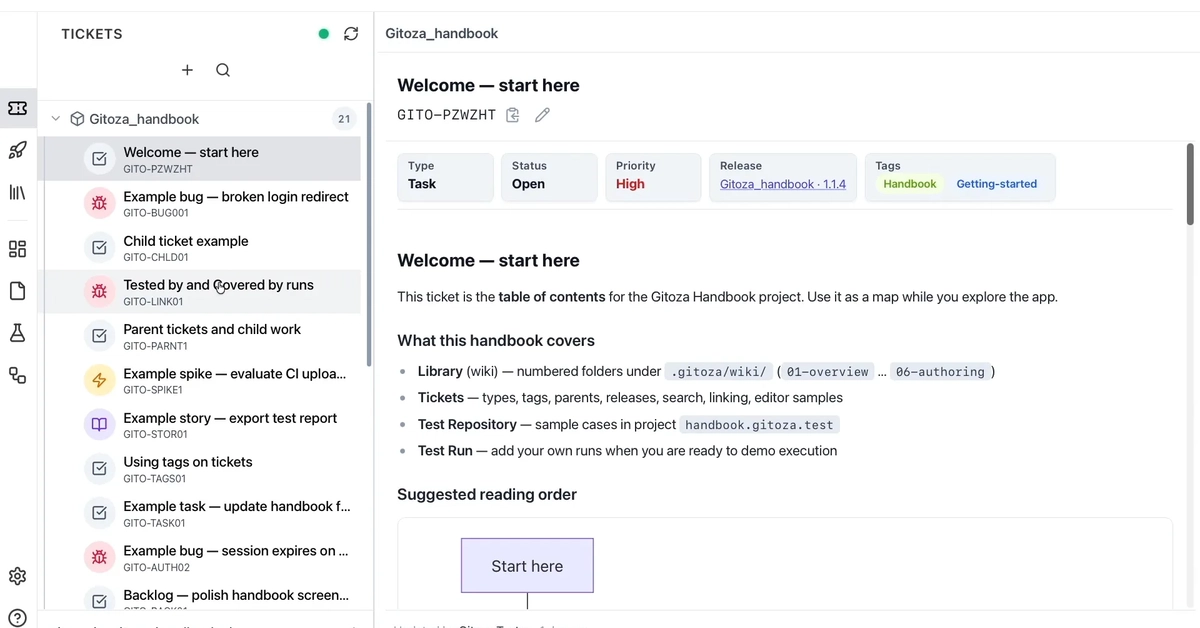
The proposed solution is deceptively simple: store the entire graph of development artifacts—tickets, wiki pages, test cases, and test runs—as files within a single Git repository. Instead of relying on external URLs that point to data residing in separate, managed systems, this approach treats all artifacts as plain text files, specifically YAML, managed by Git. Following a link becomes as simple as opening another file on disk. This eliminates the need for multiple APIs, logins, and the inherent latency and potential for drift between systems.
The core idea is to represent each artifact as a structured data file. A ticket, for instance, would be a YAML file containing its title, description, status, assignee, and any relevant metadata. A wiki page would similarly be a YAML file with its content, structure, and links to other pages or tickets. Test cases and their associated runs would also reside as YAML files, detailing preconditions, steps, expected results, and actual outcomes.
The Four File Types
This model organizes these artifacts into a clear directory structure within the Git repository. The proposed structure includes:
- Tickets/Tasks: Stored under a path like
.gitoza/tasks/tickets/{project}/{ticket-id}.yaml. Each file would contain the details of a specific task or issue. - Wiki Pages: Located at
.gitoza/wiki/{folders}/W-xxxxxx.yaml. This allows for hierarchical organization of documentation. - Test Cases: Found in
.gitoza/test/cases/{project}/.../{case-id}.yaml, enabling granular management of test scenarios. - Test Runs: Recorded under
.gitoza/test/runs/R-XXX, providing a history of test executions.
This structure creates a single, version-controlled source of truth for all critical project documentation and execution artifacts. Every change, every update, every historical record is captured by Git, providing an immutable audit trail and the ability to revert to any previous state.
Benefits of a Unified Git Repository
Adopting this file-based approach offers several compelling advantages. Firstly, it dramatically simplifies tooling. Developers interact with a single interface: Git. There's no need to learn or manage multiple complex SaaS products for task tracking, documentation, and test management. Version control becomes the central mechanism for managing all project knowledge.
Secondly, it enhances discoverability and context. When a developer needs to understand a feature, they can navigate directly to the relevant ticket and its associated documentation or test cases by simply opening files. There are no broken links, no API timeouts, and no permission errors preventing access to essential information. All related artifacts are co-located and versioned together, ensuring consistency.
Thirdly, it provides a robust audit trail. Git's inherent versioning capabilities mean that every change to a ticket, wiki page, or test case is logged. This makes it easy to track who made what changes, when, and why. It also facilitates rollbacks and helps in understanding the evolution of project requirements and testing strategies. This is particularly valuable for compliance and regulatory requirements where a clear history of changes is paramount.
Addressing Counterarguments and Potential Challenges
The most immediate counterargument is the potential for increased complexity in managing these files. Users accustomed to the rich UIs of dedicated tools might find editing YAML files less intuitive. However, this friction is often outweighed by the benefits of a unified system. Furthermore, tooling can be developed to abstract away some of the YAML editing complexity, perhaps through custom Git clients or IDE plugins that provide a more user-friendly interface for creating and editing these artifact files.
Another challenge lies in the initial migration. Moving from established systems like Jira, Confluence, or TestRail to a file-based Git structure requires a significant effort. This would involve scripting the export of existing data and transforming it into the defined YAML format. The success of such a migration hinges on the clarity of the YAML schema and the robustness of the export/import tools.
The surprising detail here is not the proposed solution itself—treating documentation as code is a well-established pattern—but its application to the entire spectrum of development artifacts, including traditionally complex systems like test case management and issue tracking. It suggests a radical simplification of the development toolchain, moving away from a constellation of specialized, often expensive, SaaS products towards a single, powerful, and universally understood version control system.
What nobody has addressed yet is how this model scales for very large teams and extremely complex projects. While the concept is elegant for smaller teams or specific projects, managing thousands of YAML files for hundreds of developers across dozens of interconnected features presents a new set of organizational and tooling challenges. How does one maintain a high-level overview of project status or sprint progress when all the data is distributed across countless files?
The Future of Development Workflow
This approach fundamentally reframes the development workflow. It shifts the focus from managing tool integrations to managing project knowledge as code. For teams that have grown weary of the constant overhead associated with disparate tools, this offers a compelling alternative. It promises a more streamlined, consistent, and resilient development process where all critical information is versioned, auditable, and easily accessible within the familiar confines of Git. The adoption of this pattern could signal a broader trend towards consolidating development workflows into version control systems, treating everything from code to documentation and issue tracking as first-class citizens within Git.