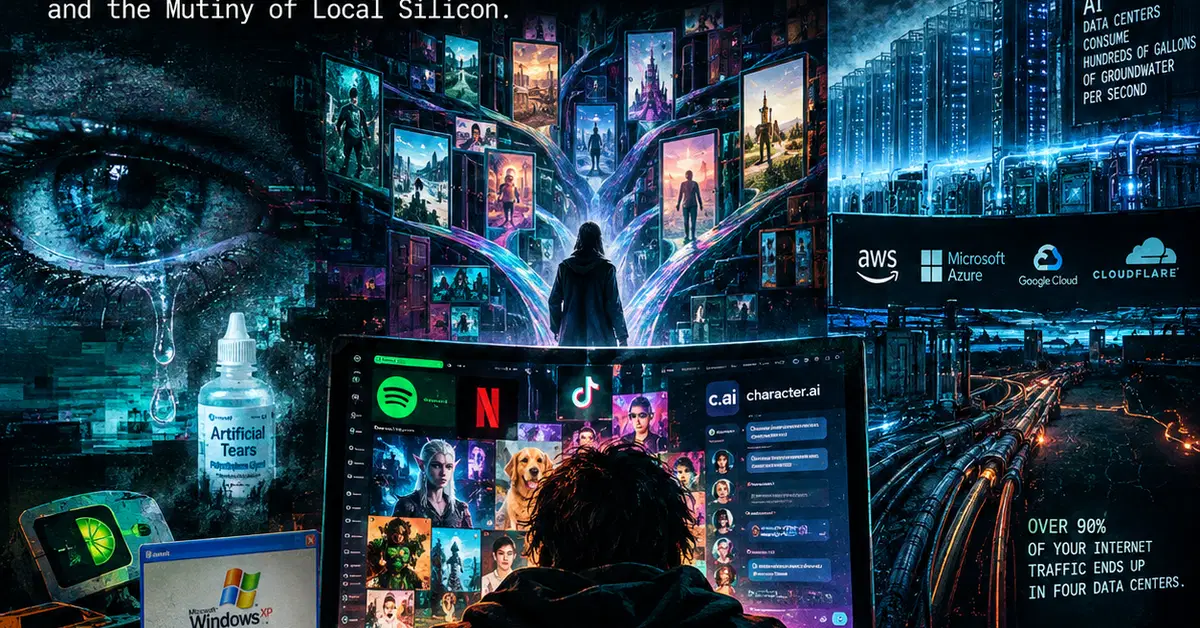
LimeWire, a name synonymous with peer-to-peer file sharing and its attendant legal controversies, has resurfaced not as a nostalgic relic, but as a surprisingly sharp critic of modern technology infrastructure. Its editorial column, C:\LimeWire\Shared, has moved beyond its initial viral dispatch on Microsoft/OpenAI leaks to publish a second, more deeply philosophical and technically grounded piece: Issue 02: Stainless Steel Rats in the Garden of Forking Paths: The Anatomy of Escapism, Fourth-Order Simulacra, and the Mutiny of Local Silicon. This manifesto is a potent blend of literary critique and practical systems architecture, delivering a scathing indictment of cloud centralization while advocating for a future powered by WebGPU and local artificial intelligence.
The Anatomy of Cloud Nihilism
The core of LimeWire's argument centers on what it terms "cloud nihilism." This isn't just a catchy phrase; it represents a deep-seated dissatisfaction with the current trajectory of cloud computing, which the authors view as leading to a state of technological dependency and creative stagnation. They posit that the overwhelming centralization of data, processing power, and AI models within a few monolithic cloud providers creates a fragile ecosystem susceptible to control, censorship, and a homogenization of digital experiences. This concentration of power, they argue, stifles innovation and leads to a "fourth-order simulacra" – a reality where digital constructs are increasingly detached from genuine utility or user agency.
The authors draw parallels to literary and philosophical concepts, invoking Chuck Palahniuk's somatic obsessions and Hunter S. Thompson's gonzo rage, juxtaposed with Jean Baudrillard's theories on simulation. This literary framing, while striking, serves a purpose: to highlight the existential and cultural implications of technological centralization. It’s less about the specific technical failings of cloud services and more about the broader societal impact of relying on opaque, corporate-controlled digital landscapes. The piece suggests that this reliance breeds a form of escapism, where users retreat into curated digital environments rather than engaging with the underlying infrastructure and its limitations.

The Mutiny of Local Silicon: WebGPU and On-Device AI
Against this backdrop of cloud critique, LimeWire champions a vision for the future rooted in decentralized technologies and the power of local hardware. The manifesto highlights two key pillars: WebGPU and on-device AI. WebGPU, a modern graphics and compute API for the web, is presented as a crucial enabler for complex computational tasks to be performed directly within the browser, bypassing the need for heavy server-side processing. This allows for richer, more interactive, and computationally intensive applications to run locally on a user's machine, leveraging their own hardware resources.
The implications for AI are particularly profound. Instead of relying on massive, cloud-hosted AI models that require constant connectivity and significant data transfer, LimeWire advocates for the rise of local AI. This means running AI models directly on user devices – whether that's a laptop, a smartphone, or even specialized local silicon. This approach offers significant advantages: enhanced privacy, reduced latency, lower operational costs, and greater user control over data and processing. The manifesto paints a picture of "stainless steel rats" – agile, independent agents operating within a decentralized digital garden – empowered by their own silicon rather than beholden to external cloud infrastructure.
The technical argument for local AI is bolstered by the increasing power and efficiency of modern hardware. The authors implicitly suggest that the performance gains offered by WebGPU, combined with advancements in AI model quantization and optimization, make on-device AI not just a theoretical possibility but a practical and superior alternative for many use cases. This shift could fundamentally alter the economics and accessibility of AI, democratizing its use beyond large enterprises and specialized labs.
Escapism and the Path Forward
The manifesto's title, Stainless Steel Rats in the Garden of Forking Paths, is a deliberate nod to Harry Harrison's science fiction and the concept of navigating complex, branching futures. LimeWire positions itself not just as a commentator but as a participant in this navigation, suggesting that the current path of cloud centralization is a dead end, a "garden of forking paths" where users are led down predetermined, controlled routes. The "mutiny of local silicon" represents a rebellion against this control, an embrace of the myriad of possibilities that arise when computation and intelligence are distributed.
What is genuinely surprising here is not that a company with roots in P2P technology would advocate for decentralization, but the sophisticated and articulate manner in which they frame this argument. They are not merely rehashing old arguments about open source or peer-to-peer networks; they are weaving together cutting-edge web technologies like WebGPU with the burgeoning field of local AI, all under a compelling philosophical critique of the dominant cloud paradigm. It’s a bold statement that challenges the prevailing narrative of cloud supremacy and offers a concrete, albeit ambitious, alternative.
The piece serves as a call to action for developers and creators. It suggests that building for a decentralized future means prioritizing technologies that empower end-users, enhance privacy, and reduce reliance on centralized intermediaries. This involves exploring the capabilities of WebGPU for client-side computation, investigating efficient on-device AI models, and designing applications that can function robustly in a distributed environment. The current cloud-centric model, they argue, fosters a passive form of digital engagement. The alternative is an active, empowered user, wielding the power of their own hardware and localized intelligence.
Ultimately, LimeWire's manifesto is more than just a blog post; it's a philosophical statement and a technical roadmap. It challenges the industry to reconsider its over-reliance on the cloud and to embrace the potential of localized computation and intelligence. The "garden of forking paths" is indeed vast, and LimeWire is urging us to choose the less traveled, more empowering routes, powered by the very silicon that sits on our desks and in our pockets.