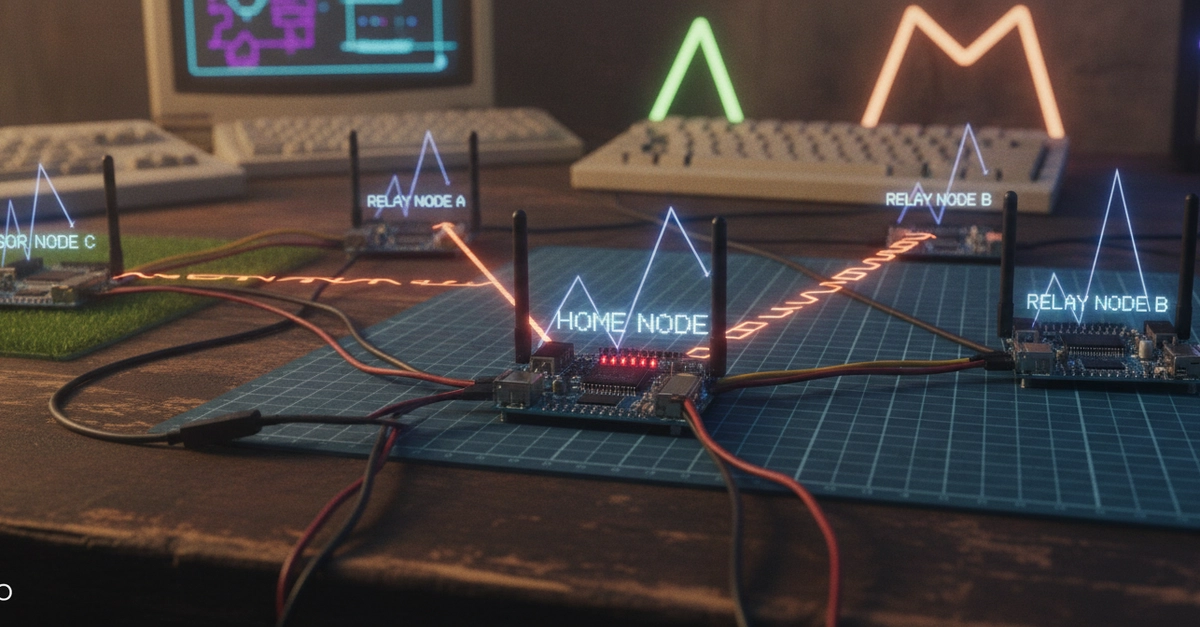
What is LighthouseReckoning?
LighthouseReckoning emerges as a novel, lightweight LoRa mesh networking library designed to bring robust, long-range communication capabilities to Arduino-compatible microcontrollers. Currently validated on the ESP32 and RP2040 platforms, and specifically targeting SX126x LoRa radios, this library aims to simplify the creation of decentralized sensor networks. The core principle is straightforward: enable a network where sensors can relay data through intermediate nodes to reach a central 'Home' node, creating a resilient communication path even when direct links are unavailable. This architecture mimics the idea of a lighthouse, guiding data back to a central point.
The network topology is intentionally kept simple from each node's perspective. Unlike traditional mesh networks that require each node to maintain a comprehensive map of the entire network, LighthouseReckoning nodes only need to know their relative distance to the designated Home node. When a node needs to send data, it doesn't need to know the full path; it simply selects a neighboring node that is closer to the Home node as its next hop. This distributed decision-making process significantly reduces the complexity and overhead on individual devices, making it ideal for resource-constrained microcontrollers.
Consider a typical scenario: a sensor deep within a remote area needs to report its readings. Instead of relying on a single, potentially weak direct connection to a base station, it can transmit its data to a nearby relay node. This relay node, in turn, forwards the data to another relay node that is even closer to the Home node. This hop-by-hop communication continues until the data successfully reaches its destination. The beauty of this system lies in its adaptability; if one relay node fails, the network can dynamically reroute traffic through alternative paths, ensuring data continuity.
Key Design Principles and Architecture
LighthouseReckoning's design prioritizes simplicity and efficiency. Each node in the network periodically broadcasts its estimated distance to the Home node. Neighboring nodes listen for these broadcasts and use the information to build a rudimentary understanding of their local network segment. When a node has data to send, it consults its list of known neighbors and their reported distances to Home. It then selects the neighbor with the smallest distance to Home as the next hop for the packet. This greedy approach ensures that data packets are always moving in the general direction of the Home node.
The 'Home' node is a special designation within the network. It's the ultimate destination for all sensor data. All other nodes strive to establish a path towards this central point. This centralized destination simplifies routing logic significantly. A node doesn't need to worry about reaching arbitrary destinations; its sole objective is to get data closer to Home. This focus allows for a more streamlined protocol and reduced processing requirements on each device.
The library handles the complexities of LoRa radio communication, including packet formatting, addressing, and error checking, abstracting these details away from the user. Developers can focus on their sensor logic and data payloads, relying on LighthouseReckoning to manage the underlying mesh networking. The lightweight nature of the library means it can be integrated into projects with limited memory and processing power, such as those based on the Arduino Uno, although current testing focuses on more powerful platforms like ESP32 and RP2040.
Technical Implementation and Compatibility
The library is built with extensibility in mind. While current implementations leverage the SX126x series of LoRa transceivers, the modular design suggests potential future compatibility with other LoRa chipsets. The choice of ESP32 and RP2040 as primary development targets reflects their popularity in the maker and IoT communities, offering a good balance of performance, connectivity, and cost. These platforms provide ample resources to handle the communication protocol and sensor data processing.
The communication protocol is designed to be efficient in terms of bandwidth and power consumption, crucial for battery-powered sensor nodes. Nodes send relatively small control packets containing their distance to Home, and larger data packets when actual sensor readings are being transmitted. The inter-packet timing and retransmission strategies can be configured by the user to balance network responsiveness with power efficiency, allowing developers to tune the network for specific application requirements, such as real-time monitoring versus infrequent data logging.
What remains to be seen is how LighthouseReckoning scales with a very large number of nodes. While the decentralized routing logic is inherently robust, the broadcast nature of LoRa and the increasing probability of packet collisions in dense networks could present challenges. Further testing and optimization will be necessary to determine the practical limits of network size and data throughput under various environmental conditions. The current focus on SX126x radios also means that users with older or different LoRa modules will need to wait for potential future porting efforts.
Potential Applications and Use Cases
The potential applications for LighthouseReckoning are vast, particularly in scenarios where traditional network infrastructure is absent or unreliable. Think of agricultural monitoring, where sensors deployed across large fields need to report soil moisture, temperature, or nutrient levels back to a central hub. In environmental monitoring, networks of sensors could track air quality, water levels, or wildlife movements in remote natural reserves. Industrial IoT applications could benefit from reliable data collection from machinery in sprawling factory floors or remote oil and gas facilities.
For disaster response and remote sensing, LighthouseReckoning could enable the rapid deployment of sensor networks to assess damage, monitor environmental hazards, or coordinate relief efforts in areas where communication lines are down. Its lightweight nature and reliance on LoRa's long-range capabilities make it suitable for deployment on drones or mobile platforms that can act as dynamic relays, extending network coverage.
The library's compatibility with popular development boards like Arduino, ESP32, and RP2040 makes it accessible to a wide range of developers, from hobbyists to professional engineers. This accessibility lowers the barrier to entry for creating sophisticated, resilient mesh networks for a variety of IoT projects. The ability to build these networks without relying on cloud services or complex network infrastructure offers a compelling alternative for applications requiring local control and data sovereignty.