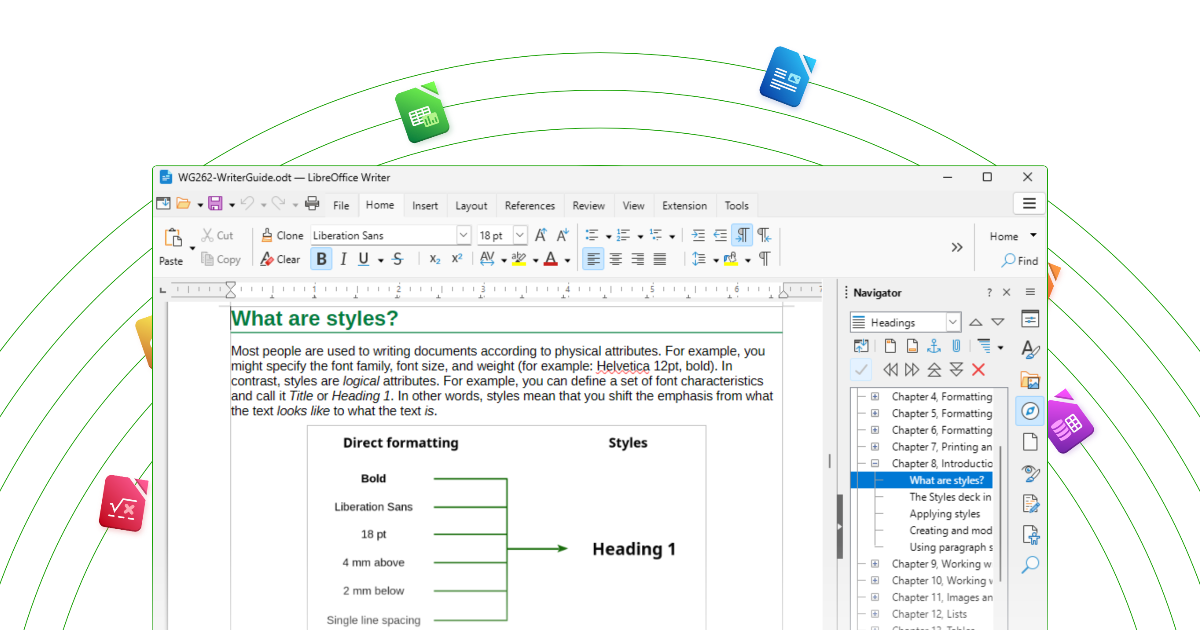
Record Downloads Amidst AI Skepticism
LibreOffice, the free and open-source office productivity suite, has reported a significant surge in downloads, reaching levels not seen in years. This spike occurred shortly after the Document Foundation, the non-profit organization behind LibreOffice, explicitly stated that the software has no artificial intelligence features. The move appears to resonate with a segment of the user base that is either wary of AI integration or values the straightforward functionality of traditional software.
While much of the tech world is captivated by the promise of AI-powered tools, LibreOffice's success suggests a growing counter-narrative. Users are not universally embracing every new AI trend. For many, particularly those who rely on office software for core productivity tasks like document creation, spreadsheet management, and presentations, stability, privacy, and predictable performance remain paramount. The explicit declaration from The Document Foundation seems to have tapped into this sentiment, positioning LibreOffice as a reliable alternative in an increasingly complex and, for some, uncertain AI-driven landscape.
What LibreOffice Offers (Without AI)
LibreOffice provides a comprehensive suite of applications that cover the essential needs of most users. Its core components include:
- Writer: A word processor for creating and editing documents, comparable to Microsoft Word. It supports a wide range of formatting options, mail merge, and extensive template capabilities.
- Calc: A powerful spreadsheet program for data analysis, calculation, and charting, similar to Microsoft Excel. It handles complex formulas, pivot tables, and data visualization.
- Impress: A presentation program designed for creating slideshows, offering various templates, animations, and transitions, akin to Microsoft PowerPoint.
- Draw: A vector graphics editor and diagramming tool. It can be used for flowcharts, organizational charts, and creative drawing tasks.
- Base: A database management program that allows users to create and manage databases, with interfaces for forms and reports. It can connect to various database backends.
- Math: A formula editor for creating and displaying mathematical, scientific, and symbolic equations.
These tools are built on a mature codebase, prioritizing functionality, compatibility with open document formats (ODF), and broad platform support, including Windows, macOS, and Linux. The absence of AI features means users do not have to contend with potential data privacy concerns associated with AI models, nor do they face the computational overhead or unexpected behavior that AI integrations can sometimes introduce.
The AI Hype Cycle and User Fatigue
The tech industry is currently experiencing an intense AI hype cycle. Generative AI, in particular, has captured the public imagination, with companies integrating AI into everything from search engines and creative tools to operating systems and productivity suites. While these advancements offer exciting possibilities, they also bring challenges. Users may feel overwhelmed by the rapid pace of change, concerned about the ethical implications of AI, or apprehensive about the reliability and security of AI-powered features. There is also a segment of users who simply do not need or want AI in their daily workflows, preferring tools that perform their core functions efficiently and predictably.
LibreOffice's stance, articulated by Thorsten Behrens, Chairperson of the Board of Directors of The Document Foundation, highlighted this divergence. Behrens stated, ". . . we want to be clear: LibreOffice does not have AI features, and we are not planning to add them." This directness cuts through the noise. It offers a clear value proposition for users seeking a robust, privacy-conscious, and uncomplicated office suite. The download surge suggests that this clarity is precisely what many users are looking for. It's akin to choosing a reliable, well-maintained classic car over a cutting-edge vehicle that requires constant software updates and may have unpredictable driving characteristics. For many, the classic car gets them where they need to go, safely and reliably, without the fuss.
Referenced Sources
- verified