
Lenovo's Strategic Bet on US AI Server Manufacturing
Lenovo is significantly expanding its AI server manufacturing capabilities in North Carolina, a move that underscores the company's commitment to meeting the explosive demand for AI-powered computing. This expansion isn't just about increasing output; it's a strategic pivot to bolster US-native production, aiming to capture a larger share of the domestic market for AI infrastructure. The company's Whitsett, North Carolina facility, already a hub for its North American operations, is undergoing a substantial upgrade to accommodate the specialized assembly required for high-performance AI servers.
The AI boom has created an unprecedented appetite for specialized hardware. Unlike traditional servers, AI workloads, particularly those involving large language models and complex machine learning, demand processors with massive parallel processing power, high-bandwidth memory, and advanced cooling solutions. Lenovo's investment is a direct response to this need, positioning the company to deliver tailored solutions to cloud providers, enterprises, and research institutions grappling with the computational demands of generative AI and advanced analytics.
This expansion is more than just a capacity increase; it's a statement of intent. By investing in US-based manufacturing, Lenovo aims to shorten supply chains, reduce lead times, and potentially navigate geopolitical complexities that can affect global hardware distribution. For US customers, this means greater assurance of supply and a more responsive local partner capable of delivering sophisticated AI hardware designed and built within their borders.
The Technical Demands of AI Servers
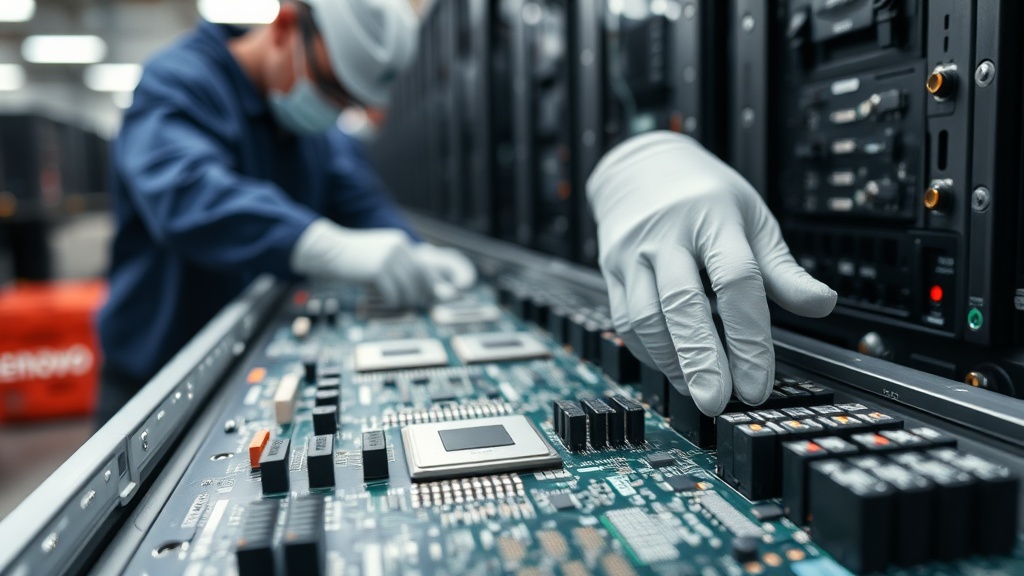
Building AI servers is a different beast than assembling standard enterprise hardware. These machines are engineered for extreme performance and require meticulous attention to detail. Lenovo's expanded line in North Carolina is equipped to handle the intricate integration of high-density GPU arrays, such as NVIDIA's H100 or AMD's Instinct accelerators, which are the workhorses of AI computation. These GPUs consume significant power and generate immense heat, necessitating robust power delivery systems and advanced thermal management solutions, including liquid cooling options.
The assembly process involves precise mounting of these power-hungry components, careful routing of high-speed interconnects like NVLink or InfiniBand, and ensuring optimal airflow. Each server is a complex system designed for maximum computational throughput, requiring specialized testing protocols to validate performance under heavy AI workloads. Lenovo's investment includes upgraded testing equipment and expanded cleanroom facilities to ensure the integrity and reliability of these high-stakes machines.
The company is also focusing on building servers with customizable configurations. This flexibility is crucial as the AI landscape evolves rapidly. Different AI models and applications have varying hardware requirements, and Lenovo's ability to offer tailored solutions, from the number of GPUs to the specific networking interfaces, provides a significant competitive advantage. This manufacturing agility allows them to adapt to the dynamic needs of their clientele, ensuring that customers receive hardware optimized for their specific AI initiatives.
Meeting Exploding Demand and Geopolitical Realities
The demand for AI-specific servers has surged exponentially. Major cloud providers and enterprises are racing to deploy massive AI infrastructure to train large models and offer AI-powered services. This has created a bottleneck in the supply chain, with lead times for high-end AI hardware stretching for months. Lenovo's expansion directly addresses this bottleneck, promising to deliver more hardware, faster, to the US market.
Beyond sheer demand, the decision to expand US-native production is also a strategic response to evolving global trade dynamics. Relying heavily on overseas manufacturing introduces risks related to tariffs, shipping disruptions, and geopolitical tensions. By increasing its US manufacturing footprint, Lenovo mitigates these risks, offering its North American customers a more stable and predictable supply chain. This move aligns with broader trends of reshoring and nearshoring critical technology manufacturing.
What remains to be seen is how quickly other major hardware manufacturers will follow suit with similar expansions of US-based AI server production. The capital investment required is substantial, but the market signals are clear: domestic production capabilities for AI hardware are becoming a critical differentiator and a strategic imperative for securing market share in the burgeoning AI economy.
The Road Ahead for Lenovo's AI Hardware
Lenovo's North Carolina expansion is a clear signal of its ambition in the AI hardware market. The company is not just assembling servers; it is building a localized ecosystem designed to support the rapid growth of AI adoption in the United States. This includes not only manufacturing but also providing robust support, maintenance, and potential customization services tailored to the US market.
The success of this expansion will depend on several factors: the company's ability to scale production efficiently, maintain stringent quality control for these complex machines, and adapt to the ever-changing demands of the AI industry. However, by investing in US-based manufacturing, Lenovo has laid a strong foundation to capitalize on the ongoing AI revolution, offering a compelling value proposition to customers prioritizing speed, reliability, and domestic sourcing for their critical AI infrastructure.