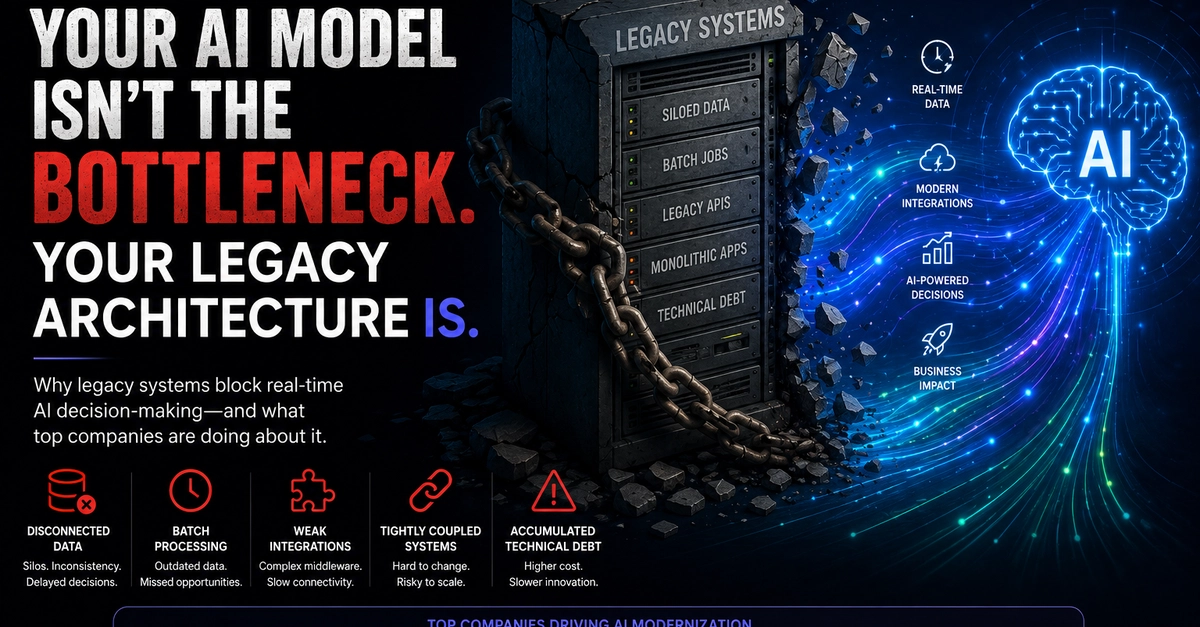
The Model Obsession
Enterprises are locked in a perennial quest for the next big AI model. The discourse often centers on choosing between proprietary giants like GPT and Claude, or exploring open-source alternatives, Retrieval-Augmented Generation (RAG), or agentic frameworks. While model selection is a relevant concern, it’s frequently addressed far too early in the adoption cycle. The real impediment to unlocking an AI's potential isn't its inherent intelligence, but its access to the data it needs to operate.
If an AI system cannot access current customer data, real-time transaction logs, up-to-the-minute inventory levels, or dynamic operational events when required, its capacity to demonstrate meaningful intelligence is severely curtailed. The model operates in a vacuum, unable to leverage the very information that would make its insights actionable and its predictions relevant.
The Hidden Constraint: Legacy Architecture
This lack of data access points directly to a pervasive, often underestimated, challenge: legacy architecture. These entrenched systems, built for a different era of computing, frequently lack the agility, connectivity, and real-time data streams necessary to support modern AI applications. They are not designed for the continuous, high-velocity data flow that AI models demand.
The temptation is to view this as an opportunity for a complete technological overhaul. However, replacing an entire legacy platform is an extraordinarily expensive and time-consuming endeavor. More importantly, it often serves as an elaborate sidestep around the core architectural problems. A new platform, if not designed with AI integration in mind, can simply become a new form of legacy infrastructure.
The problem isn't the AI model itself, but the environment in which it must operate. Think of it like trying to race a Formula 1 car on a dirt track. The car's potential is immense, but the surface prevents it from reaching anywhere near its capabilities. Similarly, a state-of-the-art AI model, when fed stale data or denied access to critical operational streams, performs poorly, not because of its own limitations, but because its environment is fundamentally unsuited to its needs.

Bridging the Gap: Integration Over Replacement
The more pragmatic and effective approach involves integrating AI capabilities into existing architectures rather than attempting a wholesale replacement. This means focusing on building the necessary infrastructure *around* the AI models already in place or being considered. This infrastructure needs to facilitate seamless, real-time data access and bidirectional communication between the AI and the enterprise's operational systems.
Key areas of focus for this integration include:
- Data Pipelines: Re-architecting or augmenting existing data pipelines to ensure AI models receive fresh, relevant data without significant latency. This might involve event-driven architectures, streaming data platforms, or optimized ETL processes.
- API Modernization: Exposing critical business data and functions through modern, well-documented APIs that AI systems can easily consume. This could involve creating new APIs or wrapping legacy systems with an API layer.
- Microservices and Orchestration: Breaking down monolithic legacy systems into smaller, more manageable services that can be independently updated and scaled. Tools like Docker Compose, while not a silver bullet for AI integration, are crucial for managing the complexity of multi-container applications, which often form the backbone of modern, distributed AI systems. They allow developers to define and run complex application stacks with a single command, abstracting away the intricacies of individual container networking, volumes, and environment variables. This simplifies the deployment and management of the distributed components that often surround an AI core.
- Security and Governance: Ensuring that data access for AI is secure, compliant, and auditable. This involves robust authentication, authorization, and data masking techniques.
The goal is not to eliminate legacy systems overnight, but to build intelligent bridges that allow AI to interact with them effectively. This approach is significantly less disruptive and more cost-effective than a full-scale rip-and-replace strategy.
The Real Challenge: Data Accessibility
The widespread adoption of AI in enterprises is hampered less by the sophistication of available models and more by the anemic state of their data infrastructure. Companies that are struggling to see tangible ROI from their AI initiatives are often those where the AI is starved of the real-time, comprehensive data it needs to function optimally. The focus needs to shift from finding a better model to enabling the models we have (or will have) with the data they require. This requires a strategic investment in modernizing data access and integration layers, rather than chasing ever-more complex AI algorithms.