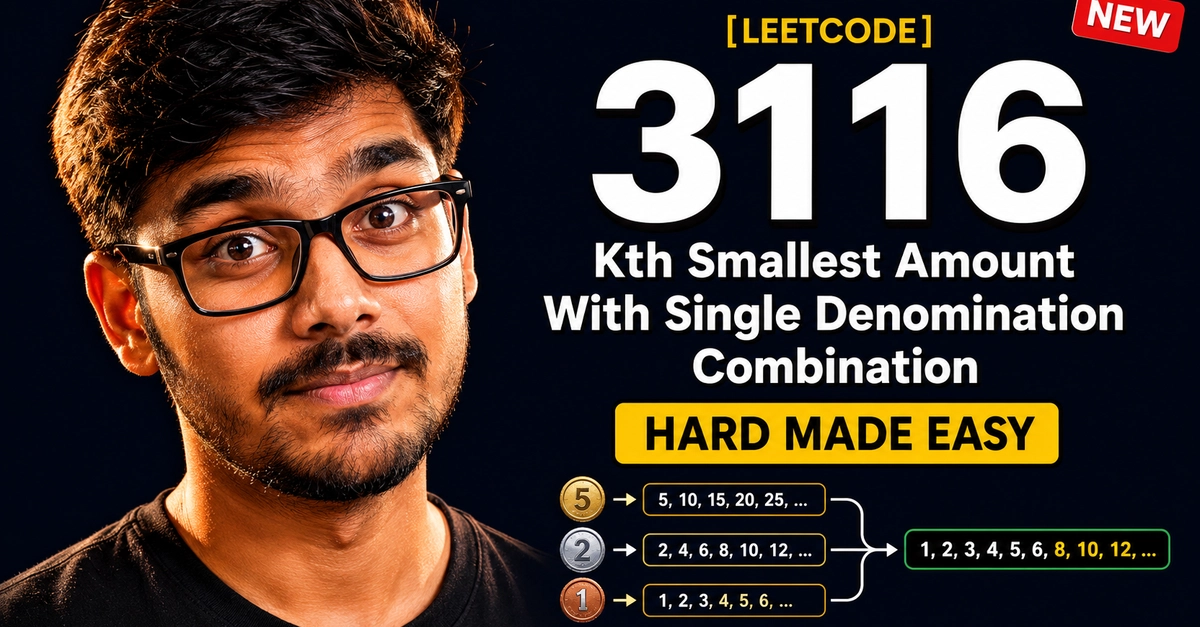
The Challenge: Kth Smallest Amount with Single Denomination Combinations
LeetCode 3116, titled "Kth Smallest Amount With Single Denomination Combination," presents a problem that appears deceptively simple but quickly escalates in complexity. The goal is to find the k-th smallest positive integer that can be expressed as a multiple of at least one number from a given set of denominations. These denominations are provided as an array of integers. The catch is that k can be as large as 2 \u00d7 109, rendering a brute-force approach—generating all multiples and sorting—entirely infeasible due to time and memory constraints.
The problem statement hints at combinations, but the constraint on k is the immediate red flag. A direct simulation of generating multiples would require iterating potentially trillions of numbers, which is impossible. This signals that a more mathematical or algorithmic approach is necessary. The low acceptance rate (around 26%) suggests that the standard solution involves a pattern that isn't immediately obvious to everyone, often requiring a combination of techniques.
The Core Insight: Binary Search on the Answer
The key to solving problems where you need to find the k-th smallest element, especially when the search space is vast and a direct enumeration is impossible, is often binary search on the answer. We hypothesize that if we can efficiently determine, for any given number X, how many valid amounts are less than or equal to X, we can use binary search to find the smallest X for which this count is at least k.
Let's define a function, count(X), which returns the number of positive integers less than or equal to X that are multiples of at least one denomination in the given set coins. If we can implement count(X) efficiently, we can binary search for the smallest X such that count(X) >= k. The search space for X would typically range from 1 up to a sufficiently large upper bound, possibly related to the maximum possible value of k and the denominations.
The binary search would work as follows:
- Initialize
low = 1andhigh = large_enough_upper_bound. - While
low <= high: - Calculate
mid = low + (high - low) // 2. - If
count(mid) >= k, it meansmidmight be our answer, or the answer is smaller. So, we recordmidas a potential answer and try smaller values by settinghigh = mid - 1. - If
count(mid) < k, it meansmidis too small, and we need to search in the larger half. Setlow = mid + 1.
The final recorded potential answer will be the k-th smallest amount.
Implementing count(X): The Inclusion-Exclusion Principle
The critical part is efficiently computing count(X). A naive approach would be to iterate through all numbers from 1 to X and check if each is divisible by any denomination. This is still too slow if X is large.
The problem asks for the count of numbers divisible by *at least one* denomination. This is a classic scenario for the Principle of Inclusion-Exclusion (PIE). If we have denominations d1, d2, d3, ..., the count is:
count(X) = (sum of multiples of d_i <= X) - (sum of multiples of lcm(d_i, d_j) <= X) + (sum of multiples of lcm(d_i, d_j, d_k) <= X) - ...
The number of multiples of any number m that are less than or equal to X is simply X // m (integer division). So, the formula becomes:
count(X) = sum(X // d_i) - sum(X // lcm(d_i, d_j)) + sum(X // lcm(d_i, d_j, d_k)) - ...
To implement this, we need to consider all subsets of the given denominations. For each subset:
- Calculate the Least Common Multiple (LCM) of the denominations in the subset.
- If the LCM is greater than
X, we can stop considering this subset and any supersets of it, as their LCMs will also be greater thanX. - If the subset has an odd number of elements, we add
X // LCMto our total count. - If the subset has an even number of elements, we subtract
X // LCMfrom our total count.
The LCM of a set of numbers can be computed iteratively using the relationship lcm(a, b) = (a * b) // gcd(a, b). For multiple numbers, lcm(a, b, c) = lcm(lcm(a, b), c).
This involves iterating through all 2n subsets of the n denominations. For each subset, we compute the LCM. The GCD function is efficient (logarithmic time). The LCM calculation needs to be careful about potential overflow if intermediate products become too large, though since we stop if LCM > X, this is manageable.
The overall time complexity for count(X) is roughly O(n * 2^n) because for each of the 2n subsets, we perform GCD/LCM operations that take logarithmic time with respect to the numbers involved, and we have n numbers to potentially combine. The constraint n <= 18 makes 2n feasible (218 is about 262,144).
Optimization and Constraints
The inclusion-exclusion part can be optimized. Instead of generating all subsets explicitly, one can use bitmasks. A bitmask from 1 to 2n - 1 can represent each non-empty subset. If the i-th bit is set, the i-th denomination is included in the subset.
The LCM calculation must handle potential overflow. If at any point during the LCM calculation for a subset, the intermediate LCM value exceeds X, we can immediately discard that subset and any larger subsets derived from it. This is because the LCM can only increase or stay the same as more numbers are included.
The maximum value for X in the binary search could be estimated. A loose upper bound could be k * max(coins), but a tighter bound might be needed. Given k up to 2 \u00d7 109 and denominations up to 1000, the maximum possible k-th amount could be very large. A safe upper bound for binary search might be around 1015 or higher, which fits within a 64-bit integer type (like `long long` in C++ or `long` in Java).
The overall complexity of the solution is O(n * 2^n * log(MAX_AMOUNT)), where MAX_AMOUNT is the upper bound of the binary search. Given n <= 18, 2^n is manageable. The logarithmic factor comes from the binary search. This complexity passes within typical competitive programming time limits.
The Unanswered Question: Generalization to Non-Single Denominations
While this solution elegantly solves the problem for amounts formed by multiples of *at least one* denomination, a natural extension would be to consider amounts formed by combinations of denominations themselves (e.g., sums of distinct denominations, or sums allowing repetitions). The inclusion-exclusion principle, while powerful, becomes significantly more complex when dealing with arbitrary sums or combinations rather than simple multiples. It's unclear how easily this binary search + PIE framework would adapt to finding the k-th smallest value that is a sum of c1 * d1 + c2 * d2 + ... where ci >= 0.
Final Thoughts on the Approach
The problem is a textbook example of how recognizing a pattern—binary search on the answer combined with inclusion-exclusion for counting—can transform an intractable problem into a solvable one. The 26% acceptance rate highlights that while the individual techniques are standard, their application together in this specific context is what trips up many participants. Mastering this pattern is key for tackling similar problems involving finding k-th elements in large, implicitly defined sets.