The Paradox of Fluid Simulation
Traditional fluid simulation typically relies on solving complex differential equations, most notably the Navier-Stokes equations. These equations describe the motion of viscous fluid substances. While powerful, their computational demands are immense, often requiring supercomputers and significant time to yield results. This is particularly true for phenomena like turbulence or intricate flow patterns. However, a different paradigm exists: the Lattice Boltzmann Method (LBM). LBM achieves fluid simulation not by directly solving the macroscopic fluid equations, but by simulating the behavior of fictitious fluid particles on a discrete lattice. The emergent macroscopic behavior of these particles then mimics the fluid dynamics we observe.
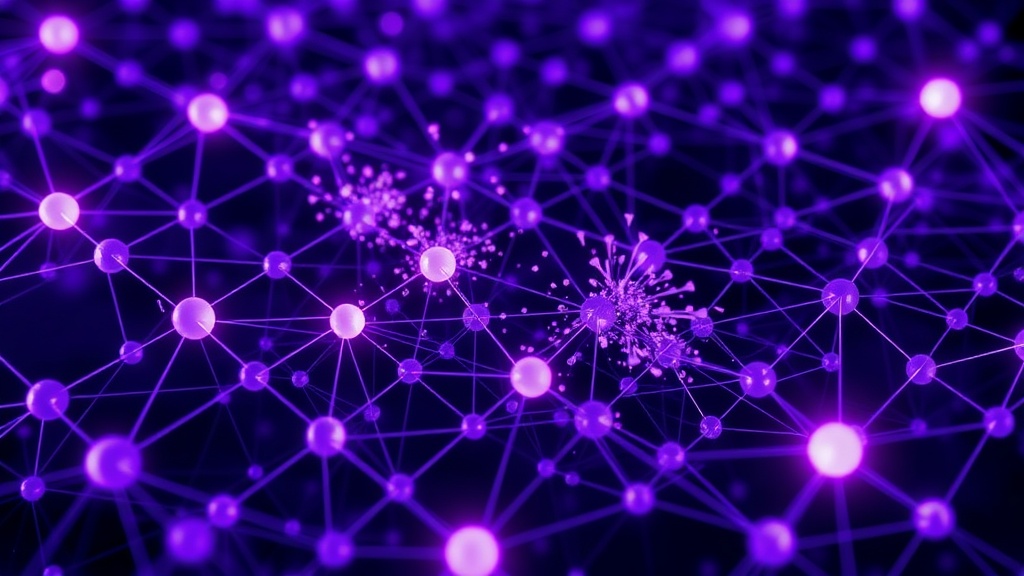
The core idea behind LBM is deceptively simple: instead of tracking the continuous flow of a fluid, it tracks the movement and collisions of discrete packets of fluid at a microscopic level. Imagine a grid, like a chessboard, where each square represents a point in space. At each intersection, there are particles moving in specific, predefined directions. When these particles move to an adjacent intersection, they collide with other particles already there. These collisions are governed by simplified rules, and it's the statistical outcome of these billions of particle interactions that gives rise to the macroscopic fluid behavior.
From Microscopic Collisions to Macroscopic Flow
The Lattice Boltzmann Method operates in two primary steps: streaming and collision. In the streaming step, particles move from their current lattice node to the next, following their direction vectors. If a particle is moving east, it moves to the eastern neighbor node in the next time step. Simultaneously, the collision step occurs at each lattice node. Here, particles that have arrived at a node interact. The simplest and most common collision model is the Bhatnagar-Gross-Krook (BGK) model. In the BGK model, particles at a node relax towards a local equilibrium distribution. This equilibrium distribution is calculated based on macroscopic fluid properties like density and velocity at that node. The rate at which particles relax is determined by a relaxation time parameter, which is directly related to the fluid's viscosity. A higher viscosity means particles relax more slowly towards equilibrium, corresponding to a more viscous fluid.
The genius of LBM lies in how these microscopic operations translate to macroscopic fluid dynamics. The macroscopic fluid density at a node is simply the sum of the populations of all particles at that node. The macroscopic fluid velocity is a weighted average of the particle velocities. By carefully choosing the lattice structure (e.g., D3Q19, D3Q27 for 3D simulations, where D denotes dimensions and Q denotes the number of discrete velocity vectors) and the collision operator, the LBM can be shown to recover the macroscopic fluid equations (like Navier-Stokes) in the limit of small lattice spacing and time steps. This means that even though we are not directly solving the equations, the underlying physics they describe emerge from the particle dynamics.
Kármán Vortex Street: A Classic Test Case
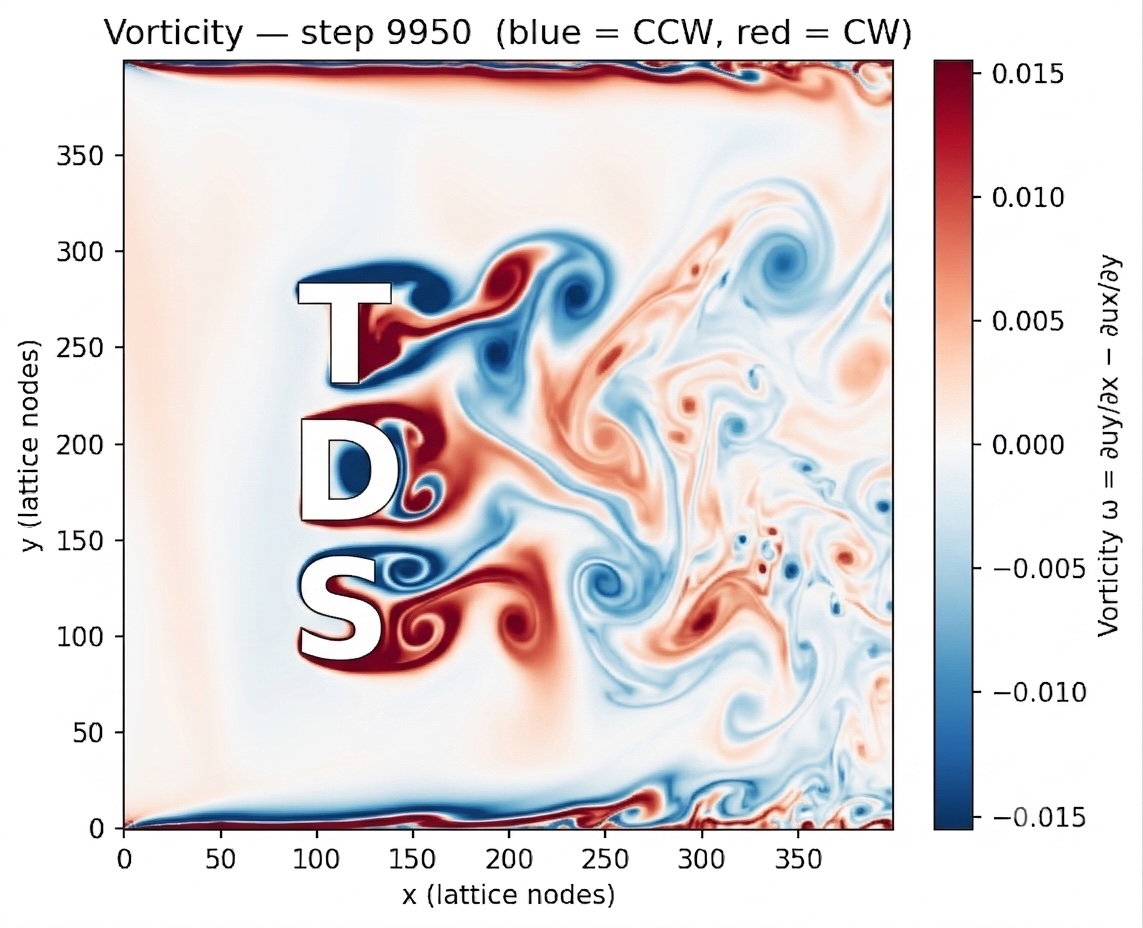
A prime example of LBM's capability is the simulation of a Kármán vortex street. This phenomenon occurs when a fluid flows past a bluff body, such as a cylinder. As the fluid detaches from the body, it forms alternating vortices that trail downstream in a staggered pattern. Visually, it looks like a street of swirling vortices. Capturing this requires accurate modeling of fluid separation and vortex formation, which are notoriously difficult for traditional solvers due to the inherently unsteady and turbulent nature of the flow.
To simulate this with LBM, one would set up a computational domain representing the fluid flow around a cylinder. The lattice would be populated with particles, and boundary conditions would be applied. For the cylinder, no-slip boundary conditions are typically used, meaning fluid particles cannot penetrate the solid boundary and their velocity at the boundary is zero. At the inlet, a uniform velocity profile might be specified, and at the outlet, outflow conditions would be applied. As the simulation progresses, particles stream and collide. The emergent velocity field would show the characteristic shedding of vortices from the cylinder, forming the distinct Kármán vortex street pattern. The simulation doesn't need to know the Navier-Stokes equations; it just needs to correctly model particle interactions on the lattice, and the vortex street appears as a natural consequence.
Implementation and Performance
Implementing LBM requires careful coding, often in lower-level languages like C++ for performance-critical simulations. The discrete nature of the lattice and the fixed set of particle velocities lend themselves well to parallelization, making LBM highly suitable for execution on Graphics Processing Units (GPUs) or distributed supercomputing clusters. The streaming and collision steps can be performed independently for many lattice nodes, allowing for massive parallel execution. This is precisely how one can generate complex phenomena like the Kármán vortex street without solving explicit differential equations, by leveraging the computational power of modern hardware.
The advantage of LBM becomes particularly apparent when dealing with complex geometries or multiphase flows, where setting up boundary conditions for traditional solvers can be a significant hurdle. LBM's particle-based nature and discrete lattice can more readily accommodate intricate shapes and interfaces. While LBM may not be a direct replacement for all Navier-Stokes solvers, especially for certain types of high-Reynolds-number turbulence, its unique approach offers a powerful and computationally efficient alternative for a wide range of fluid dynamics problems.
The Unanswered Question: Scalability Beyond the Lattice
What remains an open question is the ultimate scalability of LBM for extremely large-scale, highly turbulent flows. While parallelization on supercomputers is effective, the fundamental computational cost scales with the number of lattice nodes and the number of particles tracked. As simulations push towards higher Reynolds numbers and finer resolutions, the memory and processing requirements can still become prohibitive. Understanding the precise limits and developing optimized algorithms for these extreme regimes will be crucial for LBM to fully displace or complement traditional methods in cutting-edge research and industrial applications.