
Indefinite Airtime: The Promise of Laser-Powered Drones
The dream of drones that can operate indefinitely, unburdened by battery life, is inching closer to reality thanks to advancements in wireless power transfer. Researchers have developed a novel laser-based charging system that significantly improves energy conversion efficiency, a critical hurdle for practical implementation. This technology could transform industries reliant on aerial surveillance, delivery, and inspection, eliminating the downtime associated with battery swaps or ground-based recharging.
The core innovation lies in an improved receiver designed to capture energy from a ground-based laser. Unlike previous attempts, this new system boasts a conversion efficiency of 38.49%. This figure represents a substantial leap, making the concept of continuous aerial operation more feasible. Previous iterations often struggled with lower efficiencies, meaning a significant portion of the transmitted laser energy was lost as heat or simply not converted into usable power for the drone's systems.
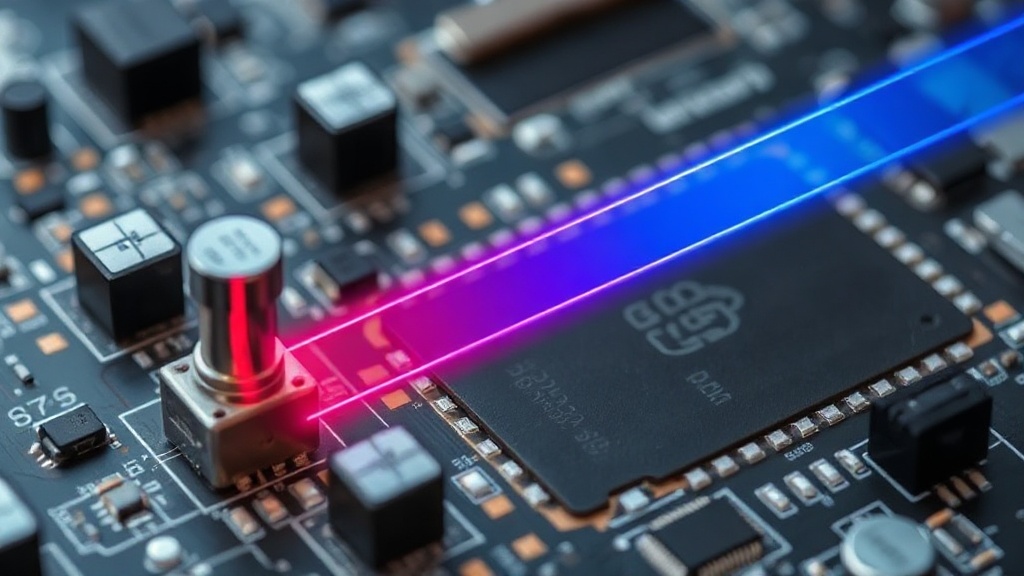
A key component enabling this efficiency gain is the incorporation of a nanocrystalline material within the receiver. This material plays a dual role: it not only aids in the efficient conversion of laser light into electrical energy but also plays a crucial part in thermal management. Overheating has been a persistent challenge in high-power laser energy transfer systems, as excessive heat can degrade components and reduce overall performance. The nanocrystalline material helps dissipate this heat more effectively, ensuring the receiver operates within optimal parameters.
The system operates by beaming a laser from a ground station towards a drone equipped with the specialized receiver. This receiver captures the laser light and converts it into electrical power, which can then be used to directly power the drone's motors and onboard electronics, or to recharge its battery. The continuous power supply means that as long as the drone remains within the laser's range, it can theoretically stay airborne indefinitely.
Addressing the Efficiency Bottleneck
For years, wireless power transfer, particularly over longer distances, has been hampered by low efficiency. Transmitting power through the air, whether via radio waves or lasers, inevitably results in energy loss. Achieving efficiencies comparable to wired charging has been the holy grail. The 38.49% conversion rate achieved by this new receiver is a significant step towards making laser wireless charging a viable alternative to traditional power sources for drones.
Consider the challenge this way: Imagine trying to fill a bucket with water using a leaky hose. The more water that leaks out before it reaches the bucket, the longer it takes to fill. Previous wireless charging systems were like hoses with many leaks. This new receiver is like a hose with far fewer leaks, meaning more of the 'water' (energy) actually makes it into the 'bucket' (drone's power system). This improved efficiency directly translates to less wasted energy, smaller and lighter receiver units, and the potential for smaller, more efficient laser transmitters.
The use of nanocrystalline materials is particularly noteworthy. These materials, with grain sizes typically between 1 and 100 nanometers, exhibit unique physical and chemical properties due to their high surface area to volume ratio. In this application, their specific crystalline structure is engineered to optimize photon absorption and electron excitation, leading to more efficient energy conversion. Furthermore, their thermal conductivity properties are leveraged to draw heat away from critical conversion components, preventing performance degradation and extending the lifespan of the receiver.
Implications for Drone Operations
The implications of this technology are far-reaching. For public safety agencies, drones equipped with this system could provide continuous aerial monitoring during search and rescue operations or disaster assessments, remaining on station for extended periods without needing to return for recharging. In agriculture, drones could perform constant crop health monitoring, identifying issues like pest infestations or nutrient deficiencies in real-time across vast farmlands.
Delivery services could see a revolution, with drones capable of making longer routes or maintaining a constant presence over a delivery zone. Infrastructure inspection, such as power lines or wind turbines, would become more efficient, as drones could patrol and inspect assets without interruption. The military applications are also significant, enabling persistent surveillance and reconnaissance missions without the logistical burden of frequent refueling or battery changes.
However, several challenges remain before widespread adoption. The safety of beaming high-power lasers into the sky needs rigorous assessment and regulation. Ensuring that the laser beam accurately tracks the drone, even in adverse weather conditions or with drone movement, requires sophisticated guidance systems. The cost and scalability of manufacturing these advanced receivers also need to be considered. Furthermore, the range and power of the ground-based laser transmitter will dictate the operational radius and endurance of the drone fleet.
The Path Forward
This research represents a critical step in overcoming the power limitations that have constrained drone capabilities. The improved efficiency and thermal management achieved by the new receiver design move the concept of indefinite aerial operation from theoretical possibility to practical engineering challenge. As research continues and these systems mature, we can expect to see a new generation of drones capable of performing tasks that were previously impossible due to battery constraints.
The specific efficiency of 38.49% is not just a number; it's a benchmark that indicates the fundamental physics and material science involved are becoming highly optimized for this energy transfer method. It suggests that further incremental improvements in receiver design, laser technology, and atmospheric transmission could push efficiencies even higher, potentially reaching levels that make wired charging entirely obsolete for many drone applications.
What remains to be seen is how quickly this technology can be scaled from laboratory prototypes to robust, commercial-grade systems. The integration of such systems into existing drone platforms and the development of regulatory frameworks will be crucial for its success. Yet, the potential for truly autonomous, continuously operating aerial platforms is a powerful motivator for continued development.