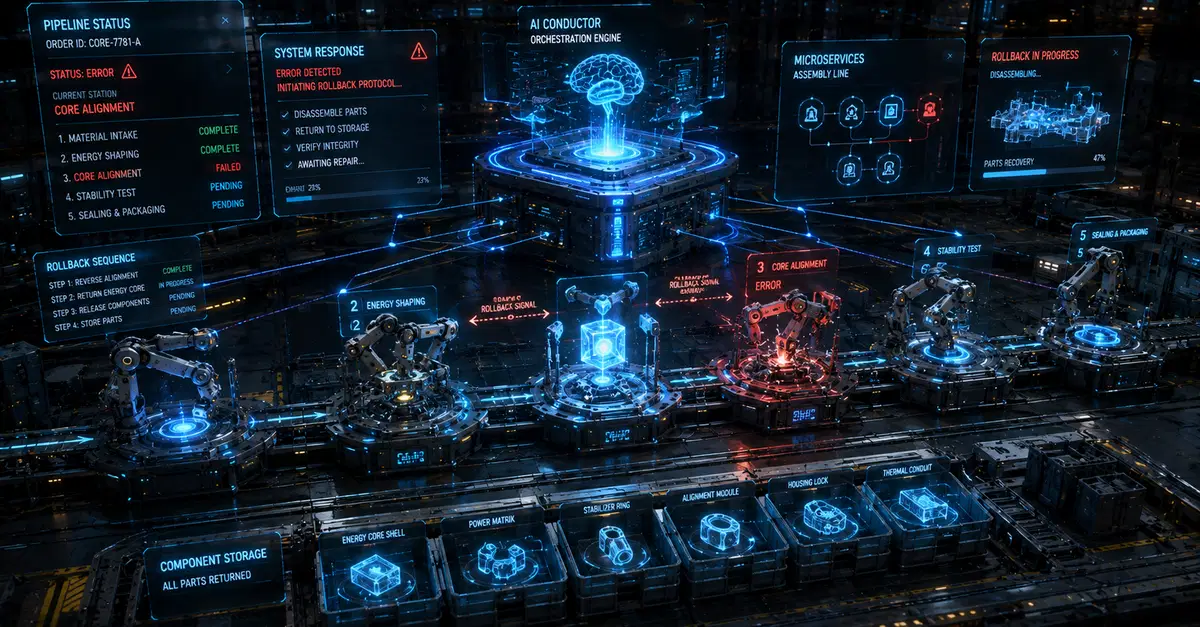
The Distributed Transaction Dilemma
Building modern applications often means moving beyond monolithic architectures. Whether you're adopting a modular monolith or embracing a full microservices approach, your business logic inevitably spans multiple distinct domains or external services. Consider a common e-commerce scenario: processing a new order. This single action typically involves reserving inventory, processing a payment (e.g., via Stripe), and generating a shipping label. In a traditional monolithic application sharing a single database, this complexity is managed elegantly using a single DB::transaction() block. If any step fails, the entire operation is automatically rolled back, ensuring data consistency.
However, this straightforward approach breaks down when these operations are distributed. Imagine Inventory, Billing, and Shipping are handled by separate microservices, or rely on asynchronous external APIs. You cannot simply wrap HTTP calls to services like Stripe or a shipping provider within an ACID relational database transaction. If you successfully reserve inventory and charge a customer's credit card, but the subsequent call to the shipping service fails, you're left with a significant data inconsistency. The customer has been billed, but the item remains unshipped, or worse, inventory was depleted for an order that cannot be fulfilled.
This is the core problem that distributed transactions aim to solve. In a distributed system, the concept of a single, atomic transaction across multiple independent services or databases becomes exceedingly difficult, if not impossible, to implement directly with traditional ACID properties. The lack of shared transactional boundaries means that operations can commit independently, leading to partial states and data corruption.
Introducing the Saga Pattern
The Saga pattern emerges as a powerful solution to manage data consistency across distributed services. Instead of a single, atomic transaction, a saga is a sequence of local transactions. Each local transaction updates data within a single service and then triggers the next local transaction in the sequence. Crucially, each local transaction has a corresponding compensating transaction that can undo the work performed by the preceding local transaction.
Think of it like a carefully choreographed dance. Each dancer (local transaction) performs a specific move. If one dancer falters, a pre-arranged sequence of counter-moves (compensating transactions) is initiated to bring the entire performance back to its starting state, leaving no trace of the incomplete dance. This ensures that even if the saga fails midway, the system can be restored to a consistent state, avoiding orphaned data or incomplete business processes.
Saga Implementations in Laravel
While Laravel doesn't have a built-in, first-party Saga implementation, the pattern can be effectively implemented using various approaches. The key is to orchestrate the sequence of local transactions and their compensating actions. Two primary approaches are commonly used:
1. Choreography-Based Sagas
In a choreography-based saga, each service publishes events upon completing its local transaction. Other services listen for these events and execute their own local transactions in response. There is no central coordinator; services react to each other's actions. For example, the Order service reserves inventory and publishes an InventoryReserved event. The Payment service listens for this event, processes the payment, and publishes a PaymentProcessed event. The Shipping service then listens for PaymentProcessed to initiate shipping.
If the Shipping service fails, it publishes a ShippingFailed event. The Payment service listens for this and executes its compensating transaction (e.g., refunds the customer). The Inventory service listens for ShippingFailed or PaymentFailed and executes its compensating transaction (e.g., unreserves inventory).
This approach is decentralized and can be simpler to implement for straightforward sagas. However, it can become complex to manage and debug as the number of services and interactions grows, as the logic is distributed across multiple services. Understanding the overall flow requires inspecting the event listeners of each participating service.
2. Orchestration-Based Sagas
With orchestration, a central orchestrator service (or a dedicated saga manager) is responsible for managing the entire saga. The orchestrator sends commands to each service to execute its local transaction. If a service successfully completes its task, it reports back to the orchestrator, which then commands the next service. If a service fails, the orchestrator is responsible for sending compensating commands to the services that have already completed their transactions, in reverse order.
For our e-commerce example, an Order Orchestrator would first command the Inventory service to reserve stock. Upon confirmation, it commands the Payment service to charge the customer. If successful, it commands the Shipping service. If the Shipping service fails, the orchestrator would command the Payment service to issue a refund and then command the Inventory service to unreserve stock.
This approach centralizes the saga logic, making it easier to understand, monitor, and debug the end-to-end process. It also provides a clear point of control for managing failures and retries. However, it introduces a single point of failure (the orchestrator) and can lead to a more complex orchestrator service as it needs to manage the state and logic for multiple sagas.
Referenced Sources
- verified