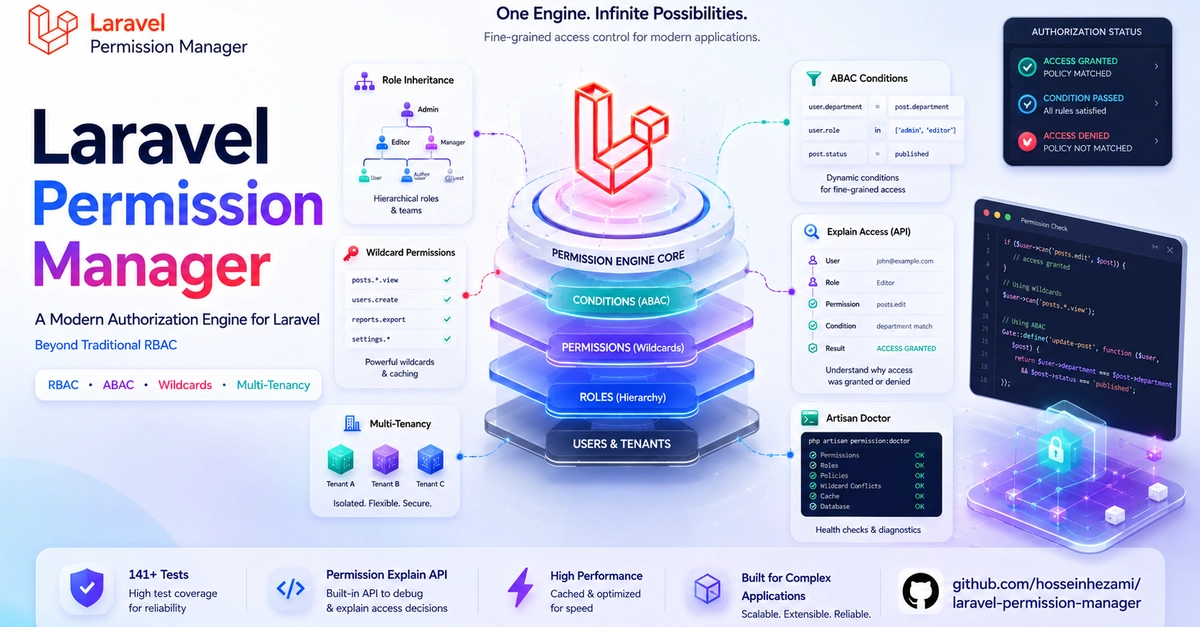
The Hidden Complexity of Authorization
When a user interacts with a web application, especially when performing a sensitive action like deleting data, the underlying authorization process is far more intricate than many developers realize. The common assumption is a straightforward boolean check: does the user have permission? In modern, robust applications, particularly those built on frameworks like Laravel, this single decision point is the culmination of a sophisticated, multi-layered evaluation. This article dissects the journey of a single request, DELETE /posts/42, as it navigates through over 14 distinct layers of authorization logic, illustrating the depth and breadth of security considerations in contemporary web development.
The complexity arises from the need to balance granular control, security, and developer convenience. Frameworks and libraries offer powerful tools, but their effective application can lead to an authorization flow that is anything but simple. We will follow a concrete example, showing precisely when and how each layer contributes to the final decision, demystifying a process that is critical for application security but often opaque to those who build and maintain these systems.
Tracing the Request: DELETE /posts/42
Consider a user attempting to delete a specific post, identified by ID 42, in a Laravel application. This action triggers a cascade of checks, far beyond a simple role assignment. The journey begins at the very edge of the application and progresses inward, with each layer potentially granting, denying, or deferring the final decision.
Layer 1: The Route
The request first hits the application's routing layer. Here, Laravel determines which controller method should handle the incoming HTTP request. While the route definition itself doesn't perform authorization, it's the entry point that directs the request to the code responsible for it. A route might be defined as:
Route::delete('/posts/{post}', [PostController::class, 'destroy']);This layer simply maps the URL and HTTP verb to the correct handler, setting the stage for subsequent authorization checks.
Layer 2: Middleware - Authentication & Basic Authorization
Before the request even reaches the controller, it passes through middleware. Authentication middleware typically verifies if the user is logged in. Following that, a basic authorization middleware might perform an initial check, such as verifying if the user has the general 'delete posts' capability. This is often a broad stroke, a first-pass filter.
Example middleware might look like:
public function handle(Request $request, Closure $next)
{
    if (! $request->user()->can('delete', $post)) {
        abort(403, 'You do not have permission to delete this post.');
    }
    return $next($request);
}
This layer ensures that only authenticated users with at least some level of permission proceed. If this check fails, the request is terminated early, preventing further processing.
Layer 3: Controller Method - Initial Access
Once through the middleware, the request arrives at the controller's `destroy` method. Here, the application might perform a more specific check related to the resource being acted upon. For instance, it might check if the authenticated user is the author of the post they are trying to delete.
PostController::destroy(Request $request, Post $post):
public function destroy(Request $request, Post $post)
{
    // Additional check: Is the user the author?
    if ($request->user()->id !== $post->user_id) {
        // This check might be redundant if handled by Gate, but demonstrates granular control.
        // Or it could be a specific 'delete own post' vs 'delete any post' logic.
    }
    // ... further checks ...
    $post->delete();
    return response()->json(['message' => 'Post deleted successfully']);
}
Layer 4: Laravel Gates - Resource Authorization
Laravel's Gates provide a more structured way to authorize actions against resources. A Gate can define complex authorization logic. For the `DELETE /posts/42` request, a Gate might be defined to check if the user can 'delete' a specific 'Post' model instance.
// In App
ipciones
oviders
ovathServiceProvider.php

Gate::define('delete', function (User $user, Post $post) {
    // Logic here could involve roles, ownership, specific conditions.
    return $user->id === $post->user_id || $user->hasRole('editor');
});
The `can('delete', $post)` call in the controller or middleware would invoke this Gate.
Layer 5: Policies - Object-Oriented Authorization
Policies offer an object-oriented approach to authorization, grouping related Gates into a single class. If a `PostPolicy` exists, the authorization logic for deleting a post would reside there.
// In App
ipciones
oviders
ovathServiceProvider.php

use App
ipciones
oviders
ovathServiceProvider;
use App
ipciones
oviders
ovath;

protected $policies = [
    Post::class => PostPolicy::class,
];

// In App
ipciones
ovicy
ovostrovicy.php

public function delete(User $user, Post $post)
{
    return $user->id === $post->user_id;
}
The `authorize('delete', $post)` method in the controller would invoke the `delete` method of the `PostPolicy`.
Layer 6: Role-Based Access Control (RBAC) - Role Inheritance
Within the Gates or Policies, the system likely checks the user's roles. A user might be a 'Super Admin', 'Editor', or 'Author'. This layer handles the logic of role inheritance. For example, a 'Super Admin' might implicitly have permission to delete any post, overriding other checks. An 'Editor' might have permission to delete posts, but not their own if they are also an 'Author'.
Layer 7: Super-Admin Bypass
A common pattern is an explicit check for a super-administrator role. This bypasses all other checks, granting immediate access. This is often implemented at the beginning of Gate/Policy logic or within middleware.
if ($user->isSuperAdmin()) {
    return true; // Bypass all other checks
}
Layer 8: Explicit Deny Rules
Conversely, some systems implement explicit deny rules. If a user is explicitly denied permission, even if they have roles that might grant it, the action is forbidden. This provides a safety net for edge cases.
Layer 9: Wildcard Matching
For certain permissions, wildcard matching might be used. For example, a user might have permission to 'edit posts_*', which would cover 'edit posts/1', 'edit posts/2', etc. While less common for delete actions on specific resources, it's part of the broader authorization landscape.
Layer 10: Attribute-Based Access Control (ABAC) Conditions
ABAC introduces more dynamic and context-aware authorization. This layer evaluates attributes of the user, the resource, and the environment. For deleting a post, an ABAC condition might be: 'Allow deletion only if the post has not been published for more than 30 days' or 'Allow deletion only if the request originates from a trusted IP address'.
// Hypothetical ABAC check within a Gate/Policy
if ($post->published_at && $post->published_at->diffInDays(now()) > 30) {
    return false; // Too old to delete
}
Layer 11: Cache Lookups
To improve performance, authorization decisions, especially complex ones, might be cached. Before re-evaluating the full logic, the system checks if a cached result for this user and action is available. This layer is crucial for scaling but adds complexity to cache invalidation.
if (Cache::has('auth_check_user_' . $user->id . '_post_' . $post->id . '_delete')) { ... }
Layer 12: Audit Logging - Decision Recording
Regardless of the outcome, the authorization decision and the user's attempt are logged. This layer ensures accountability and provides a trail for security audits. The log entry would record the user, the action, the resource, the decision (allow/deny), and potentially the specific rules that led to that decision.
Layer 13: External Authorization Services (e.g., OPA)
In more complex microservice architectures, authorization might be delegated to a dedicated service like Open Policy Agent (OPA). The application would query this external service with the request context and receive a decision. This abstracts authorization logic away from individual applications.
Layer 14: Final Decision & Action Execution
After traversing all relevant layers, a final decision is made. If allowed, the controller proceeds to execute the `delete` operation. If denied, an appropriate HTTP error (typically 403 Forbidden) is returned to the client.
The Unanswered Question: Dynamic Rule Updates
While this article meticulously traces a single request, a significant challenge remains unaddressed: how are these 14+ layers of authorization rules managed and updated dynamically without requiring code deployments? The ability to modify permissions, roles, and ABAC conditions in real-time, especially in large, active applications, is a complex operational and security problem that often involves dedicated administrative interfaces and careful change management processes.
Why This Matters
Understanding this multi-layered approach is critical for developers. It moves beyond the simplistic view of permissions to reveal the robust security posture required for modern applications. It highlights the importance of choosing the right tools (Gates, Policies, RBAC, ABAC) and understanding their interplay. For founders and security professionals, it underscores the necessity of comprehensive authorization strategies to protect user data and maintain application integrity.