The Authorization Ceiling in Laravel Apps
As Laravel applications mature, the initial, straightforward authorization logic often buckles under growing complexity. Developers frequently encounter a series of common pitfalls that hinder scalability and introduce security vulnerabilities. These aren't minor bugs; they represent fundamental challenges in managing user access effectively as the application landscape broadens. The most prevalent issues include an unmanageable explosion of roles, the difficulty of creating exceptions to general rules, the intricate demands of multi-tenant architectures, the need for permissions that change based on context, and the sheer frustration of debugging access control failures.
Understanding these problems is the first step. The second is implementing robust solutions that scale. This guide breaks down each of these five common authorization hurdles and offers practical, forward-looking strategies to overcome them, ensuring your Laravel application's security and maintainability remain intact, even in 2026.
Problem #1: The Role Explosion Trap
The most common authorization issue developers face is the 'role explosion'. This happens when you start assigning specific permissions to individual roles, and the number of roles balloons uncontrollably. Imagine an e-commerce platform: you might start with 'Admin' and 'Customer'. Soon, you need 'Product Manager', 'Order Processor', 'Customer Support Tier 1', 'Customer Support Tier 2', 'Marketing Manager', 'Content Editor', and so on. Each new role requires manual configuration, increasing the surface area for errors and making management a nightmare. If a new feature requires a slight variation in access for an existing role, you might create yet another role instead of modifying existing ones.
The solution lies in moving beyond simple role assignment to a more granular, policy-based approach. Instead of defining 'Editor' and 'Admin' roles, define 'CanManageProducts' or 'CanViewOrders' as abilities. Then, assign these abilities to roles. For even greater flexibility, consider a system where users can be granted abilities directly, independent of roles, or where roles can inherit abilities from other roles. This approach treats roles as collections of permissions rather than the permissions themselves. For instance, a 'Product Manager' role could simply inherit all permissions from 'CanManageProducts' and add 'CanViewSalesReports'. This keeps the number of core roles manageable while allowing for complex access patterns.
Problem #2: The "Except This One" Problem
A frequent challenge arises when a general permission applies to a group of users, but a specific exception is needed for a subset. For example, all 'Editors' can edit 'Articles', but a specific 'Senior Editor' should not be able to edit articles written by a particular 'Lead Author'. Implementing such exceptions directly within the authorization gates can lead to convoluted logic and hard-to-maintain code. You end up with deeply nested `if` statements or complex `can` checks that are difficult to read and debug.
The most effective way to handle these exceptions is through a combination of policies and contextual checks. Instead of a single `can('edit', $article)` check, you might implement a policy method like `canEdit(User $user, Article $article)`. Within this policy, you can add specific logic: if the user is a 'Senior Editor', check if the article's author is a 'Lead Author'. If so, return `false`. Otherwise, return `true`. This keeps the authorization logic encapsulated within the policy class, making it much cleaner. For even more dynamic exceptions, consider passing additional context to your authorization checks, such as the specific action being performed or the resource's state. Laravel's Gates and Policies are designed to be flexible; leverage them by passing extra arguments to your `can` method when necessary.
Problem #3: The Multi-Tenant Nightmare
Multi-tenancy, where a single instance of your application serves multiple distinct customers (tenants), introduces significant authorization complexities. Each user should only be able to access resources belonging to their specific tenant. A user from Tenant A must never see data from Tenant B. Simply adding a `tenant_id` to your models and filtering queries isn't enough for authorization. You need to ensure that a user's permissions are scoped to their tenant.
The standard approach involves associating users with tenants and then ensuring all authorization checks are performed within the context of that association. When a user logs in, their tenant context should be established. All subsequent authorization checks must implicitly or explicitly consider this tenant ID. For instance, a policy checking if a user can edit a 'Project' would look like: `canEdit(User $user, Project $project)`. Inside the policy, you'd verify that `$user->tenant_id === $project->tenant_id`. If not, access is denied. This requires careful design, ensuring that all models related to tenant-specific data have a `tenant_id` and that your application consistently applies this scoping. Global scopes in Eloquent can automate this filtering for queries, but authorization logic must still explicitly check the relationship.
Problem #4: Contextual Permissions
Permissions often depend not just on the user and the resource, but on the *state* or *context* of the resource or the action being performed. For example, a 'Manager' might be able to 'Approve' a 'Leave Request', but only if the request is in a 'Pending' state. A 'Financial Officer' might be able to 'Cancel' an 'Order', but only if it hasn't yet been 'Shipped'. These context-dependent permissions are difficult to model with simple role-permission mappings.
The solution here is to build richer authorization logic that considers the state of the resource. Instead of a static 'canApprove' permission, you might have a policy `canApprove(User $user, LeaveRequest $request)`. Inside this policy method, you would check `$request->status === 'pending'`. If the status is different, the user cannot approve, regardless of their role. This makes your authorization logic more dynamic and reflective of business rules. You can also consider using a dedicated permission management package that supports conditional permissions or action-based authorization rules, allowing you to define permissions like 'approve_leave_request_if_pending' or 'cancel_order_if_not_shipped'. This keeps the core roles clean and pushes the complexity into specific, testable policy methods.
Problem #5: Debugging Nightmares
When authorization fails unexpectedly, debugging can be a significant time sink. Tracing why a user was denied access can involve sifting through multiple policy files, role assignments, and conditional logic. This becomes exponentially harder in complex applications with many roles, permissions, and exceptions. Developers often resort to adding `dd()` statements throughout their code, which is a crude and unsustainable method.
A structured approach to debugging is essential. First, ensure you have comprehensive logging for authorization failures. Laravel's authorization system can log denied attempts, which you can then monitor. Second, implement a clear naming convention for your Gates, Policies, and Permissions. This makes it easier to locate the relevant logic. Third, consider using specialized debugging tools or packages designed for authorization. Some tools can provide a trace of authorization checks, showing exactly which policies were consulted and why access was granted or denied. For instance, a package that visualizes the permission structure or allows you to simulate user access under different scenarios can be invaluable. Writing thorough unit and feature tests for your authorization logic is also critical; these tests act as living documentation and quickly catch regressions.
The Laravel Permission Manager Package
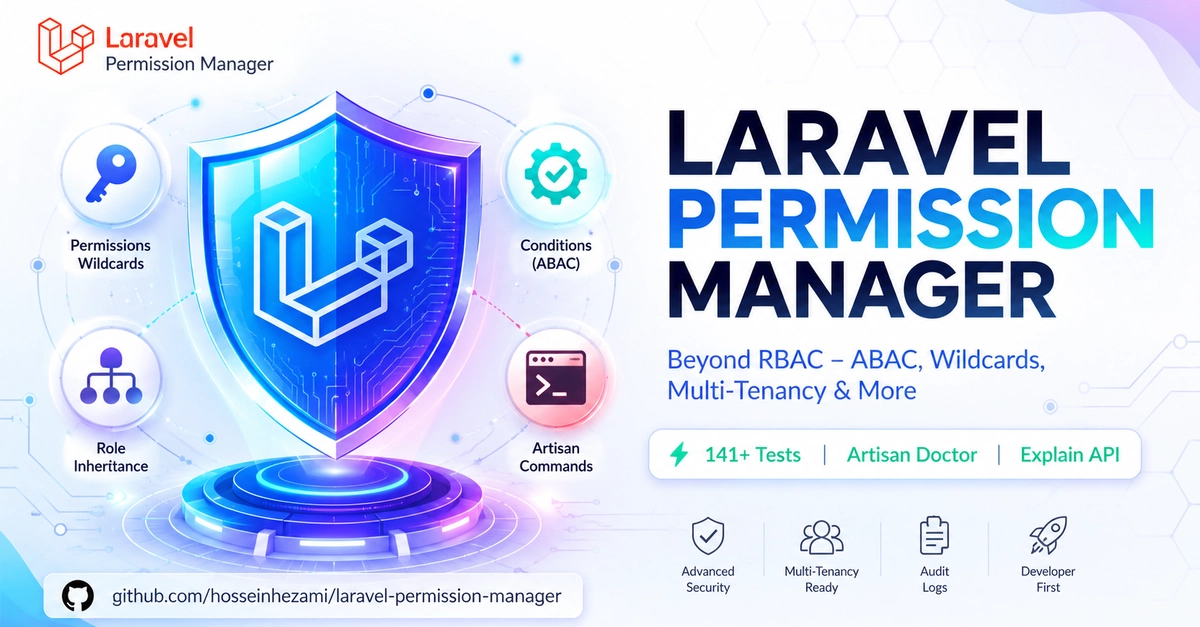
To address these five common problems holistically, the Laravel Permission Manager package offers a unified solution. It aims to simplify the management of roles, permissions, and policies, incorporating features that directly tackle role explosion, contextual permissions, and debugging. By providing a structured framework, it helps developers avoid the common pitfalls and build more scalable and secure authorization systems within their Laravel applications. The package encourages a policy-first approach and provides tools to manage complex permission relationships, making it easier to maintain access control as your application grows.