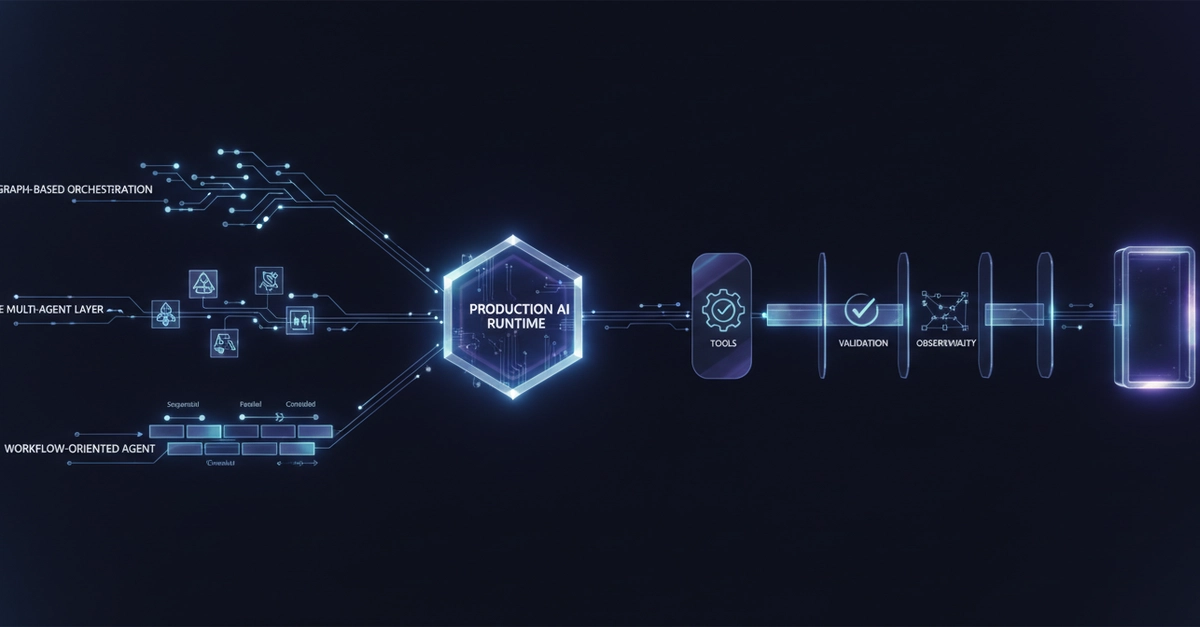
The Shifting Landscape of AI Agents
AI agents are rapidly evolving from experimental chatbots into critical components of production systems. As these agents take on more complex tasks—involving tools, memory, multi-step reasoning, validation, retries, human oversight, and collaboration—the question of architecture becomes paramount. Developers must choose the right framework to manage this complexity. LangGraph, CrewAI, and Google Agent Development Kit (ADK) all offer paths to building agentic applications, but they are built around distinct abstractions and offer varying levels of orchestration control. The key is not to find the single 'best' framework, but to identify which orchestration model best suits the specific system being built.
A production agent is fundamentally more than just a large language model (LLM) responding to a prompt. It's a system designed to act autonomously or semi-autonomously to achieve specific goals. This involves a dynamic interplay of perception, reasoning, planning, and action, often iterated over multiple steps. The choice of framework dictates how these components are wired together, how state is managed, and how agents interact with each other and external tools.
LangGraph: Graph-Based State Machines for Complex Workflows
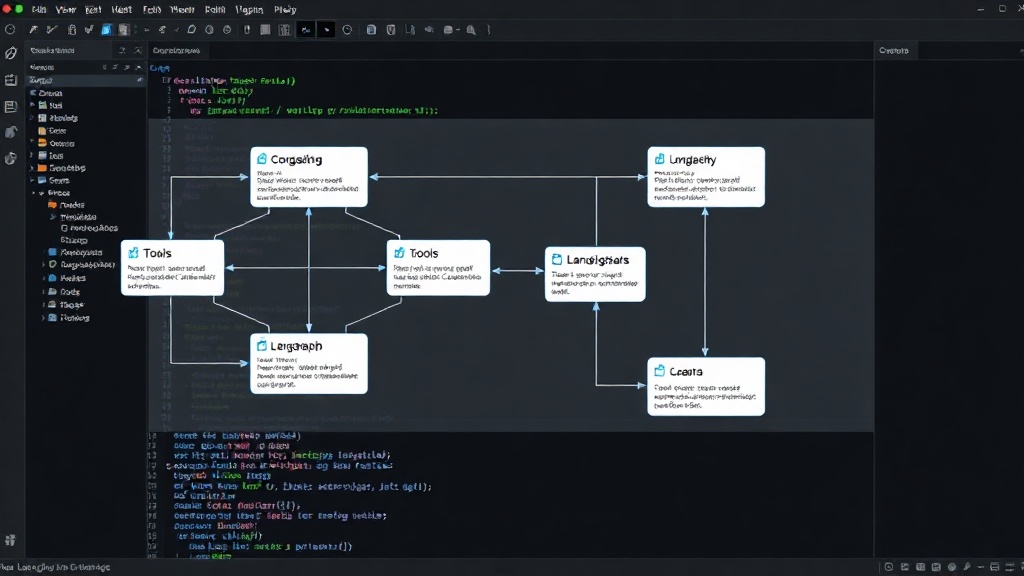
LangGraph, built on top of LangChain, provides a powerful abstraction for building stateful, multi-agent applications. Its core innovation lies in representing agent workflows as directed graphs. Each node in the graph can represent a tool, an LLM call, a conditional branch, or an agent. The edges define the flow of control and data between these nodes. This graph-based approach is particularly well-suited for applications where the sequence of operations is complex, requires explicit state management, and may involve feedback loops or conditional execution based on intermediate results.
Think of LangGraph less like a simple script and more like a sophisticated flowchart where each step can trigger a new thought process, an external action, or a decision point. This allows for precise control over the agent's execution path. If an agent needs to perform a series of steps, evaluate the outcome, and then decide on the next action based on that evaluation, LangGraph's explicit state management and graph traversal make this manageable. Its strengths lie in its flexibility and the granular control it offers over the agent's internal state and decision-making process. This makes it ideal for complex, multi-step tasks where the exact sequence of operations is critical and needs to be explicitly defined and managed.
CrewAI: Collaborative Agent Orchestration
CrewAI takes a different approach, focusing on enabling multiple AI agents to collaborate and work together to accomplish complex tasks. It abstracts the concept of an 'agent' as an autonomous entity with specific roles, goals, and tools. The framework then provides mechanisms for these agents to communicate, delegate tasks, and coordinate their efforts. This is achieved through concepts like 'tasks,' which are assigned to agents, and 'crew,' which is a collection of agents working together.
CrewAI is designed for scenarios where a problem is best solved by a team of specialized agents, each contributing its unique capabilities. Imagine a project management scenario where one agent handles research, another writes code, and a third reviews the output. CrewAI facilitates this by managing the communication and delegation between these agents. Its emphasis is on emergent collaboration and allowing agents to autonomously decide how to best achieve their assigned tasks, often through iterative communication. This makes it a strong choice for projects that benefit from a division of labor and collective problem-solving, where the overall objective can be broken down into sub-tasks suitable for individual agents.
Google ADK: Production-Ready Agent Development
The Google Agent Development Kit (ADK) is positioned as a more production-focused toolkit, aiming to simplify the development and deployment of AI agents. While specific technical details can evolve rapidly, ADK generally emphasizes robustness, scalability, and integration with Google's broader AI ecosystem. It often provides higher-level abstractions that abstract away some of the lower-level complexities of agent orchestration, allowing developers to focus on the agent's logic and capabilities.
ADK is designed to provide a structured and opinionated approach to building agents, often leveraging Google's infrastructure for tasks like tool integration, safety, and deployment. It aims to bridge the gap between prototyping and production by offering components and patterns that are battle-tested for enterprise use cases. This can include features for managing agent lifecycles, handling complex tool interactions, and ensuring reliable performance at scale. For organizations already invested in the Google Cloud ecosystem or those prioritizing a streamlined path to production with strong support for enterprise features, ADK presents a compelling option.
Choosing the Right Abstraction for Your Needs
The choice between LangGraph, CrewAI, and Google ADK hinges on the specific requirements of your agentic application. If your primary need is to build complex, stateful workflows with explicit control over execution paths, conditional logic, and feedback loops, LangGraph offers the most granular control through its graph-based state machine abstraction. Its strength lies in managing intricate sequences of operations and maintaining explicit state across multiple steps.
For applications that benefit from a team of agents working collaboratively, delegating tasks, and communicating to achieve a common goal, CrewAI is the standout choice. Its focus on agent collaboration and emergent teamwork makes it ideal for complex projects that can be broken down into specialized roles. It abstracts the coordination layer, allowing agents to function as a cohesive unit.
If your priority is a streamlined path to production, leveraging a robust and scalable framework with strong integration into a major cloud ecosystem, Google ADK is likely the most suitable option. It offers higher-level abstractions and a more opinionated structure designed for enterprise-grade deployment and management, particularly for those already within the Google Cloud platform.
Ultimately, understanding these core differences in abstraction and orchestration control is crucial. The 'best' framework is the one that aligns most closely with the complexity, collaboration needs, and deployment requirements of your specific AI agent system.