
Kimi K3's Strong Performance on the Intelligence Index
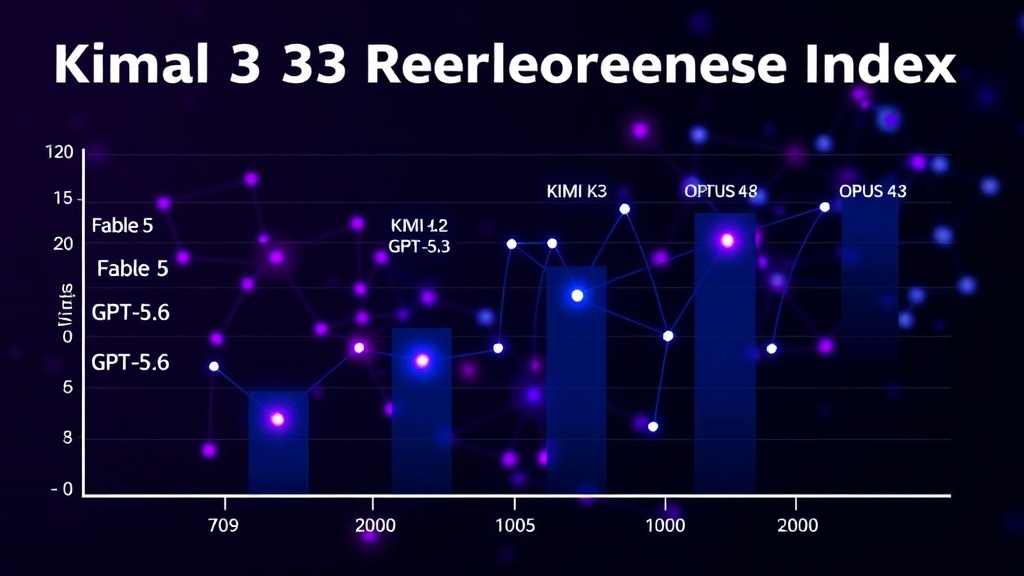
Recent analysis of the Artificial Analysis Intelligence Index reveals a significant achievement for the open-weights model, Kimi K3. The model has secured the third position with a score of 57.1, positioning it as a formidable contender against leading proprietary AI systems. This placement is particularly noteworthy as it surpasses Opus 4.8, a model previously considered a benchmark in its class. The current top spots remain occupied by Fable 5 at 59.9 and GPT-5.6 Sol at 58.9, indicating that while proprietary models still lead, the gap is narrowing considerably.
The implications of an open-weights model achieving such high rankings are substantial for the AI development community. It suggests that the performance ceiling for publicly accessible models is rapidly ascending, potentially democratizing access to cutting-edge AI capabilities. The development team behind Kimi K3 has not yet released the specific weights, but industry observers anticipate their drop on July 27th, a date that is quickly becoming a focal point for AI researchers and developers worldwide.
Understanding the Intelligence Index
The Artificial Analysis Intelligence Index is a critical benchmark for evaluating the capabilities of large language models. It assesses various facets of AI performance, including reasoning, knowledge, and problem-solving abilities, providing a standardized metric for comparison. Achieving a high score on this index signifies a model's advanced understanding and generation of complex information.
Fable 5, currently holding the top position, represents the pinnacle of proprietary AI development, showcasing the advancements made by well-funded research labs. GPT-5.6 Sol, a close second, further underscores the competitive landscape of closed-source AI. The fact that Kimi K3, an open-weights model, is within striking distance of these industry leaders is a testament to the accelerating pace of innovation in the open-source AI community. This performance suggests that the collaborative and iterative nature of open development can yield results that rival, and in some cases, even surpass, those of closed, commercially driven projects.
The performance of Kimi K3 is not just a statistical anomaly; it reflects a broader trend in AI development. As more resources and talent are directed towards open-weights models, their capabilities are expanding exponentially. This creates a dynamic where researchers can build upon existing architectures, experiment with novel techniques, and share their findings freely, leading to faster collective progress. The impending release of Kimi K3's weights is expected to further fuel this cycle, enabling a wider array of developers to fine-tune, integrate, and build upon its advanced architecture.
The Significance of Open-Weights Models
The distinction between open-weights and proprietary models is crucial. Proprietary models, like those developed by large tech corporations, are typically kept under wraps, with their inner workings and training data undisclosed. This limits external scrutiny and innovation, although it can provide a controlled environment for rapid advancement. Open-weights models, conversely, make their parameters and architecture publicly available. This transparency fosters a collaborative ecosystem where researchers can dissect, improve, and adapt the models for specific use cases without the restrictions of commercial licensing.
Kimi K3's success challenges the notion that only massive, well-funded corporations can produce state-of-the-art AI. It demonstrates that the open-weights community, fueled by shared knowledge and collective effort, can achieve comparable, if not superior, results. This has profound implications for the accessibility of advanced AI technologies. Developers and smaller organizations that may not have the resources to develop their own large models can leverage powerful open-weights alternatives, accelerating their own innovation cycles and reducing development costs.
The upcoming release of Kimi K3's weights is anticipated to be a pivotal moment. It will allow the global AI community to directly engage with a model that has proven its mettle against some of the best proprietary systems. This could lead to a surge in new applications, research papers, and fine-tuned versions of Kimi K3 tailored for specific domains, from scientific research to creative content generation. The accessibility of these weights means that the iterative process of AI development can be amplified, much like how open-source software has transformed the technology landscape over the past decades.
Future Outlook and Community Impact
The performance of Kimi K3 on the Intelligence Index is more than just a ranking; it's a signal. It indicates a shifting balance in the AI development paradigm. While proprietary models will continue to push boundaries, the rapid advancements in open-weights models suggest that the future of AI may be increasingly collaborative and decentralized. The ability for anyone to inspect, modify, and deploy these models democratizes AI development, potentially leading to a more diverse and robust AI ecosystem.
The AI community is eagerly awaiting the July 27th release of Kimi K3's weights. This event is expected to spark a new wave of experimentation and development, pushing the boundaries of what open-weights models can achieve. The challenge for proprietary model developers will be to maintain their lead in an environment where cutting-edge AI is becoming increasingly accessible. For users and developers, this competition bodes well, promising faster innovation, greater choice, and more powerful AI tools available to everyone.
What remains to be seen is how quickly the open-weights community can iterate on Kimi K3 and whether future versions can consistently challenge and surpass the top proprietary models. The performance of Kimi K3 suggests that the race for AI supremacy is far from over, and the open-weights movement is now a central player.