Understanding Kimi K3's Context Window Strategy
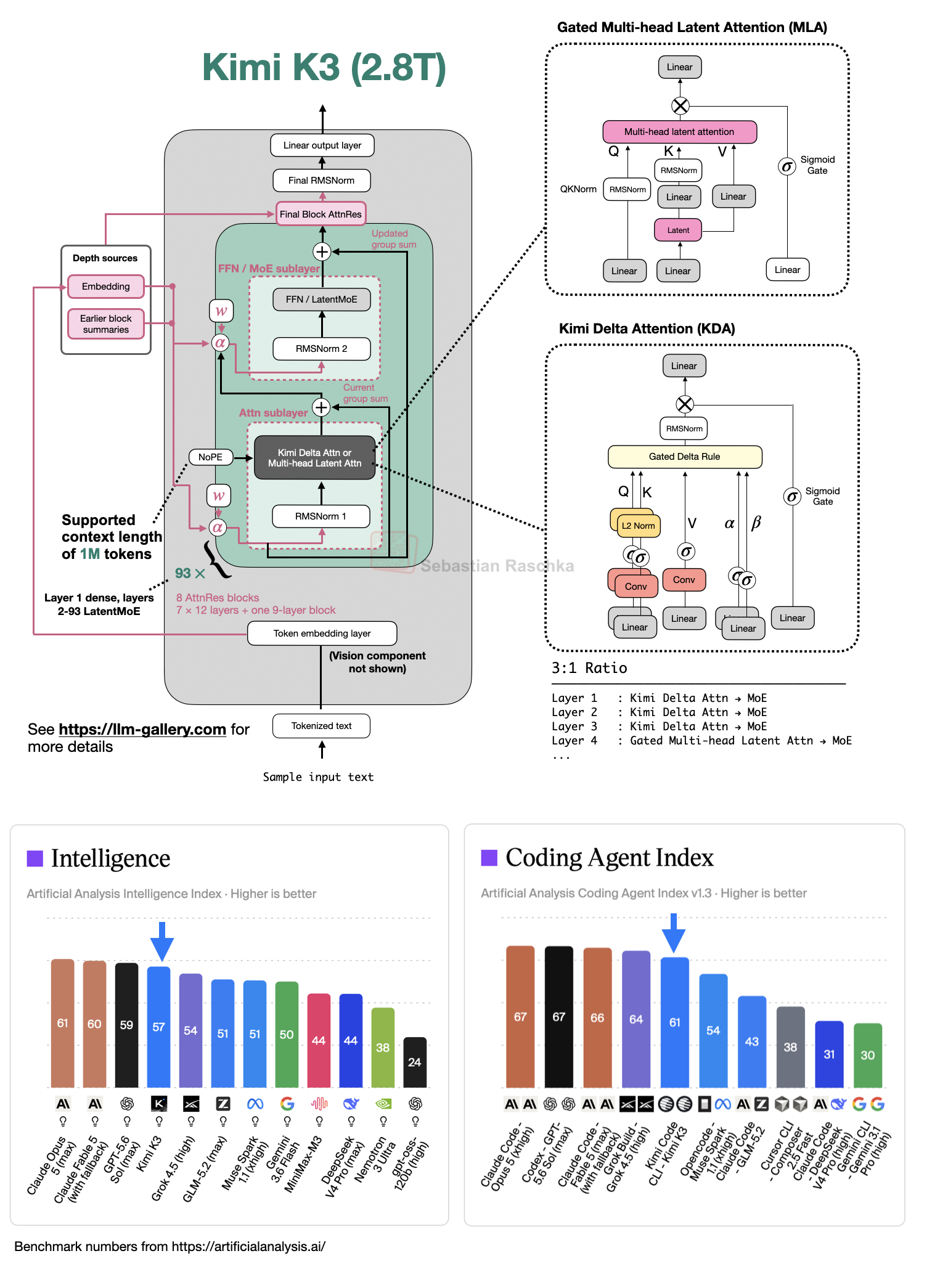
Kimi K3, developed by Moonshot AI, introduces a novel architecture designed to handle exceptionally large context windows, a critical factor for sophisticated AI applications. Unlike traditional transformer models that process input sequentially or rely on fixed-size attention mechanisms, Kimi K3 appears to employ a more dynamic and efficient method for managing its extensive context. The exact technical implementation details remain proprietary, but the observed performance suggests a departure from standard approaches, potentially involving hierarchical processing, optimized attention computations, or a hybrid model that combines different techniques.
The primary challenge with large context windows is computational complexity. Standard self-attention mechanisms in transformers scale quadratically with the sequence length (O(n^2)), making processing very long inputs prohibitively expensive in terms of memory and computation. Kimi K3’s ability to process up to 2 million tokens implies it has found a way to circumvent this bottleneck. This could involve techniques similar to sparse attention, sliding window attention, or even entirely new architectural paradigms that do not rely on dense self-attention over the entire sequence. The goal is to allow the model to access and reason over vast amounts of information without succumbing to the quadratic scaling problem.
Consider it less like reading a book page by page and more like having an incredibly fast index and summarization system that can pull relevant information from any chapter instantaneously. This allows the model to maintain coherence and understanding across a much larger span of text than previously feasible.

Performance and Use Cases
The practical implications of Kimi K3’s architecture are significant. Its ability to handle a 2 million token context window opens up new possibilities for complex tasks such as:
- Document Analysis: Processing entire books, lengthy legal documents, or extensive research papers in a single pass for summarization, question answering, or insight extraction.
- Codebase Understanding: Analyzing large code repositories to identify bugs, suggest refactors, or generate documentation without breaking the codebase into smaller, disconnected chunks.
- Conversational AI: Maintaining long-term memory and context in extended conversations, enabling more natural and coherent interactions over time.
- Data Synthesis: Integrating and reasoning over massive datasets, reports, and logs to identify trends and anomalies that might be missed with smaller context windows.
Early demonstrations and anecdotal reports highlight Kimi K3's proficiency in these areas. The model reportedly excels at tasks requiring deep comprehension of lengthy texts, demonstrating an ability to recall specific details and connect information across widely separated parts of the input. This suggests that the architectural innovations are translating directly into improved performance on real-world problems.
Architectural Innovations: Speculation and Implications
While Moonshot AI has not disclosed the precise technical blueprints, several architectural strategies could enable Kimi K3's performance:
- Hierarchical Attention: Processing text in chunks and then applying attention mechanisms at different levels of granularity. This could involve summarizing chunks and then attending to these summaries, reducing the overall sequence length for higher-level processing.
- State Space Models (SSMs): Architectures like Mamba have shown promise in efficiently handling long sequences by using recurrent-like mechanisms that maintain a compressed state. Kimi K3 might incorporate elements of SSMs or a hybrid approach.
- Optimized Retrieval Augmented Generation (RAG): While not strictly an architectural change to the core transformer, a highly optimized RAG system could allow the model to effectively 'virtually' extend its context by retrieving relevant information from an external store with extreme efficiency.
- Mixture-of-Experts (MoE): Utilizing specialized experts within the network that are activated based on the input, potentially allowing for more efficient computation by only engaging relevant parts of the model for specific tasks or contexts.
The surprising detail here is not just the sheer size of the context window, but the apparent speed and accuracy with which Kimi K3 operates. Achieving a 2 million token context is one thing; making it practically usable for complex, real-time applications is another. This suggests a significant breakthrough in efficient inference and attention computation.
The Road Ahead: Challenges and Opportunities
Kimi K3's advancement in handling massive context windows presents both opportunities and challenges. For developers and researchers, it means a new frontier for AI applications that were previously constrained by context limitations. The ability to feed entire codebases, comprehensive legal briefs, or multi-volume novels into an LLM without truncation could unlock unprecedented levels of automation and insight.
However, questions remain about the model's training data, its susceptibility to hallucination with such large contexts, and the fine-grained control users will have over its reasoning process. Furthermore, the computational resources required to train and run models of this scale, even with architectural efficiencies, are substantial. The long-term viability and accessibility of such powerful models will depend on continued innovation in hardware and algorithmic efficiency.
What nobody has addressed yet is the potential for entirely new classes of AI-driven tools that leverage this massive context. We might see AI assistants capable of managing entire projects by ingesting all related documentation, communication, and code, or research tools that can synthesize findings from thousands of academic papers simultaneously. The implications for knowledge work are profound.
For developers, integrating Kimi K3 means rethinking how data is prepared and how prompts are structured to take full advantage of its extended context. Benchmarking against existing models will likely reveal significant performance gains on tasks involving long-form input. The potential for building applications that were previously impossible is now within reach.
From a founder's perspective, Kimi K3 represents a potential shift in the AI landscape. Companies that can effectively leverage massive context windows may gain a significant competitive edge in areas like legal tech, R&D, and enterprise knowledge management. The challenge will be to identify and capitalize on these new opportunities, potentially leading to new AI-first products and services.
For data scientists and AI researchers, Kimi K3 offers a fascinating case study in pushing the boundaries of transformer architectures. Understanding its underlying mechanisms could provide valuable insights for future model development, particularly in optimizing attention mechanisms and improving computational efficiency for large-scale AI.