The Foundation: Understanding XOR Distance
Yesterday we understood XOR distance, that weird little metric that has nothing to do with geography but somehow behaves exactly like a distance is supposed to. If you haven't read it, quick recap: XOR two IDs, read the result as a number, that's your distance, and it satisfies zero-self-distance, symmetry, and the triangle inequality. This peculiar property is the bedrock upon which the Kademlia distributed hash table (DHT) algorithm is built.
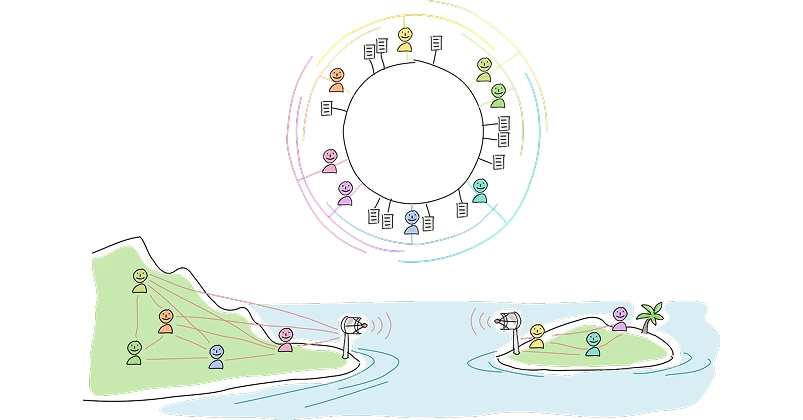
Unlike traditional network routing that relies on geographical proximity or hop counts, Kademlia leverages this abstract XOR distance to create a virtual network topology. Each node in the network is assigned a unique identifier (ID), typically a large random number. The 'distance' between any two nodes is then calculated by taking the bitwise XOR of their IDs and interpreting the result as an integer. This distance metric is crucial because it provides a consistent and mathematically sound way to measure how 'close' or 'far' two nodes are in the Kademlia network, irrespective of their actual physical location or network path.
Kademlia's Core Structure: The k-buckets
At the heart of Kademlia's efficiency lies its clever use of data structures, specifically the concept of k-buckets. Instead of maintaining a full routing table of every node in the network, each node only keeps track of a subset of its peers. These peers are organized into k-buckets, where each bucket corresponds to a range of XOR distances. A node's k-buckets are populated based on the XOR distance between its own ID and the IDs of other nodes.
For example, a node with ID `0x1234` might have a k-bucket for distances between `0x1000` and `0x1FFF`. Within each k-bucket, a node stores a list of contact information (IP address, port, node ID) for up to 'k' other nodes. The value of 'k' is a system-wide parameter that determines the redundancy and resilience of the network. A common choice for 'k' is 20. This bucket system ensures that a node's routing table remains manageable, even in networks with millions of participants. The buckets are typically structured such that the first bucket contains nodes with XOR distances closest to the node's own ID, and subsequent buckets cover progressively larger distances. This logarithmic scaling is key to Kademlia's efficiency.
Node Joining and Discovery
When a new node wishes to join a Kademlia network, it needs to discover other nodes and populate its routing table. This process typically begins with the new node knowing the contact information of at least one bootstrap node already in the network. The new node then sends a `FIND_NODE` RPC (Remote Procedure Call) to this bootstrap node, asking for nodes close to the new node's ID. The bootstrap node responds with the 'k' closest nodes it knows about.
The new node then repeats this process, sending `FIND_NODE` RPCs to the nodes it receives in response. Each time, it requests nodes closer to its own ID. This iterative process continues until the new node has identified 'k' nodes in each of its k-buckets. As it receives responses, it also adds the senders of those responses to its own k-buckets. This iterative querying and response mechanism ensures that the new node efficiently learns about a diverse set of nodes across the network, effectively integrating itself into the Kademlia DHT.
Data Storage and Retrieval
Kademlia's primary function is to provide a decentralized mechanism for storing and retrieving key-value pairs. When a node wants to store data associated with a key, it first calculates the XOR distance between the key's ID and its own node ID. It then identifies the 'k' nodes in the network whose IDs are closest to the key's ID (using the XOR distance metric). The node then sends a `STORE` RPC to these 'k' nodes, instructing them to store the key-value pair.
To retrieve data, a node again calculates the XOR distance between the key's ID and its own ID to find the 'k' closest nodes. It then sends a `FIND_VALUE` RPC to these nodes. If one of the nodes has the requested value, it returns it. If none of the 'k' closest nodes have the value, the requesting node might then query nodes that are progressively further away in XOR distance, or it might receive back the 'k' nodes closest to the key's ID, allowing for a more expansive search. This process ensures that data is distributed across the network in a way that is both resilient and efficiently discoverable.
Resilience and Decentralization
The Kademlia algorithm is designed for robustness and decentralization. Because each node maintains only a partial view of the network and data is replicated across multiple nodes, the network can tolerate node failures, churn (nodes joining and leaving), and even malicious actors to a certain extent. The XOR distance metric ensures that even as the network topology changes dynamically, nodes can still efficiently find each other and locate data.
The decentralization aspect is critical. There is no single point of control or failure. Each node participates equally in routing and storage. This makes Kademlia a foundational technology for many peer-to-peer applications, including file-sharing systems, decentralized messaging, and cryptocurrencies, where a resilient and censorship-resistant infrastructure is paramount. The algorithm's elegance lies in its ability to create a highly structured and efficient network from a collection of independent, uncoordinated nodes, all orchestrated by the simple yet powerful concept of XOR distance.
The surprising detail here is not the algorithm's complexity, but its reliance on a seemingly abstract mathematical concept – XOR distance – to solve the very practical problem of organizing a massive, distributed network. It's less about how physically close nodes are and more about how their IDs align in a bitwise, logical space.