Understanding Authentication vs. Authorization
In the digital realm, securing access to resources is paramount. Two fundamental concepts underpin this security: authentication and authorization. While often used interchangeably, they serve distinct purposes. Authentication is the process of verifying who a user claims to be. It answers the question, "Are you who you say you are?" This typically involves credentials like usernames and passwords, biometrics, or multi-factor authentication codes. Think of it like showing your ID at the entrance of a building to prove your identity.
Authorization, on the other hand, determines what authenticated users are allowed to do. It answers the question, "What actions are you permitted to perform?" Once your identity is confirmed, authorization dictates your access level. For instance, a regular user might be allowed to view content, while an administrator can modify it. This is akin to having a key card that grants access to specific floors or rooms within that building after your ID has been verified.
JWT: The Self-Contained Identity Token
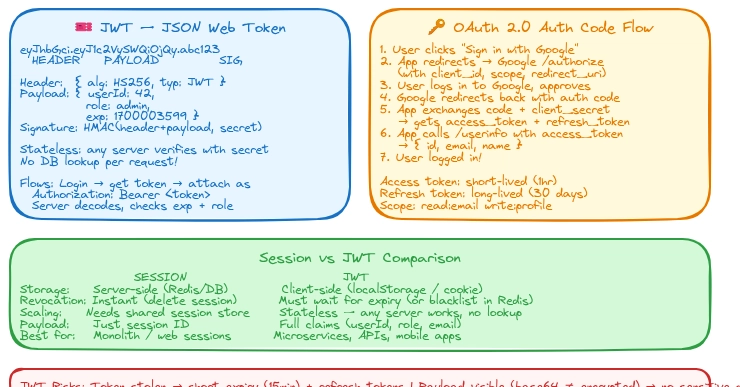
JSON Web Token (JWT) has emerged as a popular standard for securely transmitting information between parties as a JSON object. It is particularly useful for authentication, as it can be used to assert identity. A JWT is a compact, URL-safe means of representing claims to be transferred between two parties. Because the token is signed, the server can trust the data inside it without needing to fetch it from a database. This makes JWTs stateless, meaning the server doesn't need to store session information for each user.
The structure of a JWT is composed of three parts, separated by dots (.): a Header, a Payload, and a Signature.
- Header: Typically contains the type of token (JWT) and the signing algorithm used (e.g., HMAC SHA256 or RSA).
- Payload: Contains the claims. Claims are statements about an entity (typically, the user) and additional data. There are three types of claims: registered, public, and private. Registered claims are predefined, like
iss(issuer),exp(expiration time), andsub(subject). Public claims are custom claims defined by users but should be registered in the IANA JWT Registry to avoid conflicts. Private claims are custom claims created for private use between parties. - Signature: Used to verify that the sender of the JWT is who it says it is and to ensure that the message wasn't changed along the way. It's created by taking the encoded header, the encoded payload, a secret (for symmetric algorithms like HS256) or a private key (for asymmetric algorithms like RS256), and signing it with the algorithm specified in the header.
When a user logs in, the server generates a JWT containing claims about the user (like their ID and roles) and signs it. This token is then sent back to the client. For subsequent requests, the client includes this JWT in the HTTP request header. The server can then verify the token's signature to ensure its integrity and authenticity, and extract the claims to determine the user's identity and permissions without needing to query a database for session data.
OAuth 2.0: The Authorization Framework
OAuth 2.0 is an open standard for access delegation, commonly used as a way for Internet users to grant websites or applications access to their information on other websites but without giving them the passwords. It focuses on authorization, allowing users to grant third-party applications limited access to their resources on a service provider's platform. It decouples authentication from authorization, enabling a more flexible and secure way to manage permissions.
OAuth 2.0 works by introducing roles and flows that define how clients obtain access tokens. The key roles are:
- Resource Owner: The user who owns the data and grants access.
- Client: The application requesting access to the user's data.
- Resource Server: The server hosting the protected resources (e.g., Google Drive, Facebook profile).
- Authorization Server: The server that issues access tokens to the client after successfully authenticating the resource owner and obtaining authorization.
There are several OAuth 2.0 grant types (flows) designed for different scenarios:
- Authorization Code Grant: The most common and secure flow, used for web applications. The client receives an authorization code from the authorization server, which it then exchanges for an access token.
- Implicit Grant: A simplified flow for public clients (like single-page applications or mobile apps) where the access token is returned directly from the authorization server. Less secure than the Authorization Code grant.
- Resource Owner Password Credentials Grant: The client collects the user's username and password and sends them directly to the authorization server to obtain an access token. This flow should only be used with trusted clients and is generally discouraged due to security risks.
- Client Credentials Grant: Used for machine-to-machine communication where the client is requesting access to its own resources, not on behalf of a user.
In a typical OAuth 2.0 flow (e.g., Authorization Code Grant), a user wants to log into a third-party app using their Google account. The app redirects the user to Google's authorization server. The user logs into Google and grants the app permission. Google's authorization server then redirects the user back to the app with an authorization code. The app exchanges this code with Google's authorization server for an access token. This access token is then used by the app to access the user's Google data (e.g., calendar events) on the resource server.
Synergy: JWT and OAuth 2.0 Together
JWT and OAuth 2.0 are often used in conjunction to create robust authentication and authorization systems. While OAuth 2.0 handles the delegation of access and the issuance of tokens, JWTs are frequently used as the format for the access tokens themselves. The authorization server issues a JWT as an access token. This JWT contains claims about the user and the granted permissions. The resource server can then validate this JWT independently, without needing to call back to the authorization server for every request. This combination provides a powerful, scalable, and secure way to manage user access across distributed systems.
The surprising detail here is not that these two technologies are often paired, but how seamlessly they integrate. OAuth 2.0 provides the framework for obtaining delegated authority, and JWT offers a standardized, verifiable payload format for the credentials that represent that authority. This allows for a separation of concerns: OAuth 2.0 manages the authorization dance, while JWTs carry the verified permissions efficiently and securely.
Consider a microservices architecture. A user authenticates with an identity provider using OAuth 2.0, receiving a JWT access token. Each microservice that needs to access user data can independently validate this JWT. The token might contain claims specifying which services the user can access and what operations they can perform within those services. This avoids the need for a centralized session store, which can become a bottleneck and a single point of failure in distributed systems.
The Future and Beyond
Both JWT and OAuth 2.0 are continuously evolving. Standards like OpenID Connect, built on top of OAuth 2.0, add an identity layer to provide authentication. Security best practices are also constantly being refined, with ongoing discussions about token revocation, token binding, and the use of more robust cryptographic algorithms. For developers, understanding these standards is not just about implementing them correctly but also about staying informed about their security implications and potential vulnerabilities. If you're building any application that requires user accounts or third-party integrations, a solid grasp of JWT and OAuth 2.0 is essential.