The Need for Standardization in Decision Model Evaluation
The field of decision modeling, particularly with the rise of typed decision models, is rapidly evolving. These models, which represent complex decision-making processes in a structured, type-safe manner, are crucial for applications ranging from automated reasoning and planning to sophisticated business logic engines. However, a significant challenge has emerged: the lack of a standardized, reproducible benchmark for evaluating their performance. Without such a benchmark, comparing different approaches, assessing progress, and ensuring the reliability of implementations becomes a complex, often ad-hoc, endeavor.
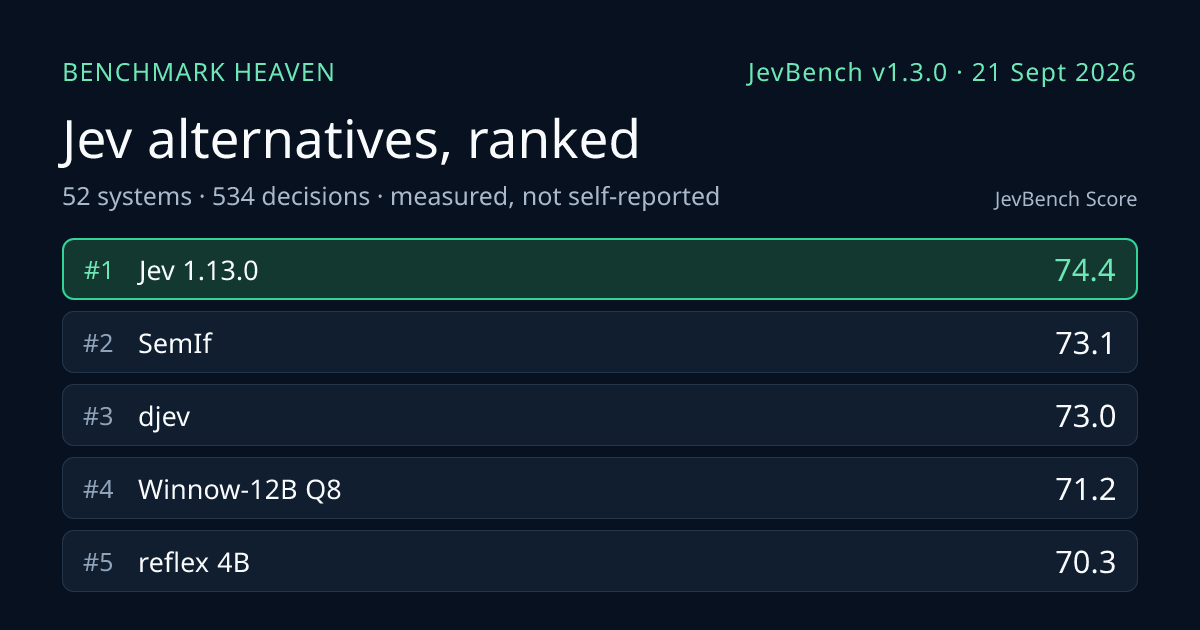
This gap is precisely what JevBench, a new open-source project, aims to fill. Showcased recently on Hacker News, JevBench introduces a curated set of typed decision models designed to test the capabilities of various decision modeling frameworks. The project's core philosophy centers on reproducibility, ensuring that researchers and developers can achieve consistent results when evaluating their own implementations or comparing them against established baselines.
The current landscape often sees researchers developing custom datasets or evaluation scripts for their specific experiments. While this serves the immediate purpose, it hinders broader scientific progress. It's akin to every team in a physics lab developing their own unique measurement tools and units for gravity; while they might get precise readings in their lab, comparing those readings to another lab's becomes an exercise in unit conversion and calibration, rather than a direct comparison of findings. JevBench seeks to provide a common set of calibrated instruments for decision model evaluation.
What JevBench Offers
JevBench is not merely a collection of problems; it is a framework designed for rigorous evaluation. It comprises a diverse set of decision models, each with specific characteristics intended to stress different aspects of a decision modeling system. These models vary in complexity, the types of constraints they involve, and the nature of the decisions to be made. This diversity ensures that the benchmark is not biased towards a particular type of problem or solution strategy.
A key feature of JevBench is its emphasis on typed decision models. This means the benchmark is specifically tailored for systems that leverage strong typing to enhance the clarity, maintainability, and correctness of decision logic. Typed models, much like strongly-typed programming languages, offer benefits such as compile-time error checking, improved tooling support, and clearer semantics, which are essential for complex decision-making systems.
The project provides clear guidelines and reference implementations to facilitate reproducible results. This includes specifying the exact problem instances, expected output formats, and potentially even the hardware and software environments under which the benchmarks should be run. By adhering to these guidelines, contributors can ensure that their benchmark scores are directly comparable to others, fostering a more objective and collaborative research environment.

Reproducibility: The Cornerstone of JevBench
Reproducibility is the central tenet of JevBench. In academic research and professional software development, the ability to reproduce results is paramount. It allows for verification of findings, debugging of implementations, and builds confidence in the reported performance metrics. JevBench addresses this by:
- Standardized Problem Sets: Providing a fixed and version-controlled set of decision problems.
- Clear Evaluation Metrics: Defining precise metrics for performance, such as solve time, memory usage, and solution quality.
- Reference Implementations: Offering example implementations in various languages or frameworks to demonstrate how to use the benchmark and to provide baseline performance figures.
- Environment Specifications: Suggesting or mandating specific software versions and hardware configurations to minimize environmental variability.
This focus on reproducibility is critical for the advancement of typed decision modeling. It allows developers to benchmark their new algorithms or system optimizations against a common, well-defined target. For researchers, it means they can more easily validate and build upon the work of others, accelerating the discovery of more efficient and robust decision-making techniques.
The Broader Impact on Decision Modeling
The introduction of JevBench signals a maturing of the typed decision modeling field. As systems become more complex and stakes higher, the demand for verifiable and high-performing decision logic increases. Frameworks that can demonstrate superior performance and reliability on a standardized benchmark will likely gain traction.
JevBench also encourages a more competitive and collaborative ecosystem. By providing a common ground for evaluation, it allows developers to identify areas where their systems excel and where improvements are needed. This can lead to faster innovation as teams focus on pushing the boundaries of what is possible in areas identified as challenging by the benchmark.
What remains to be seen is the adoption rate of JevBench by major decision modeling frameworks and research groups. Will it become the de facto standard, or will alternative benchmarks emerge? The success of JevBench will depend on community engagement, contributions to its model set, and its continued evolution to reflect new challenges in the field.
For practitioners, JevBench offers a valuable tool for selecting the right decision modeling technology or for assessing the performance of their in-house solutions. It shifts the evaluation from anecdotal evidence and custom tests to a more systematic, data-driven approach. If you are building systems that rely on complex decision logic, understanding how different tools perform on a standardized benchmark like JevBench is no longer optional—it's a prerequisite for building robust and efficient applications.