Jev + Pi: A Probability Gate for AI Agent Shell Commands
The integration of AI coding agents into developer workflows is rapidly advancing, but a persistent challenge remains: ensuring these agents execute intended commands reliably. When an agent proposes a shell command, particularly one that could modify files or system state, a robust mechanism is needed to verify its legitimacy. This is where Jev, TypeSafe's decision-only model, and the Pi coding agent CLI converge.
Released by TypeSafe on September 15, 2026, Jev operates differently from traditional large language models. Instead of generating text, Jev takes propositions as input and returns a probability score (between 0.0 and 1.0) indicating the likelihood of that proposition being true. This characteristic makes it uniquely suited for gating potentially risky operations.
The Pi coding agent, a CLI tool designed to assist developers, often interacts with the underlying shell. Its core functions like bash, write, and edit can issue commands that, if misinterpreted or misfired, could lead to unintended consequences. To address this, Jev has been placed in front of these critical Pi functions, acting as a probability gatekeeper.
Measuring Intent Coverage
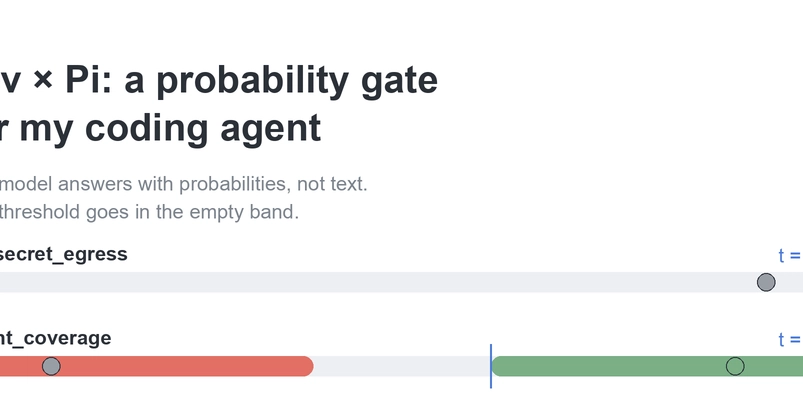
To establish effective thresholds for this probability gate, a series of tests were conducted. The experiment involved 18 real-world API fixtures, simulating various scenarios where Pi might be tasked with executing shell commands. The goal was to measure the intent_coverage – essentially, how accurately the system could discern between commands the user actually wanted and those that were extraneous or erroneous.
The results revealed a strikingly bimodal distribution of intent coverage. When commands were explicitly requested or clearly within the expected scope of the task, the intent coverage scores ranged from a high 0.77 to 0.98. Conversely, when commands were unrequested or outside the direct user intent, the scores plummeted to a low 0.06 to 0.15. Crucially, there was a significant gap: zero fixtures scored between 0.15 and 0.77. This distinct separation provided a clear window for establishing a reliable threshold.
Based on this measured gap, a threshold of 0.60 was selected. This value sits comfortably within the empty space between the high-probability zone of intended commands and the low-probability zone of unintended ones. Commands scoring above 0.60 are presumed to be intended and allowed to proceed, while those falling below are flagged for review or rejection.
The Failure Mode and Threshold Dynamics
Understanding potential failure modes is critical for any gating mechanism. In the case of Jev and Pi, the symmetric nature of probability thresholds around 0.5 presents a specific dynamic. If a command is flagged as a 'hazard' – meaning it has the potential for significant negative impact – the system's response depends on its probability score relative to the established threshold.
Consider a hazard command. If Jev returns a probability just above 0.5, say 0.55, it might fall into a grey area depending on the exact threshold. If the threshold is set at 0.60, this command would be rejected. However, if the threshold were lower, or if the AI's confidence wavered slightly, it could be mistakenly approved.
The bimodal distribution observed in testing is key here. The wide gap between 0.15 and 0.77 means that the 0.60 threshold is highly unlikely to misclassify a truly intended command as a hazard or, conversely, to approve a genuinely unintended one. The 'measured gap' essentially provides a buffer zone, making the system robust against minor fluctuations in Jev's probability output for any given command.
This setup transforms Jev into more than just a probability calculator; it becomes an active safety layer. For developers using the Pi CLI, this means an added layer of confidence. Instead of blindly executing commands generated by the agent, the system now implicitly asks: 'Is this command something the user *intends* to run?' The probability score from Jev provides the answer, enabling Pi to proceed with caution and only when confidence is high.
Implications for AI Agent Development
The Jev + Pi integration highlights a crucial direction for AI agent development: moving beyond pure text generation to incorporate verifiable decision-making. As AI agents become more integrated into critical systems, the ability to assign confidence scores to their proposed actions and act upon those scores becomes paramount.
This approach has several implications:
- Enhanced Safety: By gating potentially destructive commands, the risk of accidental data loss or system misconfiguration is significantly reduced.
- Fine-grained Control: The probability threshold can be adjusted based on the sensitivity of the operation or the user's trust level in the agent. Developers could, for instance, set a higher threshold for commands that delete files and a lower one for commands that only read data.
- Explainability: While Jev doesn't explain *why* it assigns a probability, the score itself provides a quantifiable measure of confidence, contributing to a more transparent decision-making process than a black-box text generator.
- Adaptability: The model's ability to learn and provide probabilities means it can adapt to new command patterns and user behaviors over time, potentially refining the accuracy of its gating.
The success of this Jev + Pi implementation suggests a broader applicability. Any system where an AI must propose actions that carry risk could benefit from a similar probability-gating mechanism. This moves us closer to a future where AI agents can be deployed with greater autonomy and safety, acting as true collaborators rather than just tools that require constant supervision.