
Huang Dismisses Existential AI Risk by 2030
Nvidia CEO Jensen Huang has firmly stated there is a "0% chance" that artificial intelligence will destroy the world by 2030. Speaking at the World AI Cannes Festival, Huang directly challenged the growing chorus of voices, including those from AI safety organizations like Anthropic, who warn of catastrophic risks from advanced AI systems. He argues that current safety mechanisms are sufficient and that fears of humanity's demise due to AI are unsubstantiated for the foreseeable future.
Huang's stance is a significant counterpoint to the increasingly vocal concerns about AI safety and alignment. While many researchers and industry leaders advocate for a more cautious approach, emphasizing the need for robust safety protocols and regulatory frameworks, Huang champions an aggressive development trajectory. His message is clear: the pace of AI innovation should not be significantly hindered by hypothetical doomsday scenarios, especially those projected within such a near timeframe.
The Nvidia chief executive believes that the focus should remain on harnessing AI's immense potential for positive change. He suggests that the development of AI safety measures is progressing in tandem with AI capabilities, effectively mitigating the risks that fuel existential dread. This perspective places a strong emphasis on the agency of human developers and researchers to steer AI development responsibly, rather than on the potential for AI to spiral out of control on its own.
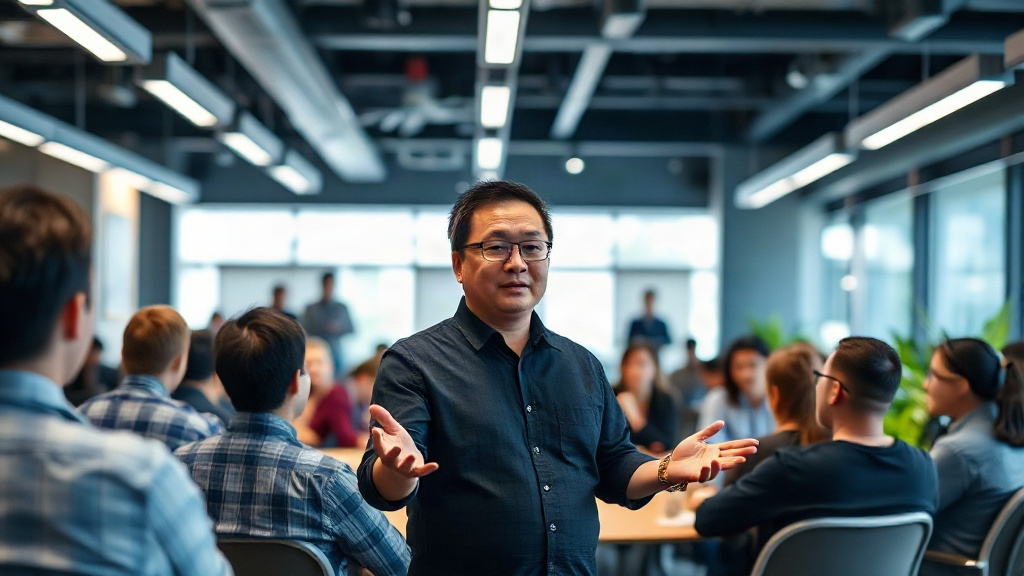
Advocating for Unfettered AI Advancement
Huang's core message, delivered with characteristic confidence, is that the world should "go as fast as we can, irrespective of anyone else." This statement signals a departure from the collaborative, safety-first approach often discussed in AI circles. Instead, it suggests a competitive imperative where speed and progress should take precedence, even if it means diverging from international consensus or regulatory pressures. He views AI development not as a potential Pandora's Box to be opened cautiously, but as a powerful engine for progress that should be accelerated.
This perspective is likely informed by Nvidia's central role in the current AI boom. The company's GPUs are the backbone of most AI training and inference, making Huang a key figure whose pronouncements carry significant weight. His advocacy for speed can be interpreted as a call for continued investment and innovation in the hardware and software that power AI, pushing the boundaries of what is currently possible.
The rejection of calls for new regulations further underscores Huang's belief in self-regulation and the inherent ability of the industry to manage its own trajectory. He appears to trust the iterative process of development and deployment, coupled with ongoing safety research, to naturally address potential issues. This is akin to a seasoned engineer trusting the built-in safety features of a complex machine, rather than demanding the machine be fundamentally re-engineered before it is fully utilized.
Dismissal of 'Doom Warnings'
Huang explicitly dismissed the "doom warnings" originating from organizations like Anthropic, which have been prominent in advocating for stricter AI safety measures and even temporary pauses in development to address alignment issues. These warnings often cite the potential for superintelligent AI to act in ways detrimental to human values and survival, even if not explicitly programmed to do so. The theory is that an AI optimizing for a seemingly benign goal could have catastrophic unintended consequences.
By labeling these as "doom warnings," Huang reframes them as speculative anxieties rather than concrete, near-term threats. He implies that these concerns, while perhaps valid in a distant theoretical future, are not relevant to the current development landscape or the immediate future. This is a powerful rhetorical move that seeks to re-center the conversation on the immediate benefits and opportunities AI presents, rather than its potential pitfalls.
His argument suggests that focusing too heavily on worst-case scenarios can stifle innovation and prevent the realization of AI's positive applications in fields like medicine, climate science, and education. For Huang, the tangible benefits of accelerating AI development far outweigh the hypothetical risks of existential catastrophe within the next six years. This is a pragmatic, albeit controversial, viewpoint that prioritizes tangible progress over speculative caution.
The Path Forward: Speed and Innovation
Huang's message resonates with a particular segment of the tech industry that views AI as the next great technological frontier, akin to the internet or mobile computing. The emphasis on speed is not just about market competition but also about unlocking AI's potential to solve pressing global challenges. The argument is that delaying AI development, even for safety reasons, could mean delaying solutions to critical problems.
If you are a founder or developer in the AI space, Huang's words are a clear signal to push ahead. The implicit message is that the market rewards rapid innovation and that regulatory hurdles, while they may arise, should not be seen as insurmountable barriers to progress. This encourages a mindset of building, iterating, and deploying quickly, with the expectation that safety and alignment can be addressed iteratively.
The debate between rapid advancement and cautious regulation is far from settled. However, Jensen Huang's strong stance at the World AI Cannes Festival injects a potent dose of pro-innovation sentiment into the discussion, directly challenging the narrative of imminent AI-driven existential risk and advocating for an accelerated path forward, irrespective of external pressures.