
The Core of JavaScript Functions: Lexical Scope
At its heart, JavaScript closure is a fundamental concept tied directly to how functions handle scope. Every JavaScript function, when created, remembers the environment in which it was defined. This environment, known as the lexical scope, includes all variables and functions accessible at that point of definition. This isn't dynamic; it's baked in when the code is written, not when it's executed. This is Lexical Scope versus Dynamic Scope. Most modern languages, including JavaScript, rely on lexical scope. This means that when you look for a variable, JavaScript searches outwards from the current block, then the current function, then its parent function, and so on, all the way up to the global scope, based on where the function was physically written in your code. It doesn't matter where the function is called from; it always remembers its origin.
Think of it like this: imagine you write a letter and seal it in an envelope. You then give that letter to a friend. Even if your friend takes that letter to the other side of the world, the contents of the letter (the variables) and the context in which you wrote it (the scope) remain the same. The letter doesn't change based on where your friend is when they open it. Similarly, a JavaScript function, when passed around or called later, still has access to the variables that were available when it was initially defined.
Execution Contexts and Nested Functions
To truly grasp closure, understanding JavaScript's execution contexts is key. When code runs, JavaScript creates an execution context. For functions, each call creates a new, distinct context. This context contains information about the function's `this` binding, scope chain, and variables. The scope chain is crucial here: it's a list of variable environments that the JavaScript engine traverses to find a variable. It starts with the current function's scope and moves up through its parent scopes.
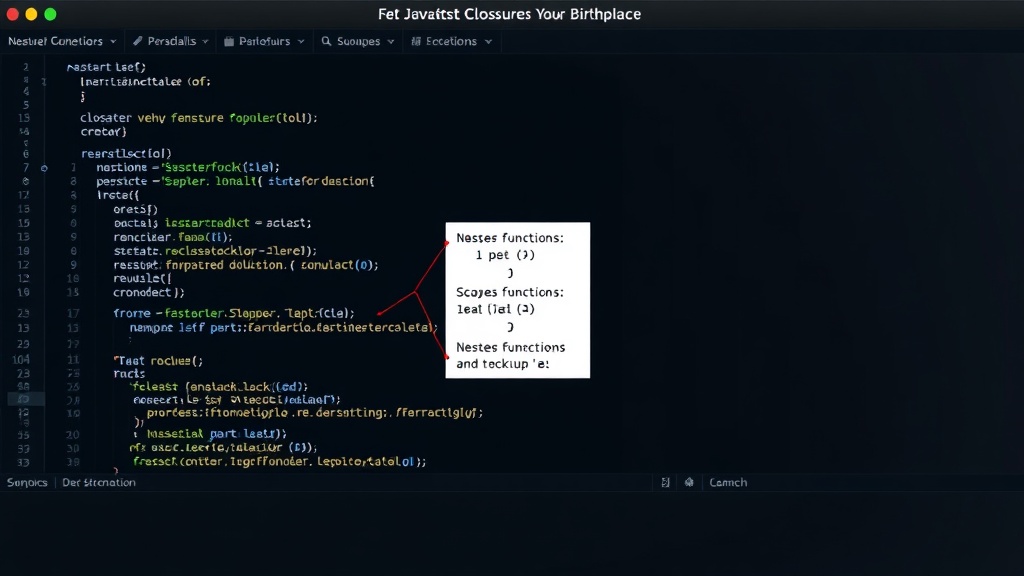
Nested functions are where closures really shine. When a function is defined inside another function, the inner function has access to the outer function's variables. This access persists even after the outer function has finished executing. This is the essence of closure: the inner function 'closes over' the outer function's scope, retaining a reference to it. This reference allows the inner function to access and manipulate variables that would otherwise be out of scope.
Practical Applications of Closure
Closures aren't just theoretical; they enable powerful programming patterns. One common use is data encapsulation. By using closures, you can create private variables that are only accessible through specific methods exposed by the outer function. This is similar to private members in object-oriented languages, but achieved through function scope.
Consider a counter function. An outer function initializes a `count` variable. It then returns an inner function that increments and returns this `count`. Each time the inner function is called, it accesses and modifies the same `count` variable from the outer function's scope, even though the outer function has already completed its execution. This `count` variable is effectively private to the returned inner function.
Another application is in creating function factories or currying. A function factory can generate specialized functions based on parameters passed to the outer function. Currying involves transforming a function that takes multiple arguments into a sequence of functions, each taking a single argument. Both rely on closures to maintain state across function calls.
When to Use and When Not To
While closures are powerful, they can also lead to unexpected memory usage if not managed carefully. Because a closure holds a reference to its outer scope, the memory associated with that scope is not garbage collected as long as the closure exists. If you create many closures that hold large scopes, or if closures live longer than necessary, you can inadvertently consume significant memory.
The key is to understand when closure provides a clear benefit. If you need to maintain state between function calls, encapsulate data, or create function factories, closures are an excellent tool. However, if a simpler approach, like passing data directly or using object properties, suffices, it's often better to avoid unnecessary closure complexity. The decision hinges on whether the persistent access to the outer scope is a core requirement for your logic.
The Surprising Persistence of Variables
What's truly remarkable about closures is that they allow variables to persist their values across multiple invocations of a function, and even across the lifetime of the program if the closure itself is long-lived. This persistence is not a bug; it's a core feature of JavaScript's design. It means that a function isn't just a block of code that runs and forgets; it's a self-contained unit that carries its history with it. This can be counterintuitive for developers coming from languages where function scope is strictly limited to the function's execution lifetime. The ability for an inner function to 'remember' and operate on variables from its parent scope, long after the parent has returned, is a powerful, albeit sometimes subtle, aspect of JavaScript programming.
If you're a developer building complex applications in JavaScript, understanding closures is not optional. It's the bedrock upon which many advanced patterns are built, from asynchronous programming callbacks to module patterns. Mastering them means writing more robust, efficient, and maintainable code. It allows you to leverage JavaScript's full potential, moving beyond simple scripting to sophisticated application development.