Local AI Agents for Regulated Industries
Building sophisticated AI agents often conjures images of cloud-based services, data privacy concerns, and complex integrations. For developers in regulated industries such as insurance, banking, or healthcare, these concerns are amplified. Data must remain within network boundaries, and proprietary logic needs to be tightly controlled. This is precisely the challenge addressed by the combination of Tools4AI and Ollama.
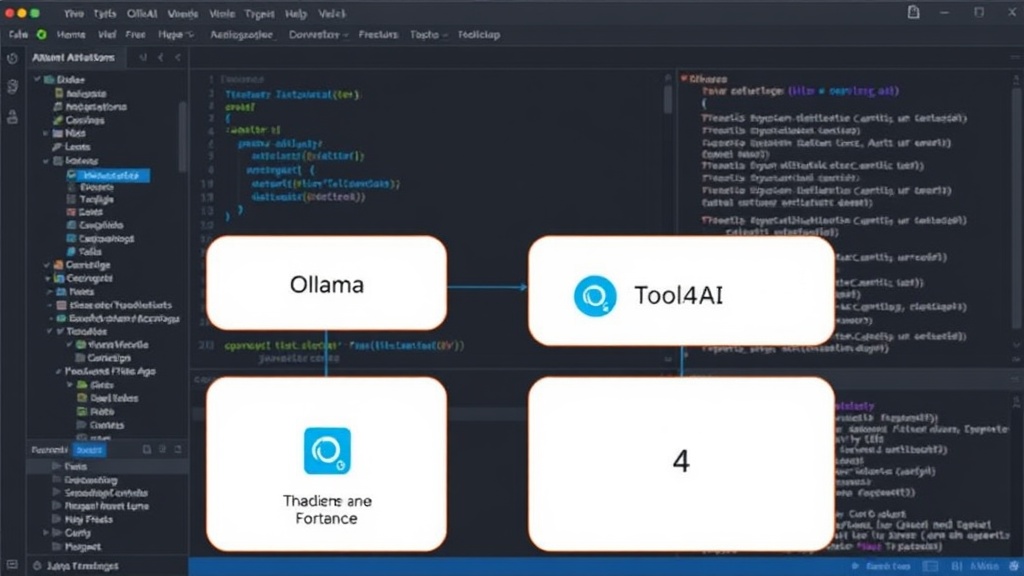
Tools4AI, a 100% Java agentic AI framework, transforms any annotated Java method into an AI-callable action. This means existing Java code, business logic, and data access layers can be directly leveraged by AI agents. Coupled with Ollama, which allows open-source large language models (LLMs) like Llama 3.1 and Phi-4 to run locally, developers can create powerful, on-premise AI agents. By pointing Tools4AI to Ollama's local OpenAI-compatible API endpoint (typically http://localhost:11434/v1), the entire AI agent runs offline, ensuring no sensitive data ever leaves the organization's network.
An Insurance Claims Triage Use Case
The tutorial demonstrates a practical application: an insurance claims triage agent. This agent is designed to automate key steps in processing incoming claims, significantly reducing manual effort and improving response times. The process begins with a claimant's free-text incident report. The AI agent, powered by Tools4AI and Ollama, analyzes this unstructured text.
The first critical function of the agent is to route the claim to the correct business action. This could involve directing a property damage claim to the property adjusters team, a bodily injury claim to the liability team, or a simple first-party claim to a faster processing workflow. This routing is achieved by interpreting the intent and keywords within the claimant's report.
Beyond routing, the agent is tasked with extracting structured data from the free-text report. This includes details such as claimant name, policy number, date of incident, description of damage, and estimated cost. This structured data is essential for populating internal systems, databases, and downstream processing workflows, turning unstructured narrative into actionable information.
Gating Payouts and Ensuring Compliance
A significant aspect of the insurance claims process is managing payouts, especially for high-value claims. To prevent fraud and ensure financial prudence, the agent implements a gating mechanism. Claims exceeding a certain predefined threshold value, or those flagged with suspicious keywords, are automatically routed for human review and approval. This ensures that significant financial decisions are not made solely by the AI, maintaining a crucial human oversight layer for critical business processes.
Furthermore, in regulated industries, maintaining an audit trail is non-negotiable. The agent records a comprehensive compliance audit trail for every claim processed. This includes the original claimant report, the AI's interpretation and actions, any data extracted, the decision to gate or approve, and the identity of the human approver if applicable. This detailed log is vital for regulatory compliance, internal audits, and dispute resolution.
The Power of Local, Agentic AI
The combination of Tools4AI and Ollama offers a compelling solution for organizations that need AI capabilities but are constrained by data privacy, security, or regulatory requirements. Running LLMs locally means that sensitive claimant data never needs to be sent to third-party cloud providers. This significantly reduces the risk of data breaches and ensures compliance with regulations like GDPR, HIPAA, or CCPA.
For Java developers, Tools4AI lowers the barrier to entry for building AI-powered applications. They can leverage their existing programming language, skills, and codebase. This is not about replacing developers; it's about augmenting their capabilities. Developers can annotate existing methods, define agentic behaviors, and integrate AI into their applications without needing to become AI/ML experts or manage complex cloud infrastructure.
The flexibility of Tools4AI allows for the creation of various agent types. Beyond claims triage, similar agents could be built for customer support chatbots that access internal knowledge bases, risk assessment tools that analyze financial documents, or compliance monitoring systems that scan internal communications. The core principle remains: turning existing Java business logic into AI-callable functions, orchestrated by an agent framework, and powered by a local LLM.
Future Directions and Considerations
While this use case focuses on insurance claims, the underlying technology has broader implications. The ability to build and deploy fully offline, on-premise AI agents in Java opens doors for innovation in numerous sectors. However, several considerations remain. The performance of local LLMs, even powerful ones like Llama 3.1, can be resource-intensive and may not match the raw inference speed of highly optimized cloud-based models for certain tasks. Model quantization and hardware acceleration will be key factors in optimizing local performance.
Furthermore, the effectiveness of the agent hinges on the quality of the LLM and the precision of the Java method annotations. Fine-tuning models for specific domain language and ensuring clear, unambiguous method signatures are crucial for accurate agent behavior. The development of robust error handling and fallback mechanisms for AI failures will also be critical for production deployments.
What remains to be seen is how quickly other established enterprise software vendors will embrace similar on-premise, Java-centric approaches. Many are still focused on cloud-first strategies, potentially leaving a gap for solutions like Tools4AI to capture market share in organizations prioritizing data sovereignty and existing Java investments.