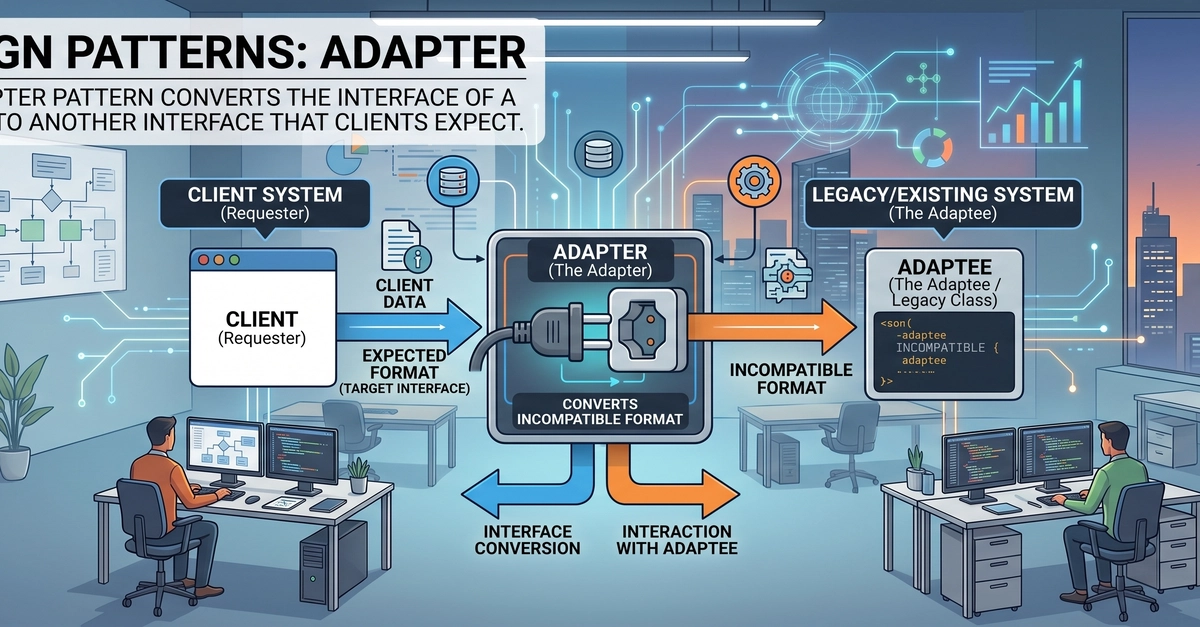
The Core Problem: Incompatible Interfaces
In enterprise Java development, integrating systems is a constant challenge. Modern applications often need to communicate with older, legacy components, third-party SDKs with fixed interfaces, or external services whose contracts cannot be altered. This incompatibility arises from differing method signatures, data formats, or communication protocols. Without a solution, these systems remain isolated, hindering progress and forcing costly rewrites.
The Adapter Pattern, a member of the Structural Design Patterns, directly addresses this problem. Its fundamental purpose, as defined by the Gang of Four (GoF), is to: "Convert the interface of a class into another interface clients expect. Adapter lets classes work together that couldn't otherwise because of incompatible interfaces."
Think of it like a universal travel adapter. You have a device with a specific plug (your legacy system or component), and you need to connect it to a power outlet in a foreign country with a different socket type (your modern architecture or client). The travel adapter translates the plug type, allowing seamless power transfer without modifying the device or the outlet itself. The Adapter pattern in Java functions similarly, translating one interface into another that the client code expects.
Understanding the Adapter Pattern: Structure and Types
The Adapter pattern typically involves three key players:
- Target Interface: This is the interface that the client code expects and uses.
- Adaptee: This is the existing class or component with an incompatible interface that needs to be adapted.
- Adapter: This is the class that implements the Target Interface and holds an instance of the Adaptee. It translates calls from the Target Interface to the Adaptee's methods.
There are two primary ways to implement the Adapter pattern:
1. Object Adapter (Composition)
This is the most common and generally preferred approach. The Adapter class holds a reference to an instance of the Adaptee class. When a method is called on the Adapter, it delegates the call to the Adaptee, performing any necessary translations or data transformations along the way.
Example Scenario: Imagine a legacy system that logs messages using a `LegacyLogger` class with a `logMessage(String message)` method. A new modern application uses a `Logger` interface with a `log(Level level, String message)` method. An Object Adapter would implement the `Logger` interface and internally hold an instance of `LegacyLogger`. When `log(Level.INFO, "User logged in")` is called on the adapter, it would translate this into a call to `legacyLogger.logMessage("INFO: User logged in")`.

2. Class Adapter (Inheritance)
This approach uses multiple inheritance (or single inheritance with interfaces in Java) to achieve the adaptation. The Adapter class inherits from both the Adaptee class and implements the Target Interface. This means the Adapter is both a type of Adaptee and conforms to the client's expected interface.
Example Scenario: If `LegacyLogger` were a concrete class (not an interface) and Java allowed multiple class inheritance, the Adapter could extend `LegacyLogger` and implement the `Logger` interface. This approach is less flexible and more tightly coupled than the Object Adapter, as it ties the Adapter to a specific implementation of the Adaptee.
In Java, since multiple class inheritance is not supported, the Class Adapter is typically implemented by extending a concrete Adaptee class and implementing the Target Interface. This still leads to tighter coupling than the Object Adapter.
When to Use the Adapter Pattern
The Adapter pattern is invaluable in several common enterprise Java scenarios:
- Integrating Legacy Code: When you have existing, well-tested legacy components that you cannot or do not want to refactor, but need to expose to new systems with modern interfaces.
- Using Third-Party Libraries: When you incorporate external libraries or SDKs that have fixed interfaces you cannot change, and you need to present them to your application as if they were built using your own internal design patterns.
- Enabling Reusability: When you want to create a reusable component that can work with various unrelated classes without being dependent on their specific implementations.
- Refactoring Existing Systems: As part of a larger refactoring effort, the Adapter pattern can be used to gradually introduce new interfaces while maintaining compatibility with existing clients.
Benefits of Using the Adapter Pattern
Employing the Adapter pattern offers several advantages:
- Decoupling: It separates the client code from the specific implementation of the Adaptee, reducing dependencies. The client code only interacts with the Target Interface.
- Flexibility: It allows you to introduce new Adapters for different Adaptees without affecting the client code, provided they all adhere to the same Target Interface.
- Reusability: Existing classes (Adaptees) can be reused in new contexts without modification.
- Maintainability: Changes to the Adaptee's internal implementation do not necessarily impact the client, as long as the translated interface remains consistent.
Potential Drawbacks
While powerful, the Adapter pattern is not without its considerations:
- Increased Complexity: Introducing an extra layer of abstraction can make the overall system design more complex to understand, especially for developers unfamiliar with the pattern.
- Performance Overhead: In performance-critical applications, the extra indirection and potential data transformations performed by the Adapter could introduce a minor performance overhead. This is usually negligible for most enterprise applications.
Bridging the Gap: Practical Java Implementation
Let's illustrate with a practical example. Suppose we have an old payment gateway service with a method to process payments:
// The Adaptee: Legacy Payment Gateway
class LegacyPaymentGateway {
    public void processLegacyPayment(String cardNumber, double amount, String expiryDate) {
        System.out.println("Processing legacy payment for card ending in " + cardNumber.substring(cardNumber.length() - 4) + ", amount: " + amount);
        // ... actual payment processing logic ...
    }
}
Our modern application expects a payment service with a different interface:
// The Target Interface: Modern Payment Service
interface PaymentService {
    void pay(String paymentId, double amount);
}
Now, we create an Adapter to bridge these two:
// The Adapter: Connects LegacyPaymentGateway to PaymentService
class LegacyPaymentAdapter implements PaymentService {
    private LegacyPaymentGateway legacyGateway;

    public LegacyPaymentAdapter(LegacyPaymentGateway legacyGateway) {
        this.legacyGateway = legacyGateway;
    }

    @Override
    public void pay(String paymentId, double amount) {
        // We need to extract card number and expiry date from paymentId, or have them passed differently.
        // For simplicity, let's assume paymentId contains enough info or we have a way to get it.
        // In a real scenario, this mapping would be more complex.
        String dummyCardNumber = "************1234"; // Placeholder
        String dummyExpiryDate = "12/25"; // Placeholder

        System.out.println("Adapter translating payment ID " + paymentId + " to legacy format.");
        legacyGateway.processLegacyPayment(dummyCardNumber, amount, dummyExpiryDate);
    }
}
Finally, we use the adapter in our modern application:
public class ModernApp {
    public static void main(String[] args) {
        LegacyPaymentGateway legacyGateway = new LegacyPaymentGateway();
        PaymentService paymentService = new LegacyPaymentAdapter(legacyGateway); // Using the adapter

        paymentService.pay("PAY-12345", 100.50);
    }
}
This setup allows the `ModernApp` to interact with the `LegacyPaymentGateway` through the familiar `PaymentService` interface, without needing to know or care about the legacy system's specific `processLegacyPayment` method signature.
Conclusion: A Vital Tool for System Integration
The Adapter pattern is a cornerstone for building robust, maintainable, and extensible Java applications. It elegantly solves the problem of integrating systems with incompatible interfaces, particularly between modern architectures and legacy components. By acting as a translator, it allows disparate parts of your software ecosystem to communicate effectively, preventing costly rewrites and enabling gradual modernization. Mastering this pattern equips developers with a powerful tool to manage complexity and ensure long-term system health.