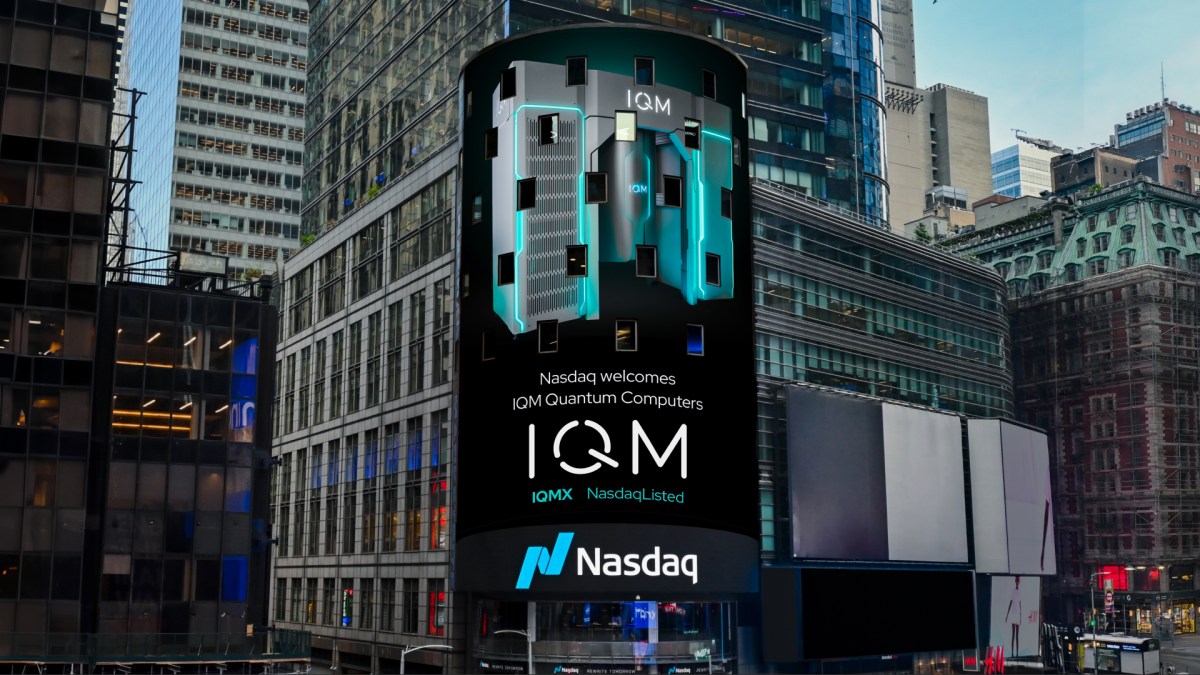
IQM's Nasdaq Debut Amidst Sector Volatility
IQM, the Finnish quantum computing firm, has achieved a significant milestone by becoming Europe's first publicly traded quantum company. The company debuted on the Nasdaq stock exchange today with a valuation hovering around $1.9 billion. This move positions IQM on a major global stage, offering it access to broader capital markets and increased visibility. The listing, under the ticker IQMX, marks a pivotal moment for the nascent quantum computing industry, signaling a potential pathway for other European deep-tech startups to follow.
However, the fanfare surrounding the IPO is tempered by a candid admission from the company itself: the future of quantum technology remains uncertain. This isn't a typical IPO narrative where the future is painted with broad strokes of inevitable success. Instead, IQM's leadership has openly acknowledged the inherent risks and the long road ahead for quantum computing to achieve widespread commercial viability. This forthrightness is a stark contrast to the often over-hyped narratives surrounding emerging technologies.
The company's valuation of $1.9 billion is substantial, reflecting investor confidence in the long-term potential of quantum computing. Yet, it also underscores the speculative nature of the current market for such advanced technologies. Investors are betting on IQM's ability to navigate the complex technical challenges and market adoption hurdles that lie ahead. The proceeds from the offering are expected to fuel further research and development, scale up manufacturing capabilities, and expand the company's global presence.
The Quantum Computing Landscape: Promise and Peril
Quantum computing promises to revolutionize fields ranging from drug discovery and materials science to financial modeling and artificial intelligence. By harnessing the principles of quantum mechanics, such as superposition and entanglement, quantum computers can perform calculations far beyond the reach of even the most powerful classical supercomputers. This potential has attracted significant investment and research efforts worldwide.
IQM, as a full-stack quantum company, develops quantum computers and offers tailored solutions for its clients. Their approach involves designing, building, and operating quantum computing hardware and software. The company's strategy focuses on delivering application-specific quantum solutions, aiming to provide tangible value to businesses sooner rather than later. This pragmatic approach is crucial in a field where fault-tolerant, universal quantum computers are still years, if not decades, away.
The uncertainty IQM acknowledges is multi-faceted. Firstly, the technology itself is still in its infancy. Building stable, scalable, and error-corrected qubits is an immense engineering challenge. Current quantum computers are noisy and prone to errors, limiting the complexity and duration of computations they can perform. Secondly, identifying killer applications that demonstrably outperform classical solutions is an ongoing process. While theoretical advantages are clear in certain domains, practical, cost-effective implementations are scarce.
Furthermore, the competitive landscape is intense. While IQM is a pioneer in Europe, it faces competition from established tech giants like IBM, Google, and Microsoft, as well as a growing number of well-funded startups globally. Each player is pursuing different technological approaches to building quantum computers, from superconducting qubits to trapped ions and photonic systems. The ultimate winner, or winners, of this technological race are yet to be determined.
IQM's Strategic Position and Future Outlook
IQM's decision to go public now, despite the admitted uncertainties, suggests a strategic imperative to secure substantial funding to accelerate its development roadmap. Being a public company provides greater financial flexibility and a platform to attract top talent. It also subjects the company to the scrutiny of public markets, demanding consistent progress and clear communication with investors.
The company's focus on application-specific quantum computers might be its key differentiator. Instead of aiming for a general-purpose quantum computer immediately, IQM is working on systems optimized for specific problems. This could lead to earlier commercial adoption and revenue generation. Think of it less like building a universal smartphone from day one, and more like developing specialized calculators for specific scientific disciplines first. This targeted approach could de-risk the path to market.
The success of IQM's IPO, and its subsequent performance, will be closely watched as a bellwether for the entire quantum computing sector. If IQM can successfully leverage its newfound capital to advance its technology and secure commercial contracts, it could embolden other quantum startups and attract further investment. Conversely, any stumbles could exacerbate existing investor caution.
What remains unaddressed is the long-term impact on the broader European tech ecosystem. Will IQM's public listing inspire a wave of similar deep-tech IPOs, or will it remain an outlier in a sector still heavily reliant on private funding and government grants? The path forward for quantum computing is undoubtedly challenging, but IQM's bold step onto the public market signifies a determined push to make that future a reality, even with its inherent uncertainties.