Flaw Exposes Sensitive Server Management Credentials
A critical vulnerability, rooted in a flaw dating back to IPMI 2.0, is allowing attackers to steal authentication hashes for Baseboard Management Controllers (BMCs). These BMCs provide out-of-band management capabilities for servers, meaning they can be controlled even when the main operating system is offline or unresponsive. This access is crucial for remote administration, diagnostics, and recovery, making its compromise a severe security risk.
The vulnerability, which leverages the IPMI 2.0 protocol over UDP port 623, permits an attacker to trigger a hash leak under specific conditions. Once obtained, these hashes can be subjected to offline cracking attempts, bypassing the need for direct network access to the target server and circumventing online brute-force protections. Initial reports indicate that over 24,000 internet-exposed BMCs are vulnerable, potentially impacting a wide range of hardware, including servers from Supermicro and HPE iLO 4 systems.
The original research that brought this to light is attributed to the Lava research group, with a notable connection to CVE-2013-4786, a previous vulnerability that may have laid the groundwork for this more recent discovery. The severity is rated as High, underscoring the urgency for affected organizations to take immediate action.
How the Authentication Hash Leak Works
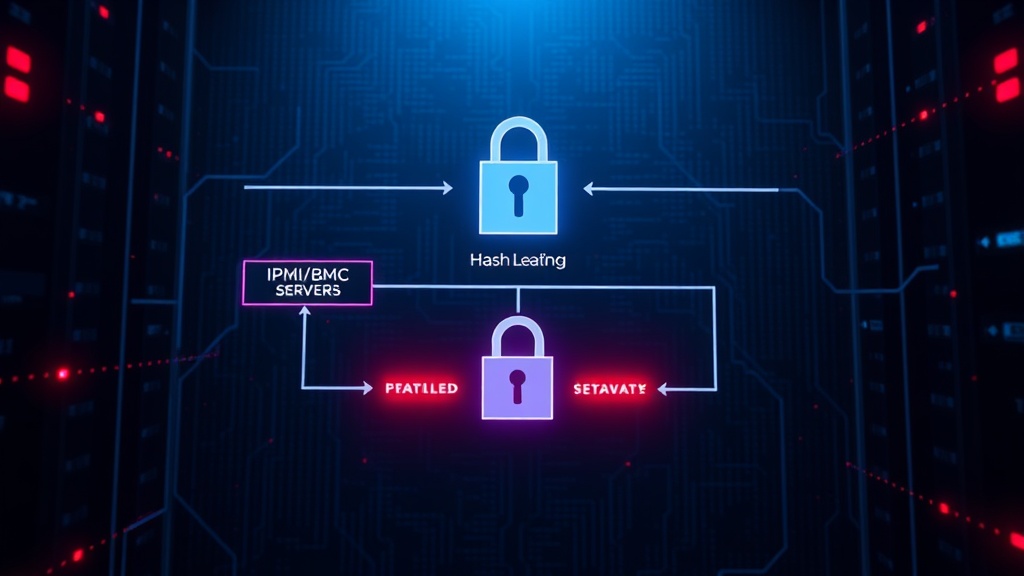
The core of the issue lies in how IPMI 2.0 handles authentication requests. While the exact technical trigger for the hash leak is not fully detailed in public reports, it is understood to involve a specific interaction with the BMC's authentication mechanism. Attackers can exploit this by sending specially crafted packets to the BMC's management interface, typically accessible via UDP port 623. This interaction can cause the BMC to inadvertently reveal the hashed password of a privileged user.
Unlike online attacks that require repeated attempts against a live system, potentially triggering intrusion detection or account lockout mechanisms, this method allows for offline analysis. Once an attacker possesses the hash, they can use powerful cracking tools on their own infrastructure. These tools employ techniques like dictionary attacks, brute-force methods, and precomputed rainbow tables to reverse the hash and recover the original password. The effectiveness of these cracking attempts depends on the complexity of the original password, but even strong passwords can eventually be compromised with sufficient computational resources.
The implications are significant. Compromising a BMC grants an attacker a level of control equivalent to physical access. They can power servers on or off, access console output, modify boot order, and potentially even re-flash firmware. For GPU and AI servers, which are often high-value targets due to their processing power and sensitive data, this vulnerability presents a direct path to unauthorized access and control.
Scope of the Vulnerability and Affected Systems
While the exact number of vulnerable devices fluctuates as systems are patched or secured, initial scans identified over 24,000 BMCs directly exposed to the internet. This number likely represents only a fraction of the total vulnerable devices, as many BMCs may be accessible within internal networks but still susceptible if an attacker gains a foothold. The vulnerability is not tied to a single vendor but affects implementations of the IPMI 2.0 standard, meaning a broad spectrum of server hardware could be impacted.
Supermicro and HPE iLO 4 are specifically mentioned as potentially affected systems. However, any server utilizing IPMI 2.0 for its BMC management is at risk. The long-standing nature of the underlying IPMI 2.0 flaw suggests that older, unpatched systems are particularly vulnerable. Furthermore, the widespread adoption of BMCs across enterprise data centers and cloud infrastructure means the attack surface is extensive.
The reliance on UDP port 623 for IPMI traffic means that network segmentation and firewall rules are critical defenses. However, misconfigurations or the presence of exposed management interfaces on the public internet render these systems vulnerable. The research highlights a concerning trend where critical infrastructure management tools, designed for convenience and remote access, become vectors for sophisticated attacks.
Mitigation and Remediation Strategies
Addressing this vulnerability requires a multi-pronged approach, focusing on reducing exposure and securing the BMC management interfaces. The most immediate and effective step is to ensure that BMC management interfaces, especially those using IPMI 2.0, are not directly exposed to the public internet. This involves rigorous network segmentation and firewalling, placing BMC management on isolated networks accessible only by authorized administrators.
For systems that must remain accessible remotely, strong, unique passwords for all BMC accounts are essential. These passwords should be complex, regularly rotated, and managed securely. Administrators should also consider disabling unnecessary IPMI services or protocols if they are not actively used. Regularly updating BMC firmware to the latest versions is crucial, as vendors may release patches to address specific IPMI 2.0 related security issues, though the underlying flaw may be inherent to the protocol standard itself.
Implementing robust monitoring for unusual BMC login attempts or network traffic on UDP port 623 can help detect potential exploitation. Security teams should also audit their systems for any known vulnerabilities, including CVE-2013-4786 and related issues, and prioritize remediation efforts for critical infrastructure. Given the potential for offline cracking, organizations must assume that any leaked hash is compromised and take steps to revoke and reset associated credentials immediately.