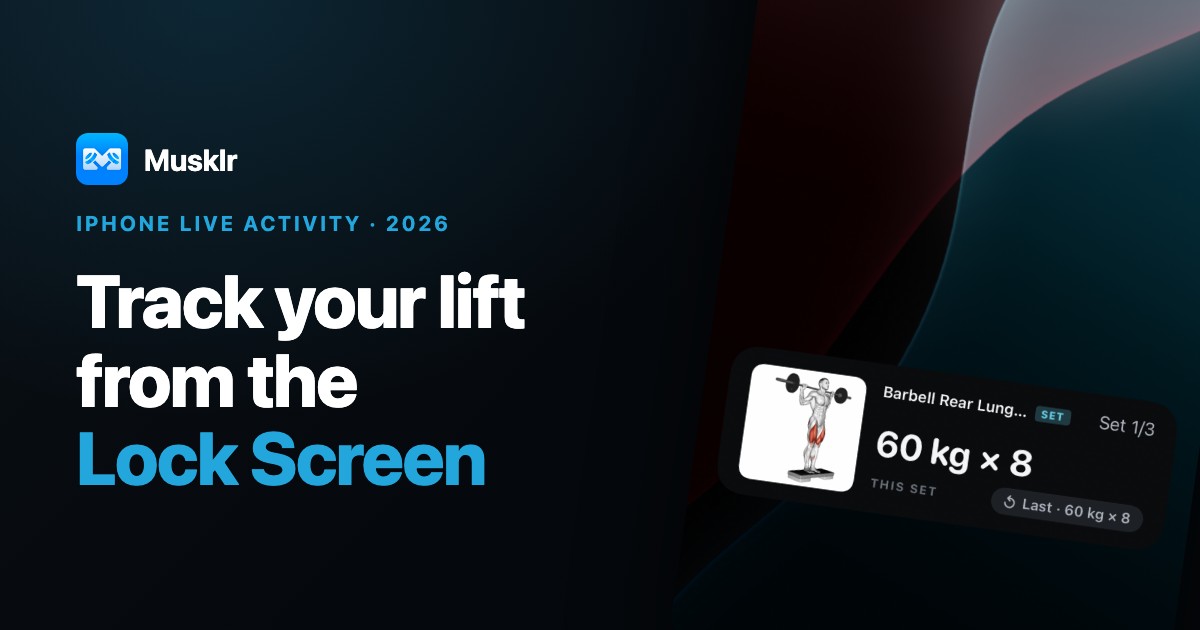
Real-Time Workout Metrics at a Glance
The iPhone's Live Activities feature, introduced with iOS 16.1, is now being leveraged by fitness apps to provide users with crucial workout data directly on their Lock Screen. Musklr, a dedicated workout tracking application, has announced its integration with Live Activities, allowing users to monitor their progress in real-time without needing to unlock their phone or interrupt their activity.
This development marks a significant step forward for mobile fitness tracking. Previously, users would have to manually open their app to check metrics like heart rate, elapsed time, distance covered, or calories burned. This often meant pausing a workout, fumbling with their phone, or simply guessing their current pace. Live Activities fundamentally changes this by making essential information persistently available. Think of it less like a traditional app notification and more like a miniature, dynamic dashboard that lives on your most accessible screen.
The implementation by Musklr focuses on providing the most critical data points for various workout types. Whether you're running, cycling, lifting weights, or engaging in any other form of exercise, the goal is to offer immediate feedback. This constant stream of information can be a powerful motivator, helping users stay within target heart rate zones, maintain a desired pace, or simply keep track of their session duration and intensity.
How Live Activities Enhance Workout Tracking
Live Activities are designed to update dynamically. This means that as your workout progresses, the information displayed on your Lock Screen will change accordingly. For example, if you're running, the elapsed time will tick up, your pace might adjust, and your heart rate will fluctuate in real-time. This continuous feedback loop is invaluable for performance-oriented athletes and casual fitness enthusiasts alike. It allows for more precise training adjustments on the fly.
Musklr's approach is to offer a streamlined experience. The app aims to detect the start and end of workouts automatically or through simple user input, triggering the Live Activity. Once active, the Lock Screen displays key performance indicators. The specific metrics shown can often be customized within the app, allowing users to prioritize what matters most to them. This personalization is key to making the feature truly useful.
The technical underpinnings of Live Activities involve a framework that allows applications to push brief, updatable information to the Lock Screen. This is distinct from standard push notifications, which are typically static and disappear after being viewed. Live Activities are persistent, appearing at the top of the Lock Screen and updating as new data becomes available. They also integrate with the Dynamic Island on newer iPhone models, offering an even more prominent display.
The Broader Impact on Fitness Apps
The integration of Live Activities by Musklr signals a potential trend in the fitness app market. As more developers explore this capability, users can expect a richer, more integrated experience with their iPhone. This could lead to a reduction in the need to constantly check a smartwatch or pull out a phone, streamlining the workout process.
For developers, Live Activities present an opportunity to deepen user engagement. By providing continuous, valuable information in a highly visible location, apps can become more indispensable. The challenge lies in balancing the desire to display data with the need for battery efficiency and a non-intrusive user experience. The system is designed to limit updates to avoid excessive battery drain, but developers must still be mindful of how frequently and how much data they push.
The success of this feature hinges on its utility and ease of use. If users find that checking their Lock Screen for workout data is genuinely faster and more convenient than other methods, adoption will likely be high. Musklr's early move positions them to capture a segment of the market looking for this specific enhancement. It also sets a precedent for other fitness apps to follow, pushing the boundaries of what's possible with mobile device integration.
What remains to be seen is how Apple will evolve Live Activities and if they will introduce further capabilities that fitness apps can leverage. Potential future enhancements could include more complex data visualizations, interactive elements on the Lock Screen, or deeper system-level integration with health sensors. For now, the focus is on delivering essential metrics efficiently, a goal Musklr appears to have met with its latest update.
Developer Considerations and Future Potential
Implementing Live Activities requires developers to manage a separate UI for the Lock Screen, distinct from the main app interface. This involves using the ActivityKit framework, which handles the lifecycle of Live Activities. Developers must define the data structure that will be displayed and ensure that updates are sent efficiently. The system itself manages the display and expiration of the activity. For Musklr, this means ensuring their backend infrastructure can reliably push these updates when a workout is active.
The long-term potential of Live Activities extends beyond simple workout tracking. Imagine real-time navigation updates during a run, progress checks for a remote task, or live scores for a sports event, all without opening an app. For fitness, this could evolve to include real-time form correction cues, pacing guidance based on historical data, or even integration with smart gym equipment to display machine metrics.
The integration of Musklr with Live Activities is a clear indicator of how iOS features are enabling new ways for users to interact with their devices and apps. It shifts the paradigm from an app-centric interaction model to a more ambient, glanceable information flow, directly addressing the user's need for immediate data without demanding full attention. This is likely just the beginning of how such features will reshape user expectations for mobile applications.