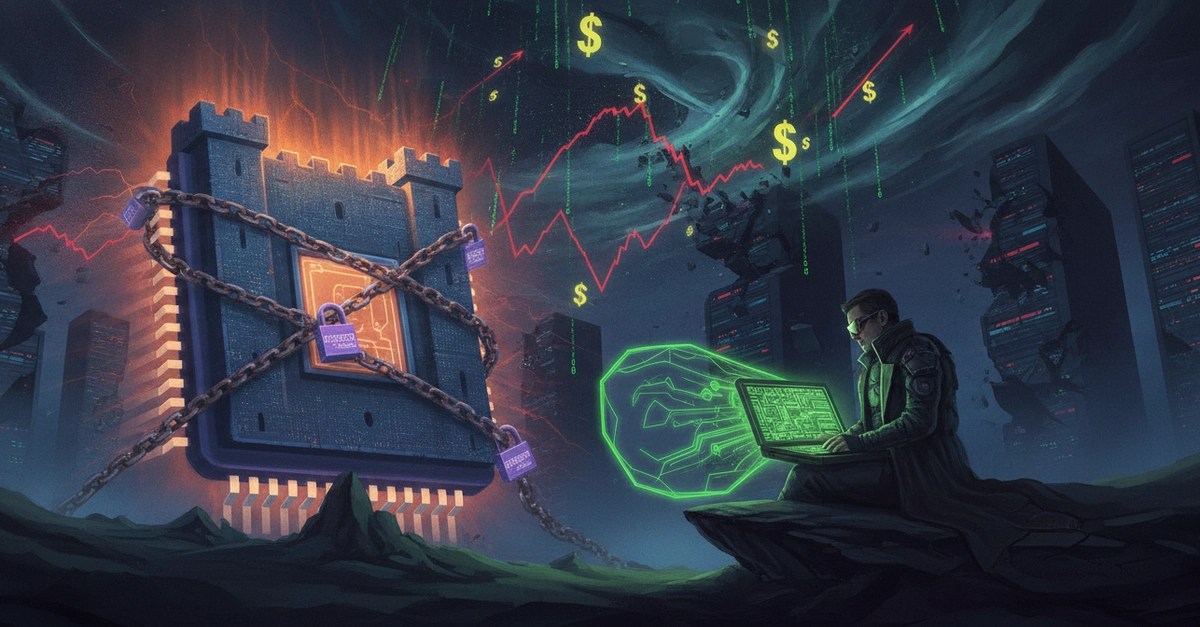
The Web's Self-Imposed Enclosure
The internet, once envisioned as a boundless commons, is increasingly becoming a walled garden. This enclosure is not accidental but a consequence of interlocking forces that shrink its perceived size and accessibility. At its core, the issue is that the web is no longer a free resource; it's fenced, mortgaged, and gated, demanding payment through hardware or subscriptions. This article examines three mutually reinforcing cycles: centralized search, the hardware aristocracy, and a $7 trillion financial bubble in AI. It posits that sovereign open-source infrastructure is the only entity that will not require a public bailout when the current fragile system inevitably collapses.
Search, SEO, and the Echo Chamber Effect
The search experience today is a shadow of its former self. Five dominant platforms—Google, Meta, Amazon, TikTok, and YouTube—now account for 90% of all traffic. These 'walled gardens' actively block their content from traditional search engines. Independent blogs, forums, and niche websites, once the vibrant fringe of the web, have either been absorbed by these giants or rendered invisible. The result is a web that feels smaller, not due to subjective perception, but due to its underlying architecture. Content has become cloned, with millions of pages optimized solely for search engine algorithms rather than user value. This homogenization means that genuine discovery is increasingly difficult, trapping users in predictable, algorithmically curated echo chambers.

The Hardware Aristocracy and the AI Bubble
A second, critical factor is the rise of a 'hardware aristocracy.' The advancements in AI, particularly large language models (LLMs), are incredibly computationally intensive. Training and running these models require specialized, expensive hardware—primarily high-end GPUs. This has created a bottleneck, concentrating power and profit in the hands of a few hardware manufacturers. Companies that can afford this infrastructure gain a significant advantage, not just in AI development but in controlling the very tools that define the next generation of digital services. This scarcity and cost create an artificial barrier to entry, akin to owning the only printing presses in an age of mass communication.
This hardware dependency fuels a massive financial bubble around AI. Venture capital has poured an estimated $7 trillion into AI companies, often based on speculative future earnings rather than demonstrated, sustainable business models. This influx of capital is largely directed towards companies that can leverage or produce this specialized hardware. The narrative is that AI will solve everything, justifying astronomical valuations. However, this is a house of cards built on expensive silicon and ambitious, often unproven, claims. When the market inevitably corrects, or when the cost of AI deployment becomes unsustainable, this bubble will burst, leaving many companies that relied on this unsustainable growth vulnerable.
Open Source: The Unbail-able Infrastructure
In the face of this centralization and speculative bubble, open source stands as the only viable resistance. Unlike proprietary systems that require constant investment, licensing fees, and are subject to the whims of corporate strategy, open-source software is built on principles of collaboration, transparency, and community. Sovereign open-source projects, those developed and governed by independent communities rather than corporate interests, offer a fundamentally different model. They are not beholden to venture capital or the need for immediate profit extraction.
Consider the difference: a proprietary AI model might require a costly subscription and is a black box. An open-source alternative, while potentially demanding more technical expertise to set up and manage, offers freedom. Developers can inspect the code, modify it, and deploy it on their own terms, using more accessible hardware or distributed computing. This resilience is key. When proprietary systems falter due to funding drying up, strategic pivots, or outright failure, open-source alternatives continue to function, maintained by their communities. They do not need a 'bailout' because their value is intrinsic to their utility and accessibility, not their market valuation or dependence on continuous, massive capital injections.
The Future of a Resilient Web
The current trajectory points towards a fragmented, expensive, and increasingly controlled internet. The convergence of search monopolies, the high cost of AI hardware, and speculative investment creates a precarious environment. The 'enclosure' of the web means less diversity of thought, less genuine discovery, and greater dependence on a few powerful gatekeepers. The AI bubble, fueled by the need for expensive hardware, further exacerbates this by creating an elite class of AI proprietors.
However, the open-source movement offers a path towards a more robust and equitable digital future. By prioritizing transparency, community governance, and accessibility, open-source projects provide the foundational infrastructure that can withstand market shocks and corporate failures. They represent a form of digital sovereignty, allowing individuals and organizations to build and operate online without being subject to the demands of a financially engineered ecosystem. As the current web model faces inevitable challenges, the value of truly open, community-driven infrastructure will become not just apparent, but essential.
What remains unaddressed is the systemic shift required to truly champion open source. While it offers resilience, widespread adoption still faces inertia, a perception of lower quality, and the sheer convenience of integrated proprietary solutions. The question is not *if* open source will be the fallback, but *how* we can accelerate its adoption to prevent the complete collapse of the open web before that fallback is desperately needed.