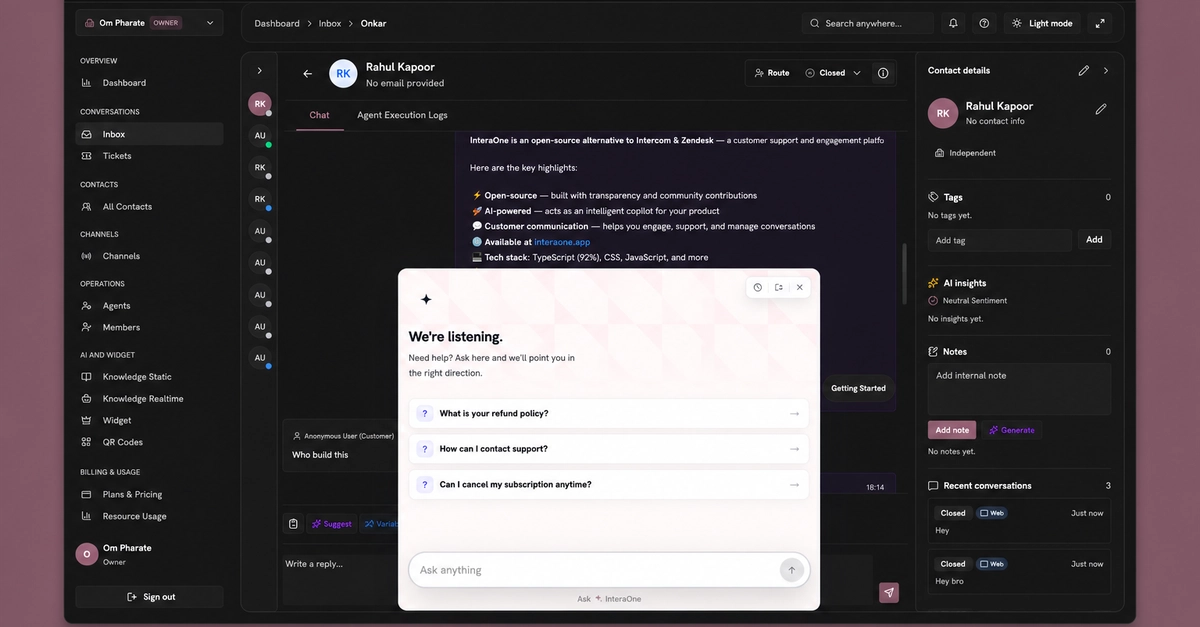
The Need for In-App AI Assistance
Modern SaaS applications increasingly require users to find help and information without leaving the product interface. The traditional approach involves embedding customer support widgets that connect to human support teams. However, the advent of large language models (LLMs) has opened up new possibilities. The core idea behind InteraOne is to imbue these support widgets with the capability to understand a product, answer user questions directly, and automate responses to repetitive support inquiries.
This concept has materialized into InteraOne, an open-source AI assistant designed for direct integration into web applications. Its primary objective is to furnish developers with an open-source framework for building AI-driven customer interactions within their own products. Instead of undertaking the complex task of developing an entire system from scratch—encompassing the chat UI, AI orchestration, knowledge retrieval mechanisms, conversation management, integrations, and underlying infrastructure—InteraOne seeks to provide a foundational layer.
What InteraOne Offers Developers
InteraOne is built to be embedded directly into a web application, acting as an intelligent layer that understands the product's context. This allows it to answer user questions and handle common support requests autonomously. The project aims to abstract away much of the complexity associated with building such a system, offering developers a pre-built infrastructure.
The core components of InteraOne include:
- Chat UI: A user-friendly interface for customer interactions.
- AI Orchestration: Manages the flow of information between the user, the AI model, and the knowledge base.
- Knowledge Retrieval: Connects to a product's documentation or knowledge base to fetch relevant information.
- Conversation Management: Tracks and maintains the context of user interactions.
- Integrations: Allows connection to other services or data sources.
- Infrastructure: Provides the underlying architecture to run the AI assistant.
By offering these components as an open-source solution, InteraOne empowers developers to customize and deploy AI-powered customer support tailored to their specific product needs. This approach democratizes access to advanced AI features that were previously the domain of larger companies with dedicated AI teams and resources.
The Open-Source Advantage
The decision to make InteraOne open-source is significant. It allows for community contributions, transparency, and extensive customization. Developers can inspect the code, modify it to fit unique requirements, and benefit from collective improvements. This contrasts sharply with proprietary solutions, where customization is often limited, and costs can escalate quickly.
The project aims to provide a robust alternative to commercial offerings like Intercom's AI assistant. While commercial solutions offer convenience and managed services, they often come with vendor lock-in and a lack of flexibility. InteraOne seeks to balance powerful AI capabilities with the freedom and control that open-source software provides.
The underlying motivation is to enable any developer, regardless of their company's size or budget, to implement sophisticated AI-driven customer support. This includes features like answering frequently asked questions, guiding users through product features, and even troubleshooting common issues. The goal is to reduce the burden on human support teams, allowing them to focus on more complex or sensitive customer interactions.
Technical Considerations and Future Development
Building an effective AI assistant involves several technical challenges. InteraOne must be capable of understanding natural language queries, retrieving accurate information from a defined knowledge base, and generating coherent and helpful responses. This requires a robust architecture that can handle the complexities of LLM integration, prompt engineering, and efficient data retrieval.
The project's success will depend on its ability to integrate seamlessly with various data sources and workflows. Developers will need to be able to easily feed their product documentation, FAQs, and other relevant information into the system. Furthermore, the AI's responses must be contextually relevant and aligned with the product's specific features and terminology.
As InteraOne evolves, its developers plan to expand its capabilities, potentially including more advanced conversational AI features, deeper integration with CRM systems, and enhanced analytics for understanding user interactions. The open-source nature of the project means that the community will play a crucial role in shaping its future direction and feature set.
The vision is to create a comprehensive, yet adaptable, AI assistant that can be a true extension of a product's support infrastructure. By providing the building blocks, InteraOne empowers developers to create bespoke AI experiences that enhance user satisfaction and operational efficiency.
What remains to be seen is how quickly the open-source community will adopt and contribute to InteraOne, and whether it can achieve feature parity and performance comparable to established commercial solutions within a reasonable timeframe. The path for open-source AI infrastructure is often challenging, but the demand for customizable, cost-effective solutions is undeniable.