The Architecture Diagram Problem: A Universal Pain Point
Anyone who has participated in system design discussions has likely experienced the frustration: a whiteboard session filled with hastily drawn boxes and lines, only for the diagram to become obsolete the moment the sprint begins. This disconnect between design and reality is a costly problem. Manual diagramming is inherently slow, collaboration becomes fragmented, and there's a distinct lack of real-time visibility into changes being made by teammates. Consequently, documentation inevitably lags behind the actual design, leaving stakeholders with an incomplete or misleading understanding of the system's architecture. This can lead to critical errors slipping through before deployment, a risk amplified when sensitive data is involved in the process, especially when relying on external AI services with potential latency issues.
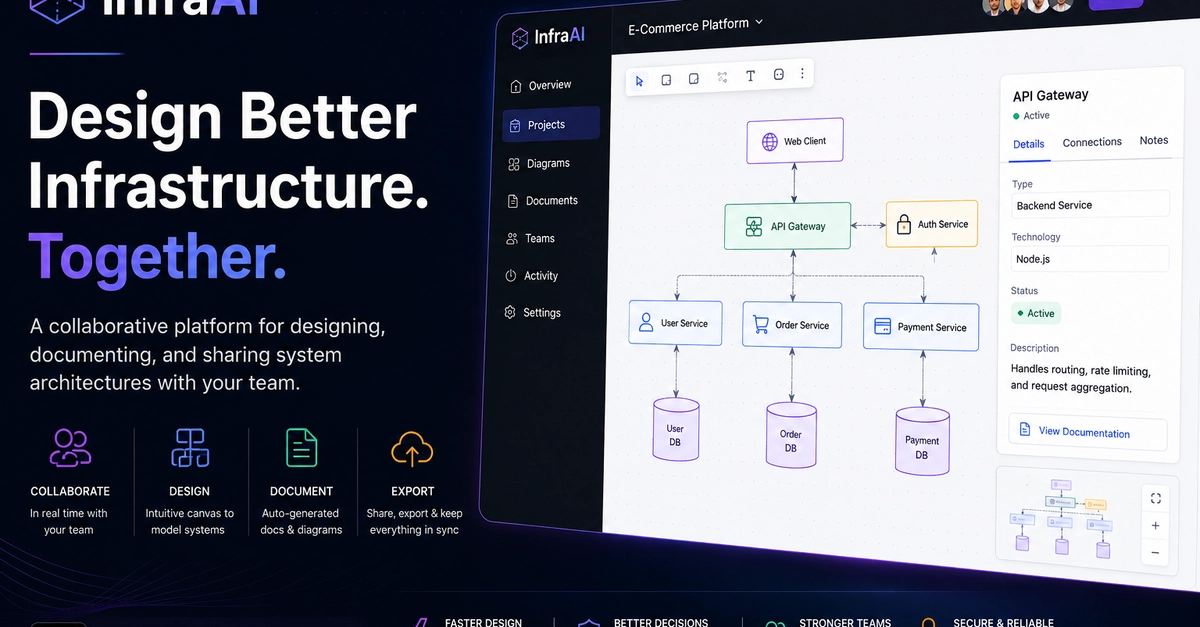
InfraAI positions itself as the solution to this pervasive challenge. It's a web-based platform designed to streamline the creation, management, and understanding of system architectures. At its core, InfraAI leverages AI to augment the human element, allowing developers and architects to describe systems in plain English and receive back editable, collaborative, and documented architecture diagrams.
Core Features and Technical Solutions
InfraAI tackles the identified problems through a series of targeted features and technical decisions. The platform's primary function is to translate natural language descriptions into visual architecture diagrams. This addresses the slowness of manual diagramming and the difficulty in keeping documentation current.
Collaboration is a key focus. InfraAI aims to provide a unified environment where multiple users can work on and view architecture diagrams simultaneously. This real-time, collaborative aspect combats the fragmentation that often occurs when design artifacts are scattered across different tools or communication channels. The platform is built to offer real-time visibility into teammates' changes, ensuring everyone is working with the most up-to-date representation of the architecture.
Documentation generation is automated. Instead of relying on manual updates that often fall behind, InfraAI generates documentation directly from the architectural model. This ensures that the documentation is always in sync with the diagram, providing a single source of truth. This feature is particularly valuable for making complex architectures understandable to a wider range of stakeholders, including those who may not be deeply technical.
Security and performance are also critical considerations. InfraAI acknowledges the risks associated with sensitive data and third-party AI services. To mitigate this, the platform is designed with a focus on ensuring that sensitive data is handled securely. Furthermore, the architecture of InfraAI itself is optimized to minimize AI latency, preventing it from becoming a bottleneck in the application development workflow. The platform is built to be responsive, ensuring that the AI augmentation enhances, rather than hinders, the design process.
The InfraAI Approach to AI Augmentation
The integration of AI into the architecture design process is not merely a feature but the foundational element of InfraAI. The platform uses AI to interpret natural language prompts, effectively converting human intent into structured architectural components. This is akin to having a diligent junior architect who can rapidly translate your high-level ideas into a visual blueprint, but with the added benefit of immediate documentation and collaborative features.
The platform’s design philosophy prioritizes developer experience. By abstracting away some of the more tedious aspects of diagramming and documentation, InfraAI frees up developers and architects to focus on higher-level design decisions and problem-solving. The ability to edit the generated diagrams means that the AI acts as a powerful starting point, not a rigid constraint. Users can refine the AI-generated output, ensuring that the final architecture accurately reflects the specific needs and nuances of their system.
The emphasis on a web-based platform ensures accessibility and ease of use. Without the need for complex installations or specialized software, teams can adopt InfraAI quickly. The collaborative nature extends beyond simple co-editing; it implies a shared understanding and a centralized repository for architectural knowledge. This is a significant departure from traditional methods where diagrams might live on individual machines or in disparate document repositories.
Addressing the Wider Ecosystem
InfraAI's ambition extends beyond just generating diagrams. By providing a clear, documented, and collaborative view of system architecture, it aims to improve the entire software development lifecycle. Reduced errors before deployment, better stakeholder communication, and faster onboarding for new team members are all direct consequences of a well-maintained and understood architecture.
The platform's success hinges on its ability to reliably interpret diverse system descriptions and generate accurate, useful diagrams. The challenge lies in the inherent ambiguity of natural language and the vast complexity of modern software architectures. InfraAI's ongoing development will likely focus on refining its AI models to handle a wider range of architectural patterns, technologies, and implicit requirements.
For organizations struggling with architectural drift and documentation debt, InfraAI presents a compelling proposition. It directly addresses the friction points that have plagued system design for years, offering a modern, AI-augmented approach to a fundamental aspect of software engineering. The ability to have architecture diagrams that are not only accurate but also living documents, constantly updated and easily understood, could fundamentally change how teams approach system design and maintenance.