
The Challenge of Static LLMs
Traditional Large Language Models (LLMs) are trained on massive, static datasets. Once training concludes, their knowledge base is fixed. Adapting these models to new information or evolving trends requires a complete, computationally expensive retraining process, which can take weeks or months. This inherent lag means that even state-of-the-art models can quickly become outdated, failing to reflect the most current events, discoveries, or linguistic shifts. The cost and time involved in retraining also limit the ability of organizations to quickly fine-tune models for rapidly changing domains or to respond to immediate feedback.
This static nature presents a significant bottleneck for applications demanding real-time knowledge and adaptability. Imagine a financial news aggregator that can't process breaking market news until its LLM is retrained, or a customer support bot that struggles with new product features announced yesterday. The gap between the model's knowledge cutoff and the live world widens daily, diminishing its utility and accuracy.
Introducing Infinite-Parameter LLMs
A new research paper, titled "Infinite-Parameter LLMs: Generating and Adapting Weights from Live Data," introduces a conceptual framework and preliminary architecture designed to overcome this limitation. The core innovation lies in decoupling the model's parameter generation and adaptation process from the static training phase. Instead of a fixed set of parameters, this approach envisions a model whose parameters can be dynamically generated and modified in response to continuous streams of live data.
The proposed system operates on a principle where the model doesn't just ingest data for inference; it uses that data to actively sculpt its own internal weights. This is achieved through a meta-learning process, where the model learns how to learn from new data. Think of it less like a textbook that's printed once and more like a highly adaptive student who constantly updates their understanding by reading the news and engaging in real-time discussions.
Mechanism of Live Weight Adaptation
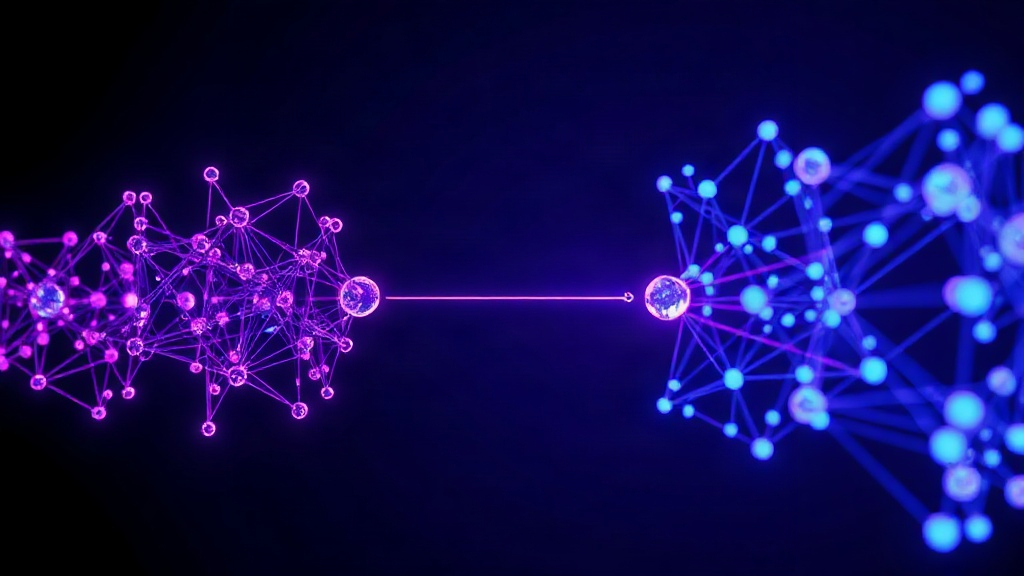
The paper outlines a multi-component architecture. At its heart is a parameter generator, which, instead of being fixed, is itself a trainable neural network. This generator takes incoming live data (e.g., news feeds, social media streams, sensor data) as input and produces a set of model weights tailored to that data. These generated weights are then integrated with the model's existing parameters.
Crucially, this integration is not a simple overwrite. The system employs a sophisticated adaptation mechanism that ensures stability and prevents catastrophic forgetting – a phenomenon where a model trained on new data loses its ability to recall previously learned information. This mechanism might involve techniques like parameter isolation, selective updates, or regularization strategies that preserve core knowledge while incorporating new information. The goal is to achieve a continuous, online adaptation that keeps the model's knowledge base current without requiring full retraining.
Potential Applications and Implications
The implications of such an architecture are profound. For developers, it means the possibility of deploying LLMs that remain relevant and accurate over time, reducing maintenance overhead and enabling more sophisticated real-time applications. Imagine personalized learning platforms that adapt to a student's current understanding, or predictive maintenance systems that incorporate the latest sensor readings and failure patterns instantly.
For researchers, it opens up new avenues for studying model plasticity and continuous learning. The ability to observe how models adapt their weights in real-time could provide invaluable insights into the learning process itself. It also poses new challenges in terms of model interpretability and control: how do you ensure a dynamically evolving model remains aligned with desired objectives and ethical guidelines?
The concept of "infinite parameters" doesn't necessarily mean an unbounded number of parameters in the traditional sense. Instead, it refers to the model's capacity to *generate* and *utilize* a potentially vast and ever-changing set of effective parameters derived from live data, effectively having an infinite capacity to learn and adapt.
Challenges and Future Directions
While the concept is compelling, significant challenges remain. The computational overhead of continuously generating and adapting weights, even if less than full retraining, needs to be managed. Ensuring the stability and reliability of such a dynamic system is paramount. Furthermore, the evaluation of these models presents a new paradigm; traditional static benchmarks may not suffice, requiring the development of dynamic, real-time evaluation methodologies.
The research is still in its early stages, with the paper presenting a theoretical framework and initial experimental designs. The practical implementation and scaling of such systems will require substantial engineering effort and further theoretical advancements. However, the promise of LLMs that can truly learn and adapt in real-time, much like humans do, marks a significant potential leap forward in artificial intelligence.
The Unanswered Question of Control
What nobody has addressed yet is the governance and control of these continuously adapting LLMs. If a model's weights are dynamically changing based on live data, how do we prevent it from drifting into undesirable behaviors or generating harmful content based on biased or malicious live inputs? Establishing robust guardrails and human oversight mechanisms for such fluid systems will be a critical hurdle to their widespread adoption.