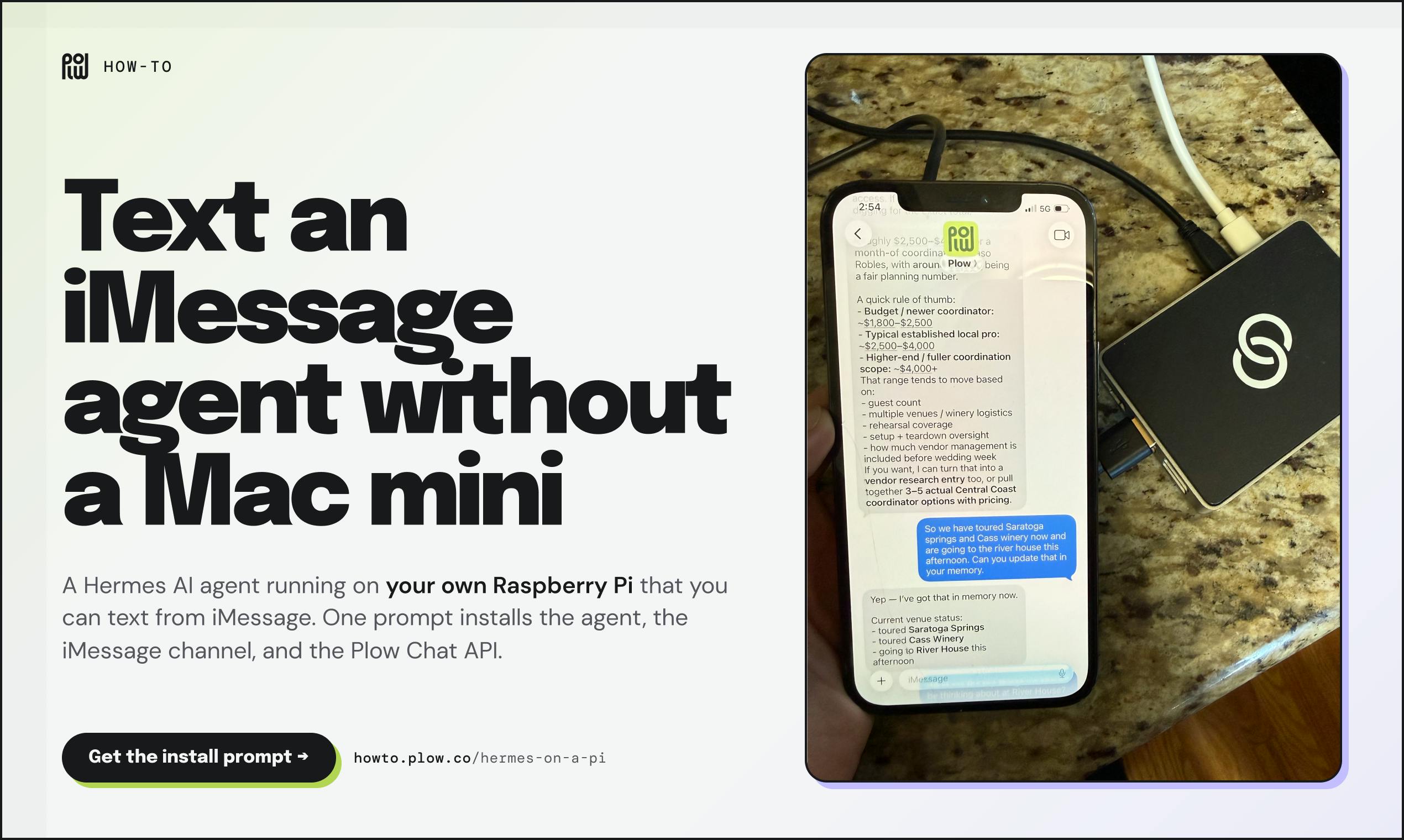
The Concept: iMessage Hermes
iMessage Hermes represents a novel approach to personal AI agents. Instead of relying on cloud-based services or dedicated hardware, it aims to reside on a low-power, always-on device within your home: a Raspberry Pi. The core idea is to leverage the ubiquity of messaging platforms, specifically iMessage, as the primary interface for interaction. This turns your existing messaging app into a portal for a local, intelligent assistant.
The agent functions as an AI that lives within your messages. This means you can interact with it by sending it text prompts, just as you would a contact. In return, Hermes processes these prompts and sends back responses, creating a conversational interface for its capabilities. This design choice is significant because it bypasses the need for dedicated mobile apps or complex setup procedures, making the AI accessible through a familiar and widely used communication channel.
The choice of a Raspberry Pi as the host hardware is strategic. These single-board computers are known for their low power consumption, affordability, and flexibility, making them ideal for continuous operation without a substantial energy footprint or cost. This allows Hermes to be an 'always-on' presence in the home, ready to respond to queries or perform tasks at any time without requiring users to boot up a desktop or engage a power-hungry server.
Leveraging iMessage for Interaction
The integration with iMessage is central to Hermes's functionality. Apple's messaging service, known for its end-to-end encryption and wide adoption among Apple users, provides a secure and convenient platform for communication. By operating within iMessage, Hermes taps into an existing ecosystem, meaning users can communicate with their AI agent from their iPhones, iPads, or Macs without needing to install additional software. This lowers the barrier to entry considerably.
The interaction model is straightforward: users send messages to Hermes as they would to any other contact. The Raspberry Pi, running the Hermes software, intercepts these messages. An underlying AI model then interprets the user's intent and formulates a response. This response is then sent back to the user via iMessage. This continuous loop of input, processing, and output creates a dynamic and interactive experience. The AI's ability to maintain context across a conversation is crucial for its utility, allowing for follow-up questions and more complex command sequences.
This approach differentiates Hermes from many other AI agents that rely on voice commands through smart speakers or dedicated mobile applications. While voice interfaces offer hands-free convenience, they can be limited by ambient noise, privacy concerns, and the need for specific wake words. App-based agents, on the other hand, require users to actively open and navigate an application. Hermes's text-based iMessage interface offers a discreet, asynchronous, and universally accessible method of interaction.
Technical Considerations and Potential
Running a sophisticated AI agent on a Raspberry Pi presents several technical challenges. The primary constraint is the computational power and memory available on these devices. Large language models (LLMs) that power advanced AI often require significant processing resources, typically found in high-end GPUs or cloud servers. For Hermes to function effectively on a Raspberry Pi, it likely employs optimized or smaller-scale AI models, or offloads certain complex computations to external services while retaining core logic locally.
The 'always-on' aspect requires robust software that can manage resources efficiently and remain stable over extended periods. This includes handling network connectivity, message queuing, AI model inference, and message sending. Developers would need to ensure the software is resilient to interruptions and can recover gracefully. The security of the Raspberry Pi itself is also paramount, as it will be connected to a personal messaging account and potentially sensitive home network resources.
The potential applications for iMessage Hermes are vast. It could act as a personal assistant, managing schedules, setting reminders, or answering general knowledge questions. For developers, it could serve as a tool for quick code snippet retrieval, debugging assistance, or even simple scripting tasks directly from their messages. For creators, it might help generate content ideas, draft social media posts, or manage project workflows. The flexibility of an AI agent that lives within a familiar communication app opens up numerous possibilities for personalized automation and information retrieval, all while keeping the processing local and the interface unobtrusive.
The counterintuitive aspect of this project is the potential for a low-cost, single-board computer to host a functional AI agent capable of sophisticated interaction. While cutting-edge LLMs often push the boundaries of what's possible with immense computational power, projects like Hermes explore the viability of delivering AI utility through optimized models and clever integration strategies, making advanced AI more accessible and personal.
The Future of Personal AI Agents
iMessage Hermes on a Raspberry Pi represents a significant step towards decentralized, personal AI. As AI models become more efficient and hardware like the Raspberry Pi continues to advance, we can expect to see more such projects emerge. The trend is moving away from solely cloud-dependent AI towards hybrid or entirely local solutions that offer greater privacy, control, and customization.
This project raises questions about the future of AI interfaces. Will messaging apps become the primary gateway to AI assistance for many users, eclipsing dedicated apps and voice assistants? The convenience and privacy offered by a local agent accessible through iMessage are compelling. It suggests a future where AI is not just a service we access, but a persistent, integrated part of our digital communication fabric, tailored to our individual needs and operating within our personal digital environments.