Unpacking the IEC 61850 Ecosystem for Security Weaknesses
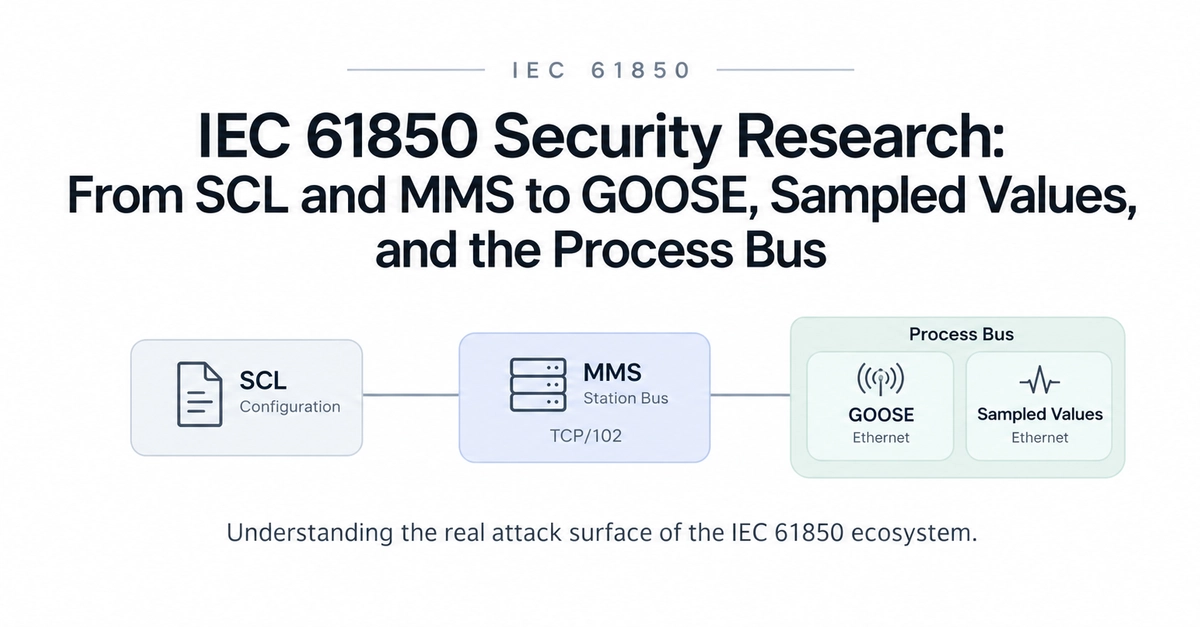
The IEC 61850 standard, designed for substation automation, presents a complex ecosystem rather than a monolithic protocol. This complexity, while enabling interoperability, also introduces significant security challenges. Recent research by RUGERO Tesla (@404Saint on GitHub) dissects the security implications across its various components, from the Substation Configuration Language (SCL) and the Manufacturing Message Specification (MMS) to the rapid communication mechanisms like GOOSE (Generic Object Oriented Substation Events) and Sampled Values (SV).
At its core, IEC 61850 facilitates communication between intelligent electronic devices (IEDs) in substations. While MMS offers a familiar client-server model, GOOSE and Sampled Values operate directly over Ethernet. This direct Ethernet integration, leveraging multicast, introduces distinct assumptions regarding timing, state management, sequencing, and data integrity that differ markedly from traditional client-server interactions. This divergence forms a central theme in understanding the protocol's security surface.
The research involved constructing an isolated IEC 61850 laboratory environment using the libIEC61850 library. This setup allowed for controlled experimentation to identify and analyze potential vulnerabilities. The work highlights that a superficial understanding of IEC 61850 as just another industrial protocol is insufficient. The true security landscape emerges when examining the interplay between different communication layers and their underlying assumptions.
SCL and MMS: The Foundation and Its Gaps
The Substation Configuration Language (SCL) is an XML-based format used to describe the configuration of an IEC 61850 substation. It defines devices, their functions, and communication mappings. While SCL itself is a data description language, its integrity and proper parsing are critical. Vulnerabilities could arise from malformed SCL files that could lead to misconfigurations or denial-of-service conditions during parsing by IEDs or engineering tools. The research implies that robust validation of SCL files is a fundamental security prerequisite.
MMS, running over TCP/IP, provides the application layer services. It defines how data is modeled and accessed, including object directories, services for reading/writing data, and event reporting. Traditional security concerns for client-server protocols, such as authentication, authorization, and encryption, are relevant here. However, the research suggests that many implementations may lack these basic security controls, potentially allowing unauthorized access to control functions or sensitive operational data. The lack of mandatory authentication in some MMS profiles presents a significant attack vector.
GOOSE and Sampled Values: High-Speed Risks on the Process Bus
GOOSE messages are designed for high-speed, peer-to-peer communication of status information and control commands within the substation. They are published and subscribed to over Ethernet, often using multicast. This design prioritizes speed and determinism, which can come at the expense of built-in security. The research points out that GOOSE messages are typically unauthenticated and unencrypted. An attacker on the substation network could potentially inject forged GOOSE messages, leading to incorrect tripping of circuit breakers, false alarms, or other critical operational disruptions. The reliance on MAC addresses for some aspects of GOOSE communication also presents potential spoofing risks.
Sampled Values (SV) are used to transmit high-resolution analog measurements (e.g., current and voltage waveforms) from instrument transformers to protection relays and other IEDs. Like GOOSE, SV messages are typically transmitted directly over Ethernet, often using multicast. The speed and volume of SV data make it challenging to implement traditional security mechanisms without impacting performance. The research indicates that the integrity and authenticity of SV data are paramount; corrupted or manipulated SV data could lead to misoperation of protection functions, potentially causing damage to grid assets or widespread outages. Ensuring the sender identity and data integrity of SV streams is a critical research area.
The Process Bus and Broader Implications
The concept of a 'process bus' in IEC 61850 often refers to the network carrying GOOSE and Sampled Values. Securing this process bus is paramount. The research emphasizes that the shift from hardwired copper connections to Ethernet-based communication introduces IT-related security vulnerabilities into the operational technology (OT) domain of substations. This convergence requires a hybrid approach to security, blending OT-specific requirements with IT best practices.
The findings suggest a critical need for enhanced security measures within IEC 61850 implementations. This includes implementing authentication and authorization for MMS, securing GOOSE and SV messages through techniques like network segmentation, message authentication codes (MACs), or potentially developing secure transport protocols. The research implicitly raises the question of how effectively current cybersecurity standards and frameworks are being adapted and applied to these critical infrastructure protocols.
Ultimately, the security of IEC 61850 is not a single problem but a multifaceted challenge that requires attention at every layer of the communication stack and across all its protocols. As substations become more digitized and interconnected, understanding and mitigating these vulnerabilities is essential for maintaining grid reliability and resilience.