Understanding Insecure Direct Object References (IDOR)
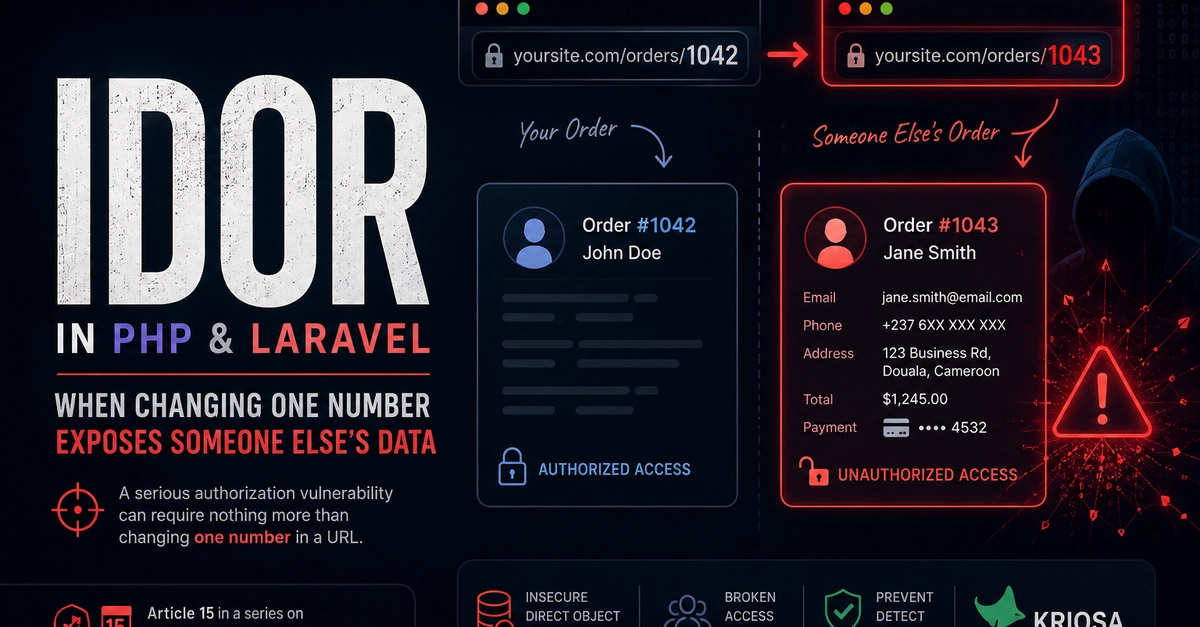
Insecure Direct Object References (IDOR) are a critical class of security vulnerabilities that occur when an application provides direct access to an object (like a file, record, or other data entry) based on user-supplied input. The most common form involves using an identifier, often a numerical ID, within a URL or request parameter. When the application fails to properly validate that the authenticated user is authorized to access the specific object requested, an attacker can manipulate this identifier to access or modify data belonging to other users.
This vulnerability is particularly prevalent in web applications where resources are identified by sequential numbers. Think of it less like a locked filing cabinet and more like an unlocked one where each folder is labeled with a number. If you can change the number on one folder to access its contents, you can likely change it to access any other folder if the system doesn't check who you are and what you're allowed to see.
IDOR in PHP and Laravel Applications
PHP, and its popular framework Laravel, are widely used for web development, making them common targets for security researchers. The excerpt provided points to a specific vulnerability where changing a single number in a request can lead to unauthorized data access. This typically happens when an application fetches data based on an ID without verifying ownership or permissions. For instance, a user might view their profile at a URL like /users/123. If the application merely uses the 123 to query the database for user data, an attacker could change this to /users/124 or /users/125, potentially viewing or altering the data of other users if their IDs are sequential and accessible.
Laravel, despite its robust features, is not immune to IDOR if developers do not implement proper authorization checks. Common scenarios include:
- Fetching a record (e.g., an order, a comment, a user profile) using an ID from the URL (e.g.,
/orders/{order_id}). - Updating a resource where the ID is passed in the request body or URL.
- Deleting a resource, again using an ID that is not properly validated against the authenticated user's permissions.
The core issue lies in the assumption that the ID provided by the user corresponds to data they are permitted to access. Without an explicit authorization check against the currently logged-in user's identity and their relationship to the requested resource, the application becomes vulnerable.
Exploitation Scenario
Imagine a typical e-commerce application built with Laravel. A user logs in and views their order history, with URLs like /my-orders/1001, /my-orders/1002, and so on, where 1001, 1002 are order IDs. If the backend code simply retrieves the order details for the ID found in the URL without checking if the logged-in user actually owns that order, an attacker could change the URL to /my-orders/1005, /my-orders/1010, or any other ID. If order ID 1005 belongs to another customer, the attacker would then be viewing that customer's private order information. This is a direct breach of data privacy and security.
The simplicity of this attack vector makes it particularly dangerous. It requires no complex tools or advanced knowledge, just the ability to manipulate a URL. Developers often overlook these checks, especially in internal tools or less critical sections of an application, assuming that only legitimate users will access them.
Preventative Measures
Preventing IDOR vulnerabilities requires a multi-layered approach focused on strict access control. Developers must rigorously implement authorization checks for every resource access request. Key strategies include:
- Explicit Authorization Checks: For every request that accesses or modifies a resource based on an ID, the application must verify that the authenticated user has the necessary permissions. This means checking if the user 'owns' the record, is an administrator with broad access, or has been explicitly granted permission.
- Avoid Sequential IDs: While not a complete solution, using non-sequential, unpredictable IDs (like UUIDs - Universally Unique Identifiers) can make brute-force attacks more difficult. However, it does not eliminate the need for authorization checks, as an attacker could still potentially guess or discover IDs.
- Centralized Authorization Logic: Implement authorization checks in a consistent, centralized manner. In Laravel, this can often be achieved using policies, gates, or middleware that are applied consistently across routes.
- Principle of Least Privilege: Ensure that users only have access to the data and functionality they absolutely need to perform their tasks.
- Input Validation and Sanitization: While primarily for preventing other types of attacks, ensuring that IDs are of the expected type (e.g., numeric, UUID format) and within a valid range can add a minor layer of defense, though it is insufficient on its own.
The most crucial step is to always assume that any user-supplied input, especially IDs, is potentially malicious or unauthorized. Developers must proactively build checks into their code rather than relying on the obscurity of IDs or the assumption of user integrity. This approach ensures that even if an attacker discovers a valid ID, they will be blocked from accessing data they are not permitted to see.
The excerpt references a series of articles on PHP and Laravel security, indicating a broader context of ongoing efforts to educate developers on common pitfalls. Understanding and mitigating IDOR is a fundamental aspect of building secure web applications, protecting both user data and the integrity of the system.