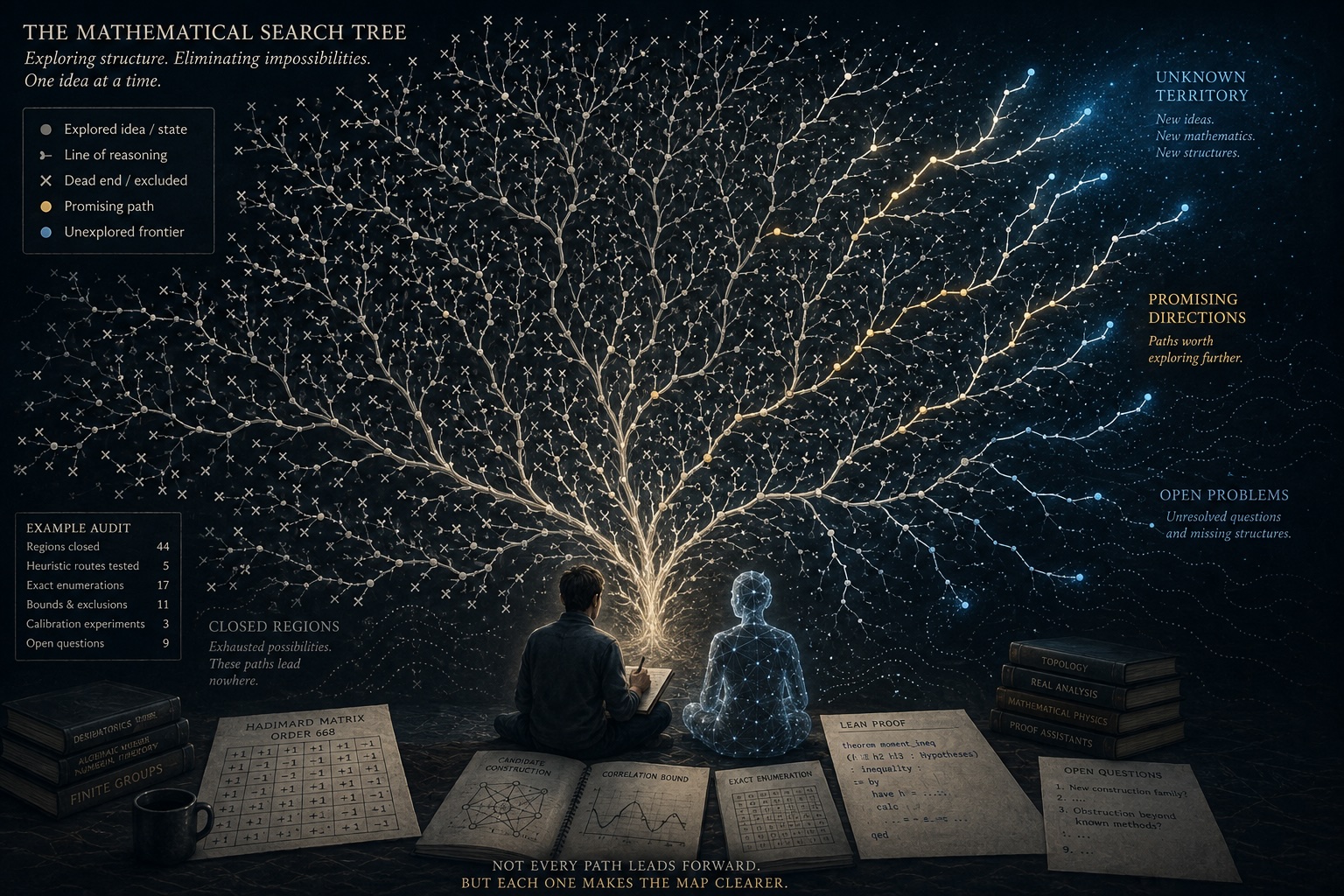
The Dawn of Human-Machine Mathematical Collaboration
The landscape of mathematical research is undergoing a profound transformation, driven by the emergence of powerful human-machine teaming capabilities. What once required weeks or months of focused human effort can now be accomplished in a fraction of the time, thanks to sophisticated AI tools working in tandem with human mathematicians. This acceleration is not just about speed; it’s about tackling previously intractable problems and opening new frontiers in pure mathematics.
Consider the recent achievement of solving two significant open problems in mathematics over a single weekend. This feat, involving exact-arithmetic checking and the development of a proof assistant, underscores the potency of this new collaborative paradigm. These are not trivial tasks. Exact-arithmetic checking, especially for large numbers or complex expressions, demands rigorous precision and computational power that can easily overwhelm manual methods. Proof assistants, on the other hand, are complex software systems designed to help mathematicians formalize and verify proofs, a process that is notoriously time-consuming and prone to subtle errors.
Demystifying Exact-Arithmetic Checking
Exact-arithmetic checking is fundamentally about ensuring that calculations are performed with absolute precision, without any loss of accuracy due to floating-point approximations or rounding errors. In traditional computing, many operations use floating-point numbers, which represent real numbers with a finite number of bits. While efficient for many applications, this can lead to accumulated errors in long or complex computations. For mathematical proofs, where absolute certainty is paramount, such approximations are unacceptable. Historically, achieving exact arithmetic often involved specialized algorithms, symbolic computation systems, or manual verification, all of which are labor-intensive and scale poorly.
The challenge intensifies when dealing with problems that involve vast quantities of numbers or intricate algebraic structures. For instance, checking the exact result of a polynomial evaluation over a finite field, or verifying the primality of extremely large numbers, requires computational tools that can handle arbitrary-precision arithmetic. Before the advent of advanced AI, this often meant relying on libraries like GMP (GNU Multiple Precision Arithmetic Library) or specialized mathematical software packages, often coupled with significant human oversight to design the checking procedures and interpret the results. The process could be slow, requiring substantial computational resources and expert knowledge to implement correctly.
The Role of Proof Assistants
Proof assistants, also known as interactive theorem provers, are software tools that help users construct and verify mathematical proofs. They operate by allowing a user to input mathematical statements and then guiding the system through a series of logical steps to construct a formal proof. The assistant then rigorously checks each step for logical validity, ensuring that the final proof adheres to the rules of a formal logical system. This process is akin to having a highly pedantic but infallible checker for every step of a mathematical argument.
Developing a proof assistant for a specific domain or problem can be an arduous task in itself. It requires defining a formal language for mathematical statements, establishing a set of axioms and inference rules, and implementing algorithms for proof search and verification. The goal is to reduce the possibility of human error in complex proofs, which can sometimes span hundreds of pages and involve intricate logical deductions. Famous examples of proof assistants include Coq, Isabelle, and Lean. These tools have been instrumental in formalizing major mathematical results, such as the Four Color Theorem and the Feit-Thompson Theorem, but their development and application demand significant expertise and time.
Synergy: How Human-Machine Teaming Accelerates Discovery
The breakthrough lies in the synergistic combination of human intuition and AI's computational prowess. Mathematicians can leverage AI to automate the tedious aspects of their work, such as performing exact calculations or exploring vast proof spaces. This allows them to focus on higher-level strategic thinking: formulating conjectures, designing experiments, and interpreting the AI’s outputs. The AI, in turn, acts as an tireless, precise, and scalable assistant.
For exact-arithmetic checking, AI models can be trained to identify patterns in computations, optimize arithmetic operations for speed and precision, and even generate verification code. They can handle the brute-force aspect of checking enormous numbers of cases or verifying complex identities that would be impractical for humans to check manually. Similarly, in the realm of proof assistants, AI can assist in generating proof steps, suggesting relevant lemmas, or even automating parts of the proof search process. This dramatically reduces the burden on the human user, making the formalization of proofs more accessible and efficient.
The speed at which these two problems were solved is a testament to this new dynamic. Instead of weeks of meticulous manual work or intricate programming of specialized tools, a weekend of focused human-AI collaboration sufficed. This suggests a future where the pace of mathematical discovery is no longer solely dictated by human endurance and cognitive limits, but amplified by intelligent computational partners. This isn't about AI replacing mathematicians; it's about AI augmenting their capabilities, enabling them to explore deeper, more complex mathematical landscapes than ever before.
The Unanswered Question: Scalability and Generalization
While the weekend-long resolution of these two problems is a remarkable demonstration, a crucial question remains: how scalable and generalizable is this human-machine teaming approach? Can the techniques developed for these specific problems be readily adapted to a broader range of mathematical domains? What is the overhead involved in training or configuring AI models for new mathematical fields, and how much human expertise is still required to guide the AI effectively? The surprising detail here is not the speed of resolution, but the implicit assumption that these AI tools are becoming increasingly general-purpose, requiring less bespoke engineering for each new challenge.
Future Implications for Mathematics
The implications for the future of mathematics are immense. We can anticipate a surge in the exploration of complex conjectures, faster verification of theorems, and potentially the discovery of entirely new mathematical structures and relationships. This human-machine partnership is poised to redefine what is possible in mathematical research, making abstract concepts more concrete through rigorous, AI-assisted verification and exploration. It signals a shift from mathematics as a purely human endeavor to a hybrid discipline where human creativity and machine precision drive innovation at an unprecedented rate.