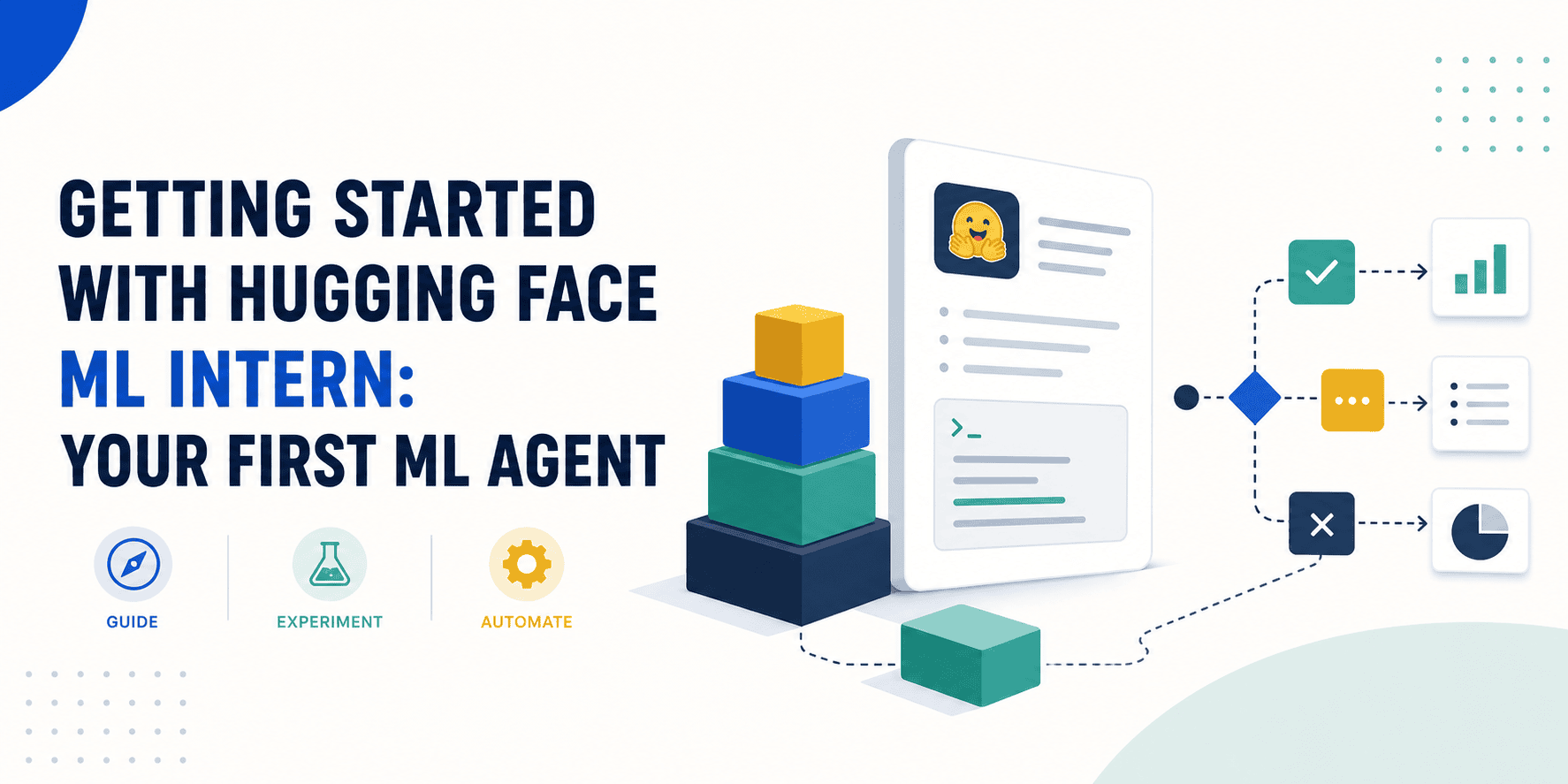
Introducing Hugging Face ML Intern
Hugging Face has launched ML Intern, a new tool designed to accelerate the development of machine learning agents. The core concept is simple: users describe the desired model, and ML Intern handles the rest. This includes generating the necessary code, executing the training process, and ultimately shipping the trained model checkpoint. This aims to significantly lower the barrier to entry for creating custom ML agents, allowing developers and researchers to focus on the conceptualization and problem-solving aspects rather than the boilerplate code and infrastructure management.
ML Intern operates on a principle of declarative programming for ML. Instead of writing detailed, step-by-step instructions for model architecture, data loading, and training loops, users provide a higher-level description. This description can be as simple as outlining the input and output formats, the desired task (e.g., image classification, text generation), and perhaps some key hyperparameters or architectural constraints. The system then interprets this description and translates it into functional Python code, leveraging Hugging Face's extensive libraries like Transformers, Datasets, and Accelerate.
The process begins with the user defining their model. This definition is key. It’s not just a natural language prompt; it involves specifying details about the data, the task, and any specific requirements. For instance, a user might describe a sentiment analysis model needing to process text inputs and output a classification label (positive, negative, neutral). They might also specify the dataset to be used, perhaps a pre-existing Hugging Face Dataset or a custom one. ML Intern then takes this structured input and begins its work.
Automated Code Generation and Training
Once the model description is provided, ML Intern's engine kicks in. It generates the Python code required to build, load, and train the specified model. This generated code is not a black box; it is intended to be transparent and modifiable, allowing users to inspect and fine-tune it if necessary. The system automatically handles tasks such as:
- Model Architecture Definition: Based on the task and description, ML Intern selects and configures appropriate model architectures from Hugging Face's vast model hub.
- Data Loading and Preprocessing: It sets up data pipelines using the Datasets library, including tokenization for text models or image transformations for vision models.
- Training Loop Implementation: A standard, efficient training loop is generated, incorporating best practices for optimization, batching, and evaluation.
- Hyperparameter Management: Key hyperparameters are either inferred from the description or set to sensible defaults, with options for user overrides.
The training phase is fully automated. ML Intern orchestrates the execution of the generated training script, managing resources and monitoring progress. This could involve running on local hardware, or if configured, leveraging cloud-based training infrastructure. The goal is to abstract away the complexities of distributed training, mixed-precision, and checkpointing, allowing users to simply wait for the model to be trained.
Deployment and Checkpointing
Upon successful completion of training, ML Intern automatically saves the trained model as a checkpoint. This checkpoint is typically stored in a format compatible with the Hugging Face Hub, making it easily accessible for inference or further fine-tuning. The system can also assist in preparing the model for deployment. This might involve packaging the model with a minimal inference script or integrating it into a serving framework. The objective is to provide a seamless transition from a model concept to a deployable artifact.
The benefits are manifold. For beginners, it offers a guided path to building their first ML agent without getting bogged down in code. For experienced practitioners, it provides a productivity boost by automating repetitive setup tasks, freeing them to experiment with more complex ideas or scale their work faster. The transparency of the generated code is a crucial aspect, ensuring that users are not merely relying on a black box but can understand and adapt the underlying implementation.
ML Intern represents a significant step towards democratizing ML agent development. By abstracting away the coding and infrastructure complexities, Hugging Face empowers a broader audience to leverage the power of machine learning. The ability to describe, generate, train, and ship a model with such a streamlined workflow is poised to accelerate innovation in the field of AI agents.