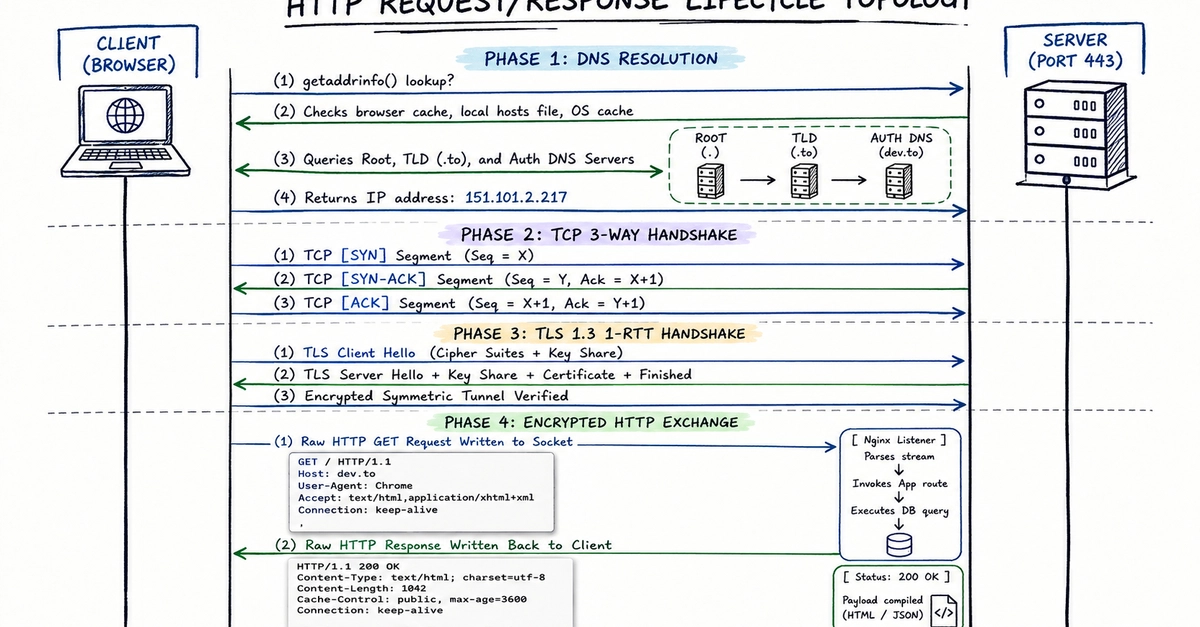
The HTTP Request/Response Lifecycle: A Developer's Deep Dive
In our modern era of abstract, zero-configuration cloud infrastructure, it's easy to overlook the fundamental mechanics that power every web interaction. Beneath the surface of a Next.js route or an AI agent's API call lies a complex, physical sequence of operations: raw socket writes, DNS recursive traversals, and cryptographic handshakes. This is the HTTP Request/Response Lifecycle. Understanding this synchronous network protocol execution loop is not merely academic; it is the critical differentiator between an application that buckles under load and a robust, scalable system that performs gracefully in production.
This guide strips away framework-specific abstractions to trace the exact, step-by-step journey of a client's GET request, culminating in the server's response. While the ISO 3166-1 alpha-2 country codes may seem unrelated, they highlight a crucial principle: even seemingly simple data representations hide complex rules and edge cases. A developer's failure to account for these nuances, as seen with incorrect country codes like UK instead of GB, can lead to significant application bugs and support nightmares. Both the HTTP lifecycle and data standards require a deep understanding of underlying protocols and specifications to build resilient software.
DNS Resolution: Finding the Address
The journey begins not with the server, but with the client's need to locate it. When you type a URL into your browser or an application makes an API call, the first step is Domain Name System (DNS) resolution. Your operating system or browser checks its local cache for the IP address associated with the domain name. If not found, it queries a DNS resolver, typically provided by your Internet Service Provider (ISP) or a public service like Google DNS (8.8.8.8) or Cloudflare (1.1.1.1).
This resolver then embarks on a recursive traversal: it asks a root DNS server, which directs it to a Top-Level Domain (TLD) server (e.g., for .com), which in turn directs it to the authoritative Name Server for the specific domain. The authoritative Name Server holds the actual IP address (e.g., 192.0.2.1) for the requested domain. This IP address is then returned to the client, completing the DNS resolution phase.
TCP Handshake: Establishing a Reliable Connection
With the IP address in hand, the client needs to establish a reliable connection with the server. This is achieved using the Transmission Control Protocol (TCP), which employs a three-way handshake to ensure both parties are ready to communicate. The process involves three steps:
- SYN (Synchronize): The client sends a TCP segment with the SYN flag set to the server, indicating a request to start a connection.
- SYN-ACK (Synchronize-Acknowledge): The server receives the SYN packet, allocates resources for the connection, and responds with a TCP segment that has both the SYN and ACK flags set. This acknowledges the client's request and signals its readiness.
- ACK (Acknowledge): The client receives the SYN-ACK packet and sends back a final ACK packet. This confirms that the connection is established and data transfer can commence.
This handshake ensures that both the client and server have agreed on connection parameters and are ready to send and receive data reliably. It's the foundational step for any data exchange over the internet.
TLS/SSL Handshake: Securing the Channel
For secure communication (HTTPS), an additional layer of security is established after the TCP handshake: the Transport Layer Security (TLS) or its predecessor, Secure Sockets Layer (SSL) handshake. This process involves several steps to authenticate the server, negotiate encryption algorithms, and generate session keys.
The key stages include:
- Client Hello: The client initiates the handshake, specifying supported TLS versions, cipher suites, and a random number.
- Server Hello: The server responds with its chosen TLS version, cipher suite, its digital certificate (containing its public key), and another random number.
- Certificate Verification: The client verifies the server's certificate against trusted Certificate Authorities (CAs) to ensure the server's identity.
- Key Exchange: The client uses the server's public key to encrypt a pre-master secret and sends it to the server. The server uses its private key to decrypt it. Both client and server then use this pre-master secret and the random numbers exchanged to independently generate identical session keys.
- Finished: Both parties exchange encrypted 'Finished' messages to confirm the handshake is complete and that all previous messages were received correctly.
Once the TLS handshake is successful, all subsequent data transmitted over the TCP connection is encrypted using the agreed-upon session keys, ensuring confidentiality and integrity.
HTTP Request Construction and Transmission
With a secure, established connection, the client constructs the HTTP request. A typical HTTP request consists of several parts:
- Request Line: This specifies the HTTP method (e.g.,
GET,POST,PUT), the requested resource path (e.g.,/users/123), and the HTTP protocol version (e.g.,HTTP/1.1orHTTP/2). For aGETrequest, it might look like:GET /index.html HTTP/1.1. - Headers: These provide metadata about the request. Common headers include
Host(the domain name),User-Agent(information about the client software),Accept(the types of content the client can understand),Content-Type(for requests with a body), and authentication tokens. - Body (Optional): For methods like
POSTorPUT, the request may include a body containing data to be sent to the server (e.g., JSON payload for creating a new user). AGETrequest typically does not have a body.
These components are assembled into a raw text format and sent over the established TCP connection.
Server Processing and Response Generation
The server receives the raw HTTP request. It parses the request line, headers, and body to understand the client's intent. Based on the request, the server performs the necessary actions:
- Routing: The server identifies the appropriate handler or controller for the requested resource path and HTTP method.
- Business Logic: It executes any required business logic, which might involve querying a database, calling other services, or performing calculations.
- Data Retrieval/Manipulation: If the request involves data, the server fetches it from storage or updates existing data.
After processing, the server constructs an HTTP response, which also has a specific structure:
- Status Line: This contains the HTTP protocol version, a status code (e.g.,
200 OK,404 Not Found,500 Internal Server Error), and a status message. - Headers: These provide metadata about the response, such as
Content-Type(the type of content being returned, e.g.,application/json),Content-Length(the size of the response body),Set-Cookie(for sending cookies to the client), and caching directives. - Body (Optional): This contains the actual resource requested or the result of the operation (e.g., HTML content, JSON data, an image file).
This response is then sent back to the client over the same secure TCP connection.
Client Receiving and Rendering
The client receives the HTTP response. It first checks the status code to determine the outcome of the request. If the request was successful (e.g., 200 OK), it then parses the response headers and body. Depending on the Content-Type, the client might render HTML, parse JSON data, display an image, or execute JavaScript. If the request failed, the client handles the error appropriately, potentially displaying an error message to the user or logging the issue.
The TCP connection may then be closed, or kept alive for subsequent requests, depending on the HTTP version and server configuration. This entire cycle, from initial DNS lookup to final response rendering, constitutes the HTTP Request/Response Lifecycle. Understanding each phase is crucial for building performant, secure, and reliable applications, much like understanding the precise definition of country codes is vital for accurate international data handling.