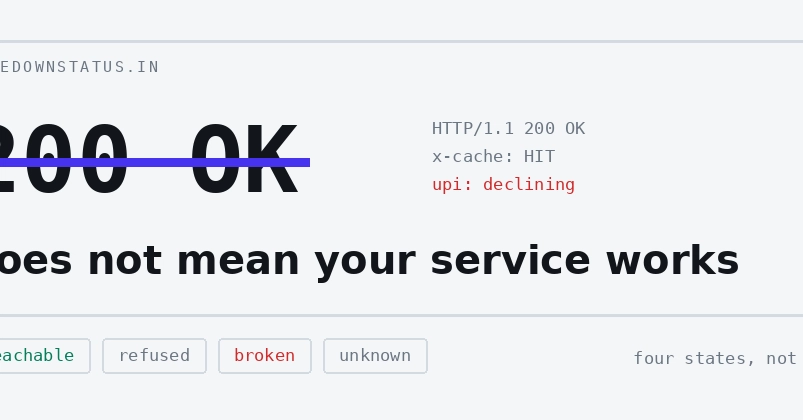
The Illusion of a Healthy Service
Many developers treat an HTTP 200 OK response as the ultimate arbiter of service health. A common pattern involves a simple GET request to a designated health check endpoint. If the server responds with 200, the service is deemed operational. This approach, while seemingly straightforward, creates a dangerous illusion of reliability. A 200 OK simply means the web server processed the request and returned a successful status. It says nothing about the application logic, database connectivity, or downstream service dependencies that are critical for the service to actually perform its intended function.
Consider a typical health check endpoint. It might look something like this:
const res = await fetch(url, { method: 'GET', signal: AbortSignal.timeout(10000) });
const isUp = res.status === 200;
This code snippet checks if the HTTP status code is 200. If it is, `isUp` becomes true. However, what if the backend service is running, but its connection to the primary database has failed? Or what if a critical third-party API it relies on is experiencing an outage? The web server might still return a 200 OK for the health check endpoint because the server process itself is alive and responding. The actual business logic, however, is likely failing silently, or worse, returning incorrect data.
Beyond the Status Code: Deeper Health Checks
To truly understand if a service is working, health checks must go deeper than a superficial HTTP status. They need to validate the critical components and dependencies that the service relies upon. This means moving from a simple 'is the server running?' check to a 'is the service actually capable of performing its core functions?' validation.
A more robust health check might involve:
- Database Connectivity: Attempting a read and/or write operation to the primary database. This validates not just the connection, but also the integrity of the database and its permissions.
- Downstream Service Pings: If the service depends on other internal or external APIs, it should attempt to call a basic endpoint on those services. This ensures that critical dependencies are reachable and responsive.
- Cache Status: Checking if the caching layer (e.g., Redis, Memcached) is accessible and functioning correctly.
- Queue Health: For asynchronous services, verifying the status of message queues (e.g., Kafka, RabbitMQ) and ensuring messages can be published and consumed.
- Application-Specific Logic: Performing a simplified, non-destructive operation that exercises a core piece of the application's business logic. This could be a calculation, a data transformation, or a lookup that doesn't alter state.
Imagine a banking application. A 200 OK on its `/health` endpoint might be returned even if the system cannot process new transactions due to a database outage. The web server is up, but the core function is broken. A better health check would attempt a mock transaction or a read from a recently created account, confirming that the entire transaction pipeline is functional.

The Pitfalls of Superficial Monitoring
Relying solely on HTTP status codes for service health monitoring leads to several critical issues. Firstly, it masks underlying problems, leading to a false sense of security. Users might be experiencing degraded service or complete failure, while monitoring systems report everything is green. This delay in detection can significantly increase downtime and impact user trust. Secondly, it complicates debugging. When an issue eventually surfaces, engineers might waste valuable time investigating network or server issues when the root cause lies deeper within the application's dependencies.
The surprising detail here is not that a 200 OK can be misleading, but how deeply ingrained this simplistic approach is across the industry. Many teams operate with health checks that only verify the web server's ability to respond, ignoring the actual functional state of the application. This is akin to checking if a car's engine is turning over, without verifying if the transmission is engaged or if there's fuel in the tank.
Implementing Effective Health Checks
Building effective health checks requires a shift in mindset. Instead of asking 'Is the server running?', ask 'Is the service capable of fulfilling its purpose right now?'. This requires understanding the critical path of your application and what dependencies are essential for its operation.
For developers, this means actively designing health check endpoints that probe these critical components. For operations and SRE teams, it means configuring monitoring tools to use these more sophisticated health checks and to alert not just on 5xx errors or timeouts, but also on specific functional failures reported by the enhanced health endpoints.
The goal is to create a system that provides a true reflection of service availability and functionality. This proactive approach helps prevent user-facing incidents, reduces mean time to recovery (MTTR), and builds a more resilient infrastructure. When you're building or maintaining a service, don't just check if the lights are on; verify that the appliances are actually working.