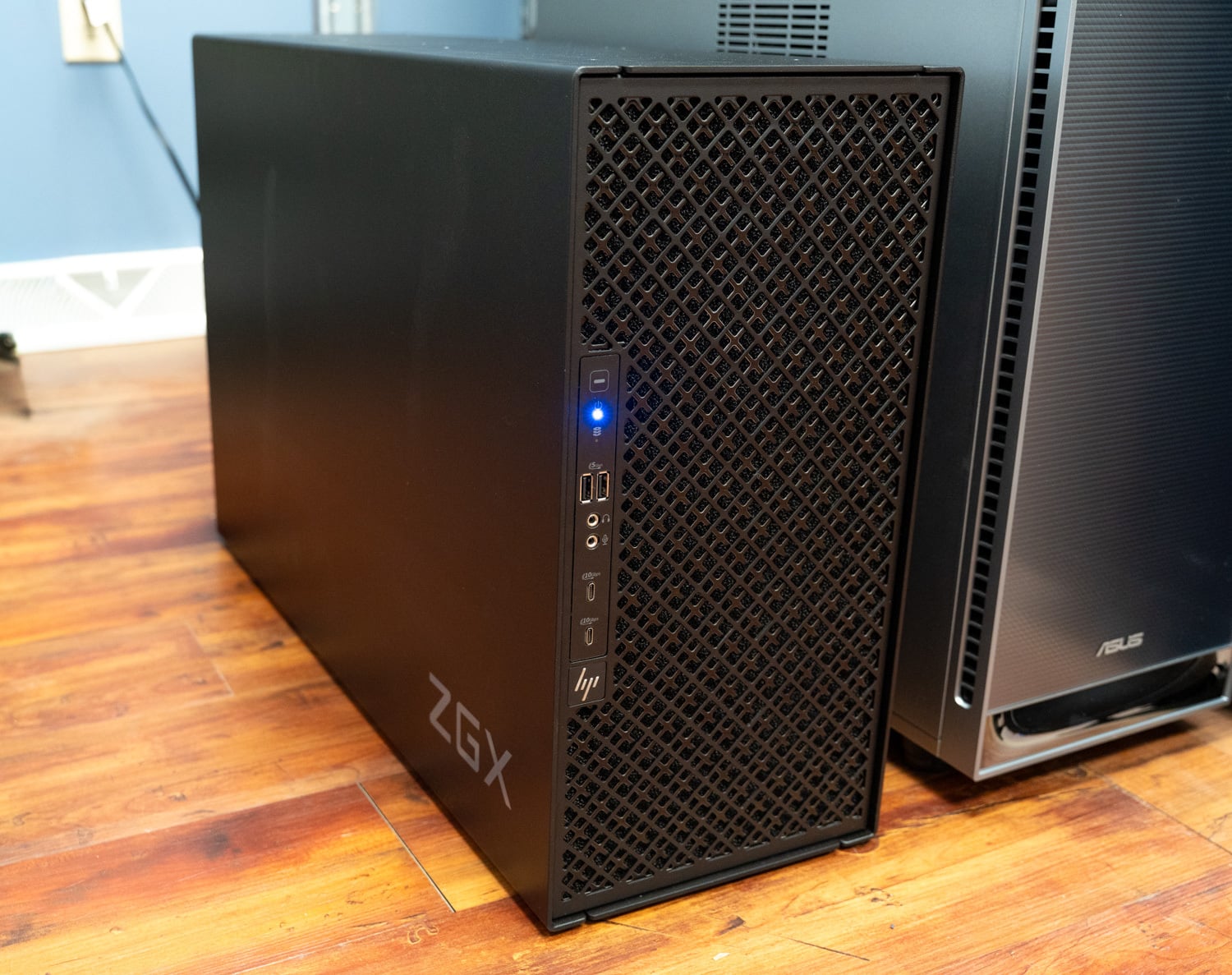
HP ZGX Fury Workstations Go Live with Advanced AI Hardware
HP has officially opened orders for its ZGX Fury workstations, marking a significant step in bringing powerful, specialized AI hardware to a broader professional audience. The ZGX Fury line is designed to accelerate AI development and deployment at the edge and in enterprise environments. Central to this offering is the integration of the new GB300 Superchip, a component engineered for high-performance AI inference and training tasks. Paired with an impressive 748GB of unified memory, these workstations aim to provide the raw computational power and memory bandwidth necessary for demanding machine learning workloads.
The availability of the ZGX Fury signifies HP's commitment to the rapidly evolving AI hardware landscape. Unlike traditional server or workstation configurations that might require complex multi-GPU setups or specialized interconnects, the ZGX Fury focuses on a more integrated, optimized approach. The GB300 Superchip, while details remain somewhat scarce, is positioned as a purpose-built solution that consolidates processing capabilities for AI tasks, potentially offering significant advantages in terms of power efficiency, latency, and ease of deployment compared to more general-purpose hardware. The substantial unified memory capacity is particularly noteworthy, as it directly addresses a common bottleneck in AI model development and execution – the need to hold large datasets and complex models in memory for rapid access.
GB300 Superchip and Unified Memory: A Deep Dive
The GB300 Superchip represents a new class of processor tailored for AI inference and potentially smaller-scale training. While HP has not disclosed extensive technical specifications for the GB300 itself, its integration into the ZGX Fury suggests it is designed to handle the parallel processing demands of neural networks efficiently. This could involve specialized tensor cores or other architectural innovations that accelerate matrix multiplication and other fundamental AI operations. The unified memory architecture, boasting 748GB, is a key differentiator. In traditional systems, CPU and GPU memory are separate. Unified memory allows both the CPU and the AI accelerators within the GB300 to access the same pool of data without costly data transfers between distinct memory spaces. This drastically reduces latency and increases throughput, which is critical for real-time AI applications and for training models that require rapid iteration over large datasets.
Consider the process of training a large language model. Traditionally, data would be loaded from storage to system RAM, then transferred to GPU VRAM. With a unified memory system like the one in the ZGX Fury, this data can reside in a single, massive memory pool accessible by all processing units. This is akin to having all your books on a single, enormous desk where you can grab any one instantly, rather than having to walk to different bookshelves for different types of books. The benefit is speed and reduced overhead. For edge AI deployments, where resources are often constrained and low latency is paramount, this architecture can enable more complex models to run locally without relying heavily on cloud connectivity.
Red Hat AI Factory and Edge AI Strategy
Beyond the hardware, HP is also detailing its strategy for enabling AI at the edge, including plans for a Red Hat AI Factory. This partnership with Red Hat signals a focus on providing a comprehensive software stack that simplifies AI development, deployment, and management. An AI Factory implies a streamlined, integrated environment where data scientists and developers can move models from experimentation to production with greater ease. For edge deployments, this is particularly crucial. Managing distributed AI models across numerous edge devices presents significant challenges in terms of consistency, updates, and monitoring. By leveraging Red Hat's expertise in enterprise Linux and container orchestration, HP aims to offer a robust and scalable platform for these scenarios. The combination of specialized hardware like the ZGX Fury and a well-defined software ecosystem is HP's play to capture a significant share of the growing edge AI market.
The implications for developers are substantial. Instead of piecing together disparate hardware and software components, they can potentially deploy a pre-integrated solution. This reduces the time and expertise required to get AI applications running in real-world environments. For founders looking to deploy AI solutions at scale, this could mean faster time-to-market and lower operational costs. The Red Hat AI Factory concept, when fully realized, could abstract away much of the complexity of managing AI infrastructure, allowing businesses to focus on the AI models themselves and the business value they deliver.
Referenced Sources
- verified