The Leap from Abstract to Tangible Automation
For many, automation conjures images of endless lines of code, abstract logic, and virtual processes. As a Lead QA Engineer, my days are spent transforming manual software workflows into automated tests. It’s a discipline focused on the virtual, the digital, the SaaS platforms and mobile apps that run on screens. Yet, I never truly considered the tangible, physical world as a domain for automation. Then came Home Assistant.
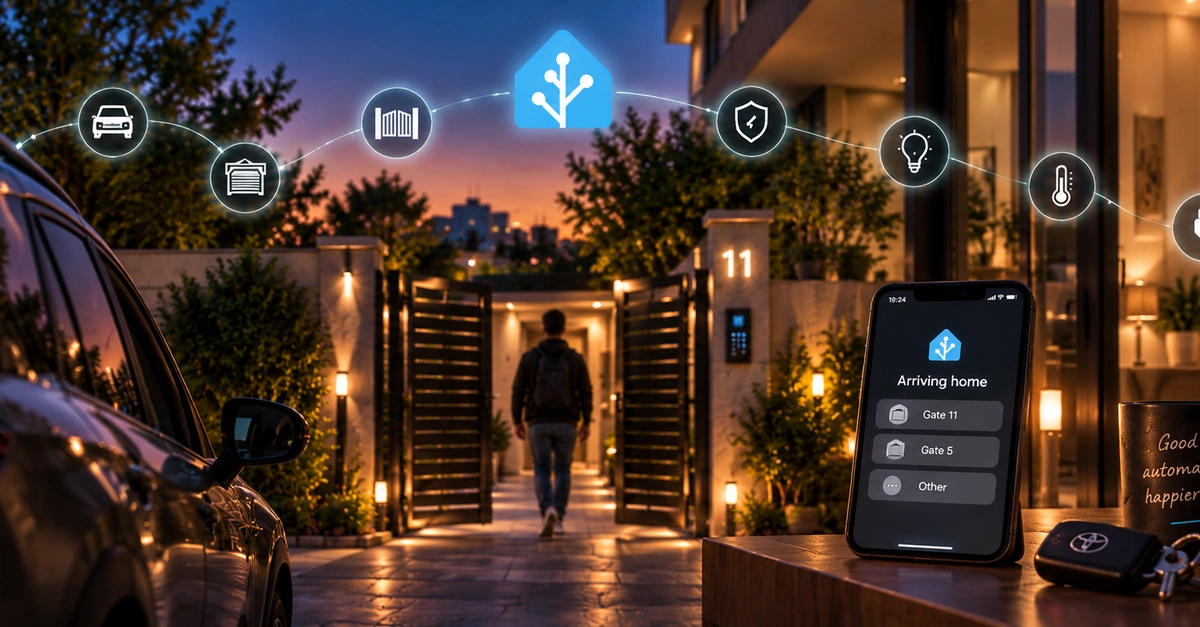
The shift wasn't immediate. It began with simple questions: “What if I could open the garage door directly from my car’s screen?” A quick integration, and that became a reality. Then, a more complex scenario: “What if, upon arriving home, a prompt on my phone asked which building entrance I was using, and then automatically unlocked the corresponding sequence of gates?” This, too, became achievable. Home Assistant bridges the gap between the digital commands we’re accustomed to and the physical actions that directly impact our daily lives. It transforms abstract concepts into concrete, convenient realities, making automation feel less like a technical exercise and more like a personal assistant.
Redefining Daily Routines with Smart Triggers
The true power of Home Assistant lies in its ability to orchestrate complex sequences based on simple triggers. Consider the morning routine. Historically, this involved a series of manual actions: checking the weather, adjusting the thermostat, perhaps turning on lights. With Home Assistant, this can be a single, automated flow. For instance, upon detecting that the primary user has woken up (perhaps via a motion sensor in the bedroom or a wearable device), the system can initiate a cascade of actions. The thermostat adjusts to a comfortable temperature, the bedroom lights gently fade on, and the coffee maker begins its brew cycle. This isn't just about convenience; it's about reclaiming time and mental energy previously spent on mundane tasks.
The implications extend beyond mere comfort. Security is a significant beneficiary. Imagine a system that arms itself automatically when the last person leaves the house, verified by geofencing or individual presence detection. Or, conversely, a system that disarms and disengages security protocols only when authorized individuals are detected approaching the property. The system can be configured to send immediate alerts to your phone for any unusual activity, providing peace of mind whether you’re across town or across the globe. The ability to create custom automations, tailored to specific needs and environments, makes Home Assistant a powerful tool for enhancing both personal convenience and household security.
From Software QA to Physical World Orchestration
My professional background as a Lead QA Engineer involved meticulously documenting and automating software processes. I was adept at identifying edge cases, ensuring reliability, and streamlining digital workflows. However, the physical world, with its inherent delays, mechanical components, and environmental variables, presented a different challenge. Home Assistant provided the framework to apply these QA principles to tangible objects and situations. It’s one thing to automate a software deployment pipeline; it’s another to automate the physical act of a door unlocking or a light turning on in response to a real-world event.
The learning curve, while present, is significantly lowered by Home Assistant’s robust community and extensive documentation. The platform supports a vast array of devices and integrations, allowing for a high degree of customization. This extensibility means that users are not limited to a predefined set of actions. Instead, they can construct intricate logic that responds to a multitude of inputs—from sensor readings and time-based schedules to the presence of specific individuals or the status of other devices. This hands-on approach to physical automation is deeply satisfying, transforming the abstract discipline of software automation into a tangible, real-world practice. It’s akin to moving from designing blueprints to actually building the house, brick by brick, with every action having a visible, immediate effect.
The Future is Orchestrated
The journey with Home Assistant has been more than just setting up smart devices; it has been a profound shift in perspective. It has demonstrated that automation is not confined to the digital realm. It can, and increasingly should, extend into our physical environments to enhance our lives. The ability to craft personalized automation flows, where a specific event triggers a series of precise physical actions, is incredibly empowering. This is not merely about futuristic gadgets; it’s about making everyday life more efficient, secure, and, frankly, more enjoyable. The question is no longer “Can this be automated?” but rather, “How can we best orchestrate our environment to serve our needs?” Home Assistant provides the tools and the platform to answer that question, proving that automation flows can indeed change your life, one tangible action at a time.
What remains to be seen is how deeply these personalized physical automation systems will integrate with broader societal infrastructure. Will smart homes become truly communicative with city services, or will they remain largely isolated ecosystems? The potential for interconnectedness is vast, but the current focus remains on empowering individuals to build their own intelligent environments.