
The Genesis of a Tiny Renderer
The project began with a clear, albeit ambitious, goal: to render 3D graphics on a surprisingly small and resource-constrained handheld device. This wasn't about pushing the boundaries of AAA gaming, but rather a deep dive into the fundamental mechanics of 3D rendering stripped down to its essentials. The developer, SaffronCR, embarked on this journey not for commercial gain, but for the sheer intellectual challenge and the satisfaction of building something from the ground up.
The choice of hardware was deliberate. The target device, a small handheld with limited processing power and memory, immediately dictated the scope and complexity of the renderer. This constraint forced a focus on efficiency, clever algorithms, and a deep understanding of how graphics pipelines operate at a low level. It's a different world from leveraging powerful GPUs and vast VRAM; here, every clock cycle and every byte counts.
Core Rendering Pipeline Decisions
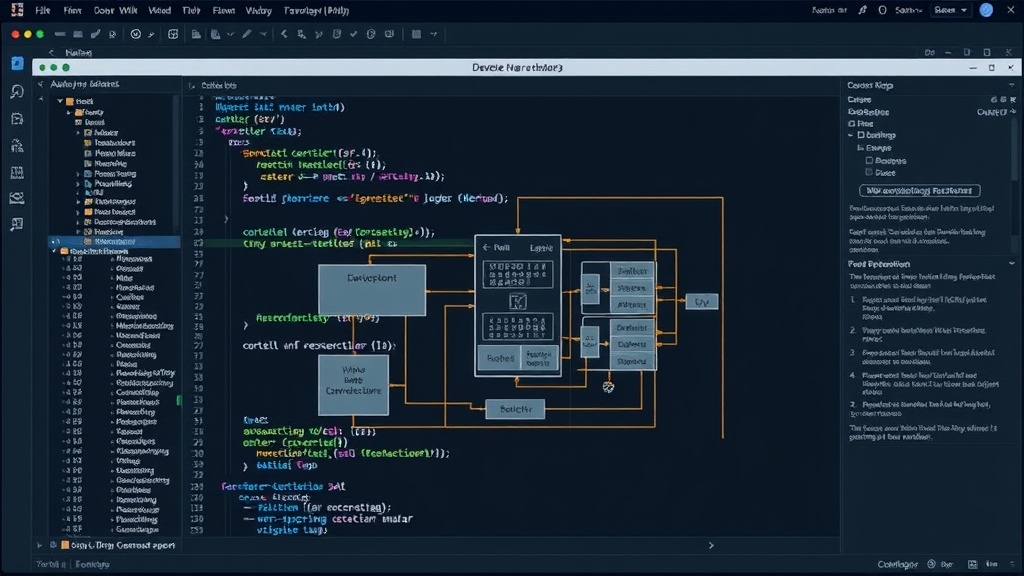
Building a 3D renderer involves a series of critical decisions about the rendering pipeline. For a low-power device, these decisions become even more crucial. SaffronCR opted for a software-based rasterization approach. This means the CPU does the heavy lifting of transforming vertices, clipping primitives, and determining pixel colors, rather than relying on dedicated GPU hardware acceleration. This is inherently slower but offers maximum control and is feasible for simpler scenes on modest hardware.
The pipeline typically starts with vertex processing. Vertices, which define the points of 3D models, are transformed from their local space into world space, then view space, and finally projected onto the 2D screen. This involves matrix multiplications, a common operation in 3D graphics. On a tiny handheld, optimizing these transformations is key. Techniques like pre-calculating common matrices or using fixed-point arithmetic where precision allows can yield significant performance gains.
Following vertex transformation is primitive assembly and clipping. Primitives, usually triangles, are formed from vertices. Clipping removes parts of primitives that fall outside the camera's view frustum – anything that won't be visible on screen. This is a vital step to avoid processing unnecessary geometry. For a software renderer, efficient clipping algorithms are paramount to prevent wasted computation.
Rasterization and Shading Challenges
The heart of a rasterizer is taking those clipped primitives and figuring out which pixels on the screen they cover, and what color each of those pixels should be. This is where the term 'rasterization' comes from – converting vector graphics into raster (pixel) graphics.
Interpolation is a core technique here. As a triangle is rasterized, attributes like color, texture coordinates, and depth are interpolated across its surface. For example, if a triangle's vertices have different colors, the pixels inside the triangle will smoothly blend between those colors. This requires barycentric coordinates or similar methods to calculate the interpolated values for each pixel. On a low-power CPU, these calculations need to be fast and efficient.
Shading determines the final color of each pixel. This can range from simple flat shading (where an entire triangle has one color) to Gouraud shading (interpolating vertex colors) or Phong shading (interpolating normals and calculating lighting per pixel). For a tiny renderer, the choice is a trade-off between visual quality and performance. SaffronCR likely opted for simpler shading models, perhaps Gouraud or even flat shading for certain elements, to keep the computational load manageable. Managing the depth buffer (Z-buffer) is also critical for correctly rendering overlapping objects; closer objects must obscure farther ones. Implementing an efficient Z-buffer read/write operation is essential.
Memory and Performance Constraints
The most significant hurdle for any embedded or low-power graphics project is memory. Handheld devices often have limited RAM, and this RAM might be shared between the CPU and any available graphics hardware. A software renderer places all its demands on the CPU's memory bandwidth and cache. Storing vertex data, index buffers, texture data, and framebuffers all compete for this limited resource.
Texture mapping, a technique that applies images to surfaces to add detail, is particularly memory-intensive. Deciding on texture resolution, color depth, and compression formats becomes a strategic decision. Perhaps only small, low-resolution textures are used, or clever tiling and procedural generation are employed to reduce the need for large texture assets. The developer might also forgo mipmapping, a technique that uses pre-filtered versions of textures for distant objects, to save memory and computation.
Performance optimization is an ongoing battle. Profiling the code to identify bottlenecks is crucial. This could involve optimizing loops, reducing branching, using SIMD instructions if available and applicable, or even resorting to assembly language for critical routines. The goal is to achieve a smooth frame rate, even if that frame rate is modest. For a handheld device, a stable 15-30 frames per second might be the target, rather than the 60+ FPS common on desktops.
Lessons Learned and Future Directions
Building a 3D renderer from scratch for limited hardware is a profound learning experience. It demystifies the graphics pipeline, revealing the complex interplay of geometry, mathematics, and algorithms that underpin even the simplest 3D visuals. The project forces a deep appreciation for the optimizations built into modern graphics hardware and software stacks.
What nobody has addressed yet is the portability of such a custom renderer. If the developer were to target a different, similarly constrained handheld with a different CPU architecture or operating system, how much of this renderer could be salvaged? Would the core logic remain, or would significant rewrites be necessary for each new platform? This highlights the trade-offs between highly optimized, platform-specific code and more general-purpose, albeit potentially less performant, solutions.
The success of such a project lies not in achieving photorealism, but in demonstrating that 3D graphics are accessible even on the most humble of computing platforms with thoughtful engineering and a deep understanding of the underlying principles.