
The Interactive History Podcast
The traditional podcast format, while popular, often leaves listeners with unanswered questions. A new project, Historai, aims to break this mold by introducing an interactive element to historical narratives. Developed by a lone engineer, Historai functions as an AI-powered podcast generator that allows users to delve deeper into historical topics by interrupting the hosts and asking questions in real-time.
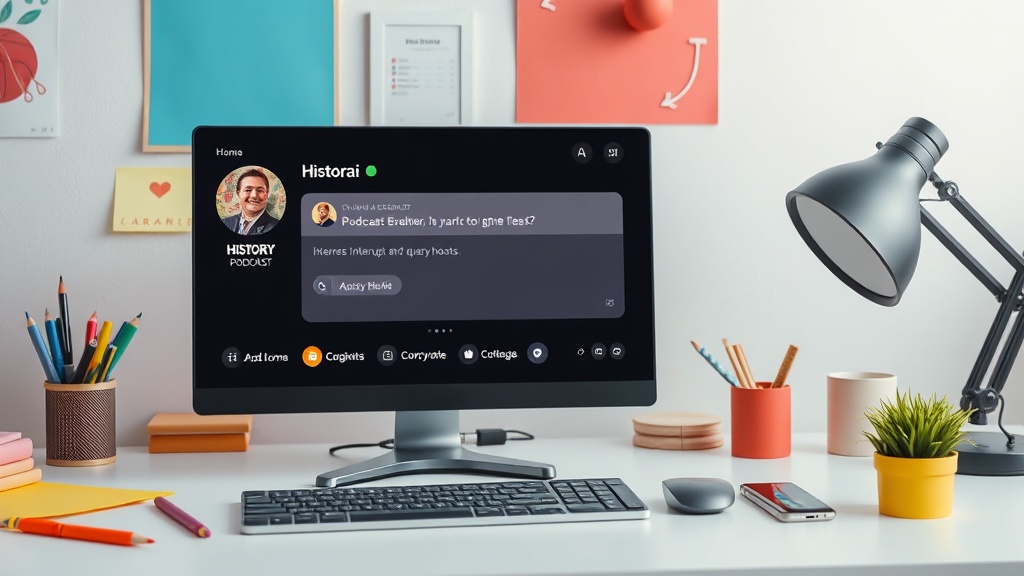
Historai starts with a user-defined historical moment, person, or object. The system then researches and constructs a narrative episode, complete with two AI-generated hosts and accompanying visual slides. The core innovation, however, lies in its interruptible nature. At any point during the episode, a listener can pose a question. The AI hosts then provide an answer, drawing from their research, before seamlessly resuming the original narrative. This feature addresses a long-standing limitation of podcasts: the inability for listeners to engage directly with the content or presenters beyond the playback controls.
The genesis of Historai, as described by its creator, stems from a personal frustration with existing learning resources. The developer found it difficult to explore specific historical tangents or gain clarity on particular aspects of an event when listening to conventional podcasts or consuming other media. This led to the vision of a dynamic, responsive audio-visual experience that could cater to individual curiosity.
Technical Underpinnings and User Experience
While the specific technical architecture of Historai is not detailed, its functionality implies a sophisticated integration of several AI technologies. These likely include natural language processing (NLP) for understanding user queries, large language models (LLMs) for generating coherent and contextually relevant host dialogue and answers, and potentially text-to-speech (TTS) engines to render the narration. The visual slide component suggests an additional layer of AI or algorithmic content generation to create or select relevant imagery based on the historical context.
The user experience is designed to be intuitive. A user initiates an episode by specifying a historical subject. As the episode progresses, the AI hosts present information. If a listener has a question, they can interrupt the flow. The AI processes the query, formulates an answer that aligns with the historical facts it has processed, and then reintegrates this answer into the ongoing narrative. The goal is to make the learning process feel more like a conversation with knowledgeable hosts rather than a passive consumption of information.
The ability to ask questions and receive immediate, context-aware answers transforms the podcast from a linear broadcast into an interactive learning tool. For history enthusiasts, this means the potential to explore nuanced details, clarify ambiguities, or even challenge the presented information within the episode itself. The system’s capacity to resume the narrative after answering a question is crucial for maintaining engagement and coherence, ensuring that the learning journey is not derailed but rather enriched by user interaction.
The Future of Audio Content
Historai represents a significant step toward more personalized and engaging audio content. While traditional podcasts offer a curated experience, they are inherently one-size-fits-all. The ability to inject personal queries and receive tailored responses moves closer to a one-on-one educational experience, albeit mediated by AI. This approach could have profound implications for educational media, historical documentation, and even entertainment.
Consider the current landscape of educational podcasts. Many are excellent, but they are produced with a general audience in mind. A student struggling with a specific concept, or a professional seeking to refresh their knowledge on a particular historical event, might find themselves wishing for more targeted explanations. Historai’s interruptible format offers a potential solution, allowing users to self-direct their learning journey within the framework of a well-researched narrative. The visual slides add another dimension, providing a more immersive experience akin to a virtual lecture.
The success of Historai will depend on several factors: the accuracy and depth of its research, the naturalness of the AI hosts' dialogue, the seamlessness of the interruption and resumption process, and the quality of the visual aids. If these elements are executed well, Historai could pave the way for a new generation of interactive audio and audiovisual content that is more responsive to individual learner needs. The challenge for creators will be to balance the AI's generative capabilities with the need for historical accuracy and pedagogical effectiveness.
What remains to be seen is how widely this interactive model will be adopted. Will other podcast creators integrate similar AI-driven Q&A features, or will Historai remain a novel niche product? The technical hurdles, particularly in maintaining narrative flow and ensuring factual accuracy during spontaneous query responses, are substantial. Yet, the appeal of a truly conversational learning experience is undeniable.