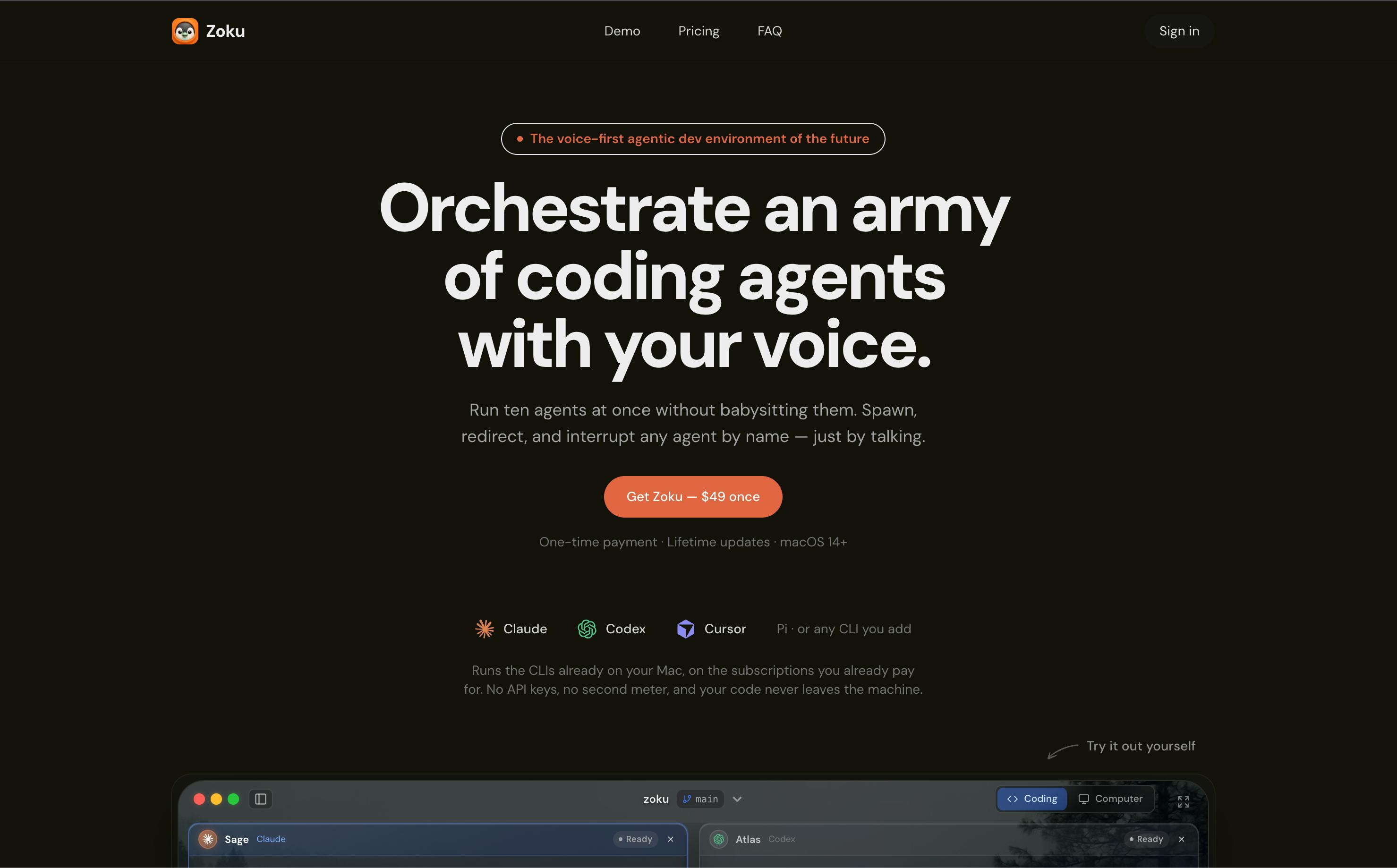
The Promise of Voice-Powered Code Generation
Imagine dictating a complex software feature and having it appear, fully formed, in your IDE. This is the ambitious vision behind HeyZoku, a new AI-powered platform that aims to orchestrate coding agents using natural language voice commands. The tool, which recently launched on Product Hunt, positions itself as a way to democratize software development, making intricate coding tasks accessible to a broader audience, potentially even those without deep programming expertise.
At its core, HeyZoku is designed to act as a conductor for a suite of specialized AI coding agents. Instead of writing lines of code, users interact with HeyZoku through their voice. The platform then interprets these spoken instructions, breaks them down into manageable tasks, and dispatches them to the most appropriate AI agent. These agents, presumably trained on vast datasets of code and development best practices, work in concert to fulfill the user's request.
The immediate appeal lies in the potential to drastically accelerate development workflows. For seasoned developers, this could mean offloading repetitive tasks, rapid prototyping, or quickly scaffolding new projects. For aspiring coders or product managers, it could lower the barrier to entry, allowing them to translate ideas into functional code more directly and intuitively. The idea of using voice commands for something as complex as software development is, frankly, surprising given the precision typically required in coding. It suggests a significant leap in natural language understanding and AI agent coordination.

How HeyZoku Aims to Orchestrate AI Agents
The technical underpinnings of HeyZoku are not fully detailed in its initial announcement, but the concept revolves around a sophisticated orchestration layer. Think of it less like a single, monolithic AI model and more like a smart air traffic controller for a fleet of specialized drones. Each drone (or AI agent) is an expert in a particular area of coding – perhaps one handles front-end UI generation, another manages database schema design, and a third focuses on API integration. The user's voice command is the mission briefing.
HeyZoku's system must first parse the spoken request, identify the core objective, and then decompose it into a sequence of sub-tasks. For example, a request like “Build me a user authentication system with email and password, and integrate it with a PostgreSQL database” would need to be broken down. The system might then assign the UI component generation to a front-end agent, the database schema to a database agent, and the backend logic and API endpoints to a backend agent. These agents would then execute their tasks, potentially communicating with each other to ensure compatibility and consistency.
The success of such a system hinges on several critical factors:
- Natural Language Understanding (NLU): The AI must accurately interpret nuanced and potentially ambiguous spoken instructions. This is a notoriously difficult problem, especially in a domain as precise as programming.
- Task Decomposition: The ability to break down complex requests into executable steps for individual agents is paramount. This requires a deep understanding of software architecture and development lifecycles.
- Agent Coordination: Ensuring that specialized agents can collaborate effectively, share information, and resolve conflicts is a significant engineering challenge.
- Code Quality and Correctness: The generated code must be functional, efficient, secure, and maintainable. This is where the underlying AI models' training data and architectures become crucial.
The platform likely employs a hierarchical approach, with a master AI agent or system responsible for high-level task management and communication with the user, while specialized worker agents handle the granular coding tasks. This modular design is essential for scalability and maintainability, allowing for individual agents to be updated or replaced without disrupting the entire system.
The Potential Impact and Unanswered Questions
If HeyZoku delivers on its promise, the implications for the software development landscape could be profound. It could empower a new generation of creators to build software without needing to master the complexities of syntax and programming paradigms. For existing developers, it could significantly boost productivity, freeing them to focus on higher-level architectural decisions and innovation rather than the minutiae of implementation.
However, several critical questions remain unanswered. What is the learning curve for effectively using HeyZoku? While it aims to simplify coding, mastering the art of instructing AI agents to produce desired outcomes might present its own set of challenges. Developers will need to learn how to articulate their needs precisely and how to troubleshoot when the AI doesn't quite grasp the intent. This shifts the skill from writing code to effectively directing AI.
Furthermore, what happens to the vast ecosystem of existing developer tools and platforms if voice-controlled AI agents become the primary means of software creation? Will IDEs adapt, or will new interfaces emerge? How will version control systems and CI/CD pipelines integrate with AI-generated code that might be less transparent in its creation process? The economic implications for developer education and the job market are also significant. Will demand for traditional coding skills decrease, or will it shift towards AI supervision and prompt engineering?
The success of HeyZoku will likely depend on its ability to strike a delicate balance: providing enough abstraction to empower non-programmers while offering enough control and transparency to satisfy experienced developers. The journey from voice command to production-ready code is complex, and HeyZoku is positioning itself at the forefront of this ambitious endeavor.