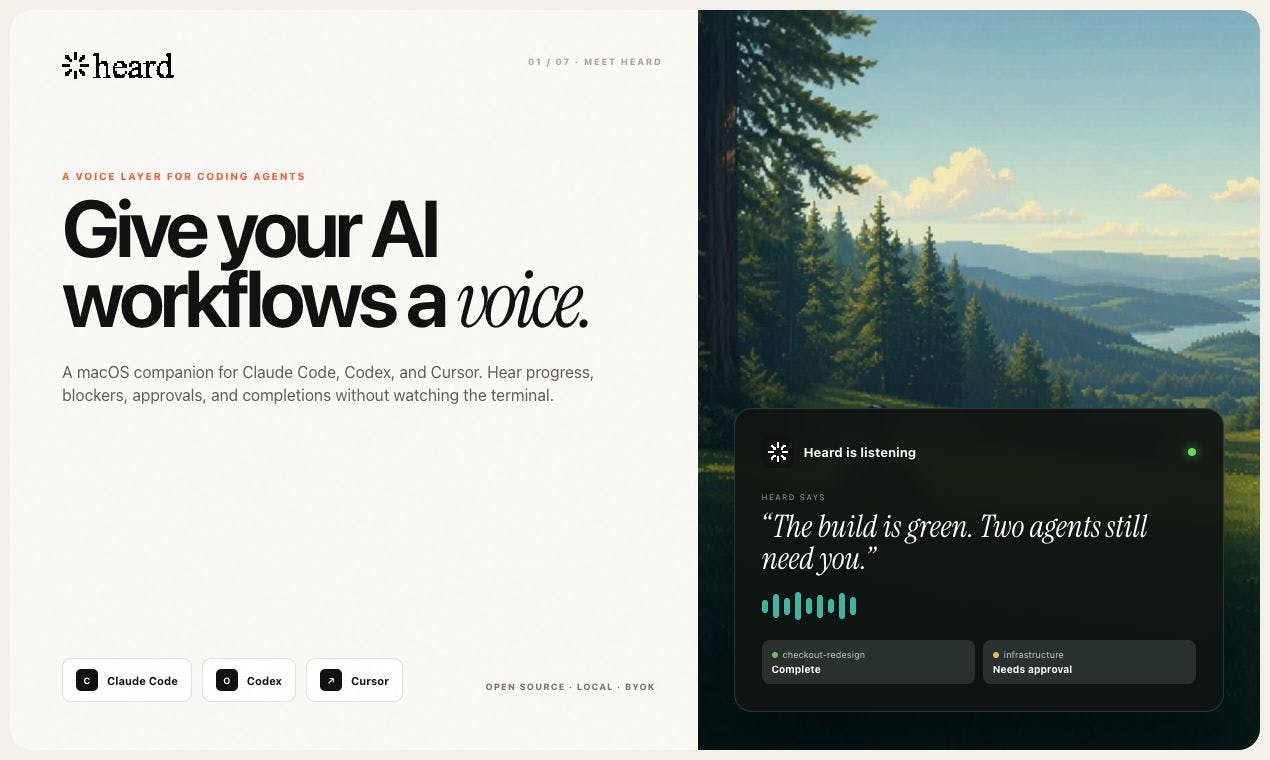
Heard: Bringing Voice to AI Code and Text Interaction
The proliferation of powerful AI models like Claude and Codex has opened up new avenues for developers and creators. However, the primary mode of interaction remains text-based. Heard emerges as a novel tool designed to bridge this gap, offering a voice-enabled interface for these advanced AI systems. This product aims to make interacting with AI more natural and accessible by transforming written code and text into spoken output, and vice versa.
Heard positions itself as a way to give Claude and Codex a voice. This implies a two-way communication channel: users can speak their queries or instructions, which Heard then processes and feeds to the AI model, and the AI's responses, whether code snippets or explanatory text, are then vocalized back to the user. This approach could significantly alter how developers debug code, brainstorm ideas, or learn new programming concepts.
How Heard Enhances AI Interaction
The core functionality of Heard revolves around its ability to convert spoken language into text that AI models can understand, and to synthesize AI-generated text into audible speech. For developers working with code, this means they can potentially dictate code, ask for explanations of code blocks, or request refactoring suggestions without needing to type. Imagine a developer debugging a complex algorithm; instead of painstakingly typing out each command or query, they could simply speak their requests to Heard, receive the AI's analysis audibly, and perhaps even hear the corrected code read back.
This voice-first approach is not merely a convenience feature. It taps into the growing trend of conversational AI and aims to lower the barrier to entry for individuals who may not be as comfortable or efficient with traditional keyboard-based coding environments. For those with accessibility needs, a voice interface can be transformative. Furthermore, for experienced developers, it could streamline workflows, allowing for more fluid thought processes and faster iteration cycles, especially during periods of intense concentration where frequent typing might be disruptive.
The integration with models like Claude and Codex is key. Claude, known for its strong natural language processing and reasoning capabilities, can handle complex instructions and generate detailed explanations. Codex, built on OpenAI's GPT models, excels at understanding and generating code. By layering a voice interface over these powerful engines, Heard unlocks new use cases. For instance, a user could verbally describe a desired function, and Heard would translate that into a prompt for Codex, which would then generate the code. The resulting code could then be read aloud by Heard, allowing the user to review it aurally before it's even displayed on screen.
Potential Use Cases and Broader Implications
The implications of Heard extend beyond simple voice commands. Consider educational settings where students are learning to code. Heard could act as an interactive tutor, allowing students to ask questions about syntax, logic, or best practices using their voice and receive immediate, spoken feedback. This could foster a more engaging and less intimidating learning environment.
For content creators, especially those working with AI-generated text for scripts, articles, or even creative writing, Heard offers a way to iterate rapidly. They can dictate prompts, listen to generated paragraphs, and provide verbal feedback for revisions. This can feel much more natural than constantly switching between typing and reading text on a screen.
The surprising detail here is not the existence of voice interfaces for AI, but their application to highly technical domains like code generation and analysis. Historically, voice interfaces have been more common in consumer applications for tasks like setting reminders or playing music. Applying this to the intricate world of programming suggests a future where interacting with complex computational tools becomes as simple as having a conversation. This could democratize access to powerful AI coding assistants, allowing a wider range of individuals to leverage them effectively.
What nobody has addressed yet is the long-term impact on developer ergonomics and cognitive load. While voice interaction can reduce physical strain from typing, the cognitive load of formulating spoken instructions and processing auditory output needs further study. Will developers become more or less efficient in the long run? How will this affect code reviews and collaborative development, where written documentation and clear text-based commit messages are paramount?
The Future of Conversational AI Development
Heard represents a step towards a more integrated and intuitive relationship between humans and artificial intelligence. As AI models become more capable, the interfaces through which we interact with them must evolve. Voice offers a natural, efficient, and potentially more equitable way to harness the power of these tools. If Heard proves successful, it could pave the way for similar voice-driven interfaces for other complex AI applications, blurring the lines between human thought and machine execution.
The development of tools like Heard is indicative of a broader trend: making advanced technology accessible and usable for a wider audience. By abstracting away some of the friction inherent in traditional interfaces, Heard allows users to focus on the creative and problem-solving aspects of working with AI, rather than the mechanics of input and output. This shift promises to unlock new forms of innovation and collaboration in the rapidly evolving landscape of artificial intelligence.