The Academic Ideal vs. Production Reality
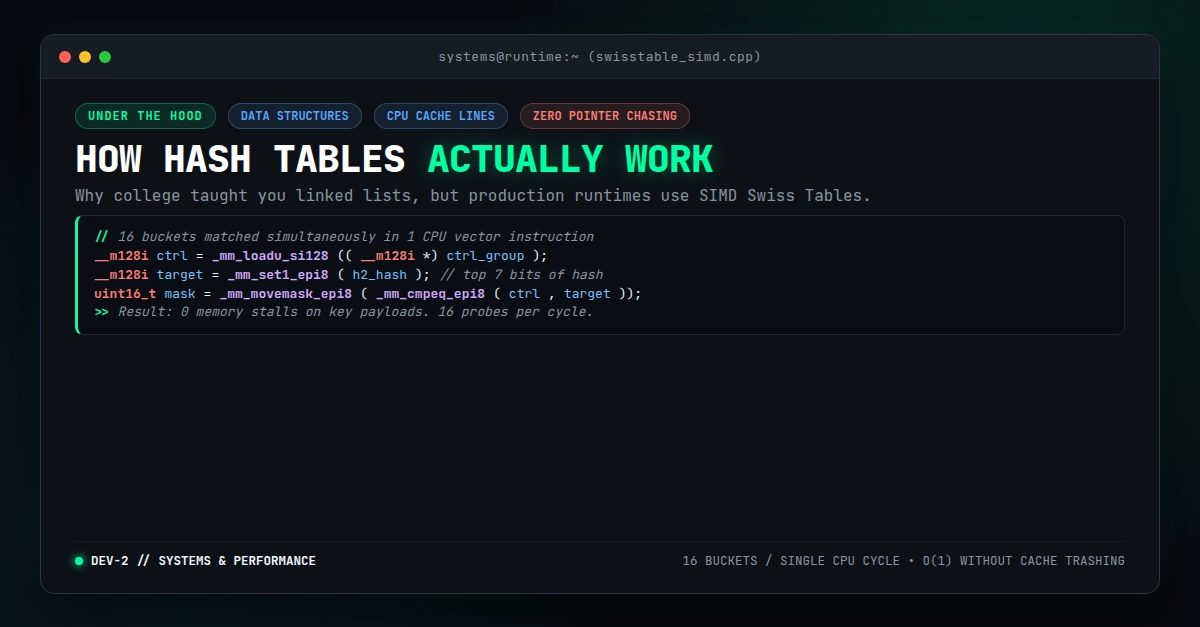
Introductory computer science courses present a uniform picture of hash tables: take a key, hash it, compute an index via modulo arithmetic, and if a collision occurs, append the new entry to a linked list at that bucket. This is the model of separate chaining. However, a glance at the standard libraries of high-performance runtimes reveals a stark departure. Rust's std::collections::HashMap, Google's Abseil C++ flat_hash_map, Python 3.6+ dict, and Go's runtime.hmap largely eschew linked lists. The reason is rooted in fundamental hardware physics: while CPUs perform arithmetic operations in nanoseconds, fetching data from random access memory (RAM) can take hundreds of clock cycles. This latency disparity makes linked lists, with their inherent pointer chasing, a significant performance bottleneck.
The core issue with linked lists in this context is cache locality. Each node in a linked list resides in a separate memory location. When the CPU needs to traverse the list to find an element, it often has to make multiple round trips to RAM, each trip incurring substantial latency. Modern CPUs employ caches (L1, L2, L3) to mitigate this, prefetching data that might be needed soon. However, linked lists scatter data unpredictably, making effective caching difficult. If the next node in the list isn't already in the cache, the CPU stalls, waiting for it to be fetched from RAM. This is akin to trying to find a specific book in a library where each book is stored in a different, randomly chosen building across town – you might get lucky and find a few nearby, but generally, you'll spend most of your time traveling.
Open Addressing and the Cache Line Advantage
To overcome the latency of linked lists, modern hash tables predominantly use open addressing. In open addressing, all elements are stored directly within the hash table array itself. When a collision occurs (i.e., two keys hash to the same index), instead of creating a linked list, the algorithm probes for an alternative empty slot within the table. This approach keeps related data closer together in memory, significantly improving cache performance. When a CPU fetches a block of data (a cache line) from RAM, it brings not just the requested byte but also its surrounding bytes. If subsequent elements of the hash table are located within this same cache line, they can be accessed almost instantaneously, as they are already present in the CPU's faster cache memory.
Several probing strategies exist for open addressing:
- Linear Probing: If index
iis occupied, tryi+1, theni+2, and so on. This is simple but can lead to primary clustering, where occupied slots tend to clump together, degrading performance. - Quadratic Probing: If index
iis occupied, tryi+1^2, theni+2^2, etc. This reduces primary clustering but can lead to secondary clustering, where keys that hash to the same initial index follow the same probing sequence. - Double Hashing: Use a second hash function to determine the step size for probing. This is more complex but generally offers better distribution and avoids clustering issues more effectively.
Robin Hood Hashing: Fairness in Collision Resolution
While open addressing improves cache locality, performance can still degrade significantly as the table fills up. A particularly elegant solution to manage collisions in open addressing is Robin Hood Hashing. This strategy aims to reduce the variance in probe sequence lengths. In a standard open addressing scheme, some keys might be stored very close to their ideal hash index, while others could be far away due to multiple collisions. Robin Hood Hashing attempts to equalize this 'distance' or 'probe count'.
The core idea is that when inserting a new key, if it encounters an existing key that is 'richer' (i.e., has traveled fewer steps from its ideal hash index than the new key has), the new key 'steals' the slot from the existing key. The displaced key then continues the insertion process from that slot. This process is analogous to the folklore of Robin Hood, who took from the rich and gave to the poor. By doing so, Robin Hood Hashing minimizes the maximum probe sequence length, leading to more predictable and often better average-case performance, especially at higher load factors.
Referenced Sources
- verified