The Unseen Jitter Problem in Distributed Systems
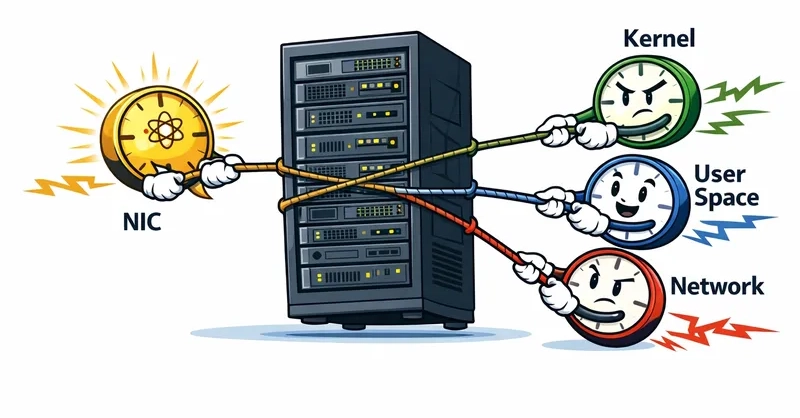
In distributed systems, the precise ordering and timing of events are paramount. Whether for financial trading, replicated databases, or high-frequency network protocols, even microsecond deviations in timestamps can cascade into significant operational failures. The common culprit? Software timestamps. The CPU and kernel, burdened by context switches and interrupt handling, offer an unreliable picture of when a network packet truly arrived at the network interface card (NIC). This fundamental disconnect means that software timestamps are the weakest link when microsecond-level accuracy, fairness, or regulatory auditability are non-negotiable.
Consider the downstream effects: event order flips in logs, inconsistent timestamps in replicated writes, or trading systems reporting re-feeds with erroneous timing. For protocols like Precision Time Protocol (PTP), relying on software timestamps can lead to slave clocks reporting hundreds of microseconds of wander, far from the desired nanosecond or microsecond precision.
Making the NIC the Source of Truth: Hardware Timestamping and PHC
The only reliable way to capture accurate event times is to move timestamping as close to the physical layer as possible. This is where hardware timestamping on the NIC comes into play. By leveraging the NIC's own clock, systems can achieve timestamps that reflect the actual arrival or departure time of a packet at the wire, independent of the host CPU's load or scheduling whims. This technique is often referred to as Precision Time Protocol (PTP) hardware timestamping.
A key component in this strategy is the Physical Layer Clock (PHC). Each NIC equipped with hardware timestamping capabilities typically has its own PHC. This clock is much more accurate and stable than the system's software clock. To synchronize the system's software clock with the NIC's PHC, a driver plumbing layer is essential. This layer facilitates the transfer of time information, ensuring that the system can at least approximate the accurate hardware timestamps.
Locking On: PLLs, Servos, and Practical Clock Modeling
Achieving and maintaining microsecond-level clock synchronization requires more than just hardware timestamps. It involves sophisticated clock modeling and control mechanisms. Phase-Locked Loops (PLLs) and servo algorithms are critical for this. A PLL, in essence, uses feedback to adjust a local oscillator's phase and frequency to match that of a reference signal. In the context of clock synchronization, this means the NIC's PHC (or a system clock synchronized to it) is constantly nudged to align with a more authoritative time source, often an external PTP grandmaster clock.
The servo algorithm acts as the brain of this operation. It analyzes the timing differences and drift between the local clock and the reference clock, calculating the necessary adjustments. This isn't a simple on/off switch; it's a continuous process of modeling the clock's behavior – its frequency offset, its aging, and its susceptibility to environmental factors – and applying corrective measures. Practical clock modeling considers these factors to predict and counteract clock drift, ensuring that the synchronized clock remains stable and accurate over time, even under varying network conditions.
Stripping the Stack: Kernel Bypass and Software Tuning
Even with hardware timestamping, the journey of a packet through the operating system's network stack introduces its own form of jitter. Traditional network processing involves multiple layers of software – interrupt handlers, protocol stacks, and application-level processing – each adding latency and variability. To minimize this, techniques like kernel bypass are employed.
Kernel bypass mechanisms, such as DPDK (Data Plane Development Kit) or XDP (eXpress Data Path), allow applications to interact directly with the NIC, circumventing the kernel's network stack. This dramatically reduces the number of software layers a packet must traverse, thereby cutting down on latency and jitter. Furthermore, careful software tuning is necessary. This includes optimizing interrupt handling, disabling unnecessary kernel features, and using real-time patches for the operating system. Techniques like CPU isolation and affinity ensure that critical network processing threads run on dedicated cores, free from interference from other system processes.
Proving It: Measuring Jitter and Allan Deviation
The ultimate test of any clock synchronization strategy is rigorous measurement and validation. Simply implementing hardware timestamping is not enough; one must be able to quantify its effectiveness and demonstrate compliance with required precision levels. Key metrics include measuring jitter, which is the variation in the timing of a signal from its ideal position. For clock synchronization, this translates to the variation in the time difference between two clocks.
A more advanced technique for characterizing clock stability over time is Allan deviation. It measures the fractional frequency stability of an oscillator or clock. By analyzing Allan deviation, engineers can understand how a clock's stability changes with averaging time, identifying potential sources of drift or noise. Validation recipes involve setting up controlled environments, injecting known timing variations, and meticulously recording the system's response. This allows for the identification of bottlenecks and the fine-tuning of synchronization parameters. For applications requiring regulatory compliance, such as financial data transmission, this level of proof is non-negotiable, often requiring auditable logs of timing performance.
An Actionable Checklist for Eliminating Software Jitter
To achieve reliable, microsecond-accurate clocks in a distributed system, a systematic approach is required. Here is a step-by-step protocol:
- 1. Identify Requirements: Determine the precise timing accuracy and jitter tolerance needed for your application. Is it nanoseconds, microseconds, or milliseconds?
- 2. Hardware Timestamping: Deploy network interface cards (NICs) that support hardware timestamping (PTP hardware timestamping).
- 3. Driver Configuration: Ensure the NIC drivers are correctly configured to enable hardware timestamping and that the necessary driver plumbing for PHC synchronization is in place.
- 4. Clock Synchronization Protocol: Implement a robust clock synchronization protocol, such as PTP (IEEE 1588), and configure it to utilize the NIC's PHC.
- 5. Clock Modeling: Employ advanced clock modeling and servo algorithms to continuously adjust and stabilize the synchronized clock, counteracting drift.
- 6. Kernel Bypass: For latency-sensitive applications, investigate and implement kernel bypass techniques (e.g., DPDK, XDP) to reduce software stack jitter.
- 7. Software Tuning: Optimize operating system and application settings. Isolate critical processes, tune interrupt handling, and consider real-time kernel options.
- 8. Measurement and Validation: Regularly measure clock jitter and stability using tools that can analyze Allan deviation and other relevant metrics.
- 9. Auditing: For compliance-critical systems, implement logging and auditing mechanisms to record timing performance and synchronization status.
By systematically addressing each of these points, engineers can move from the unreliable world of software timestamps to the deterministic precision offered by hardware-accelerated timing.