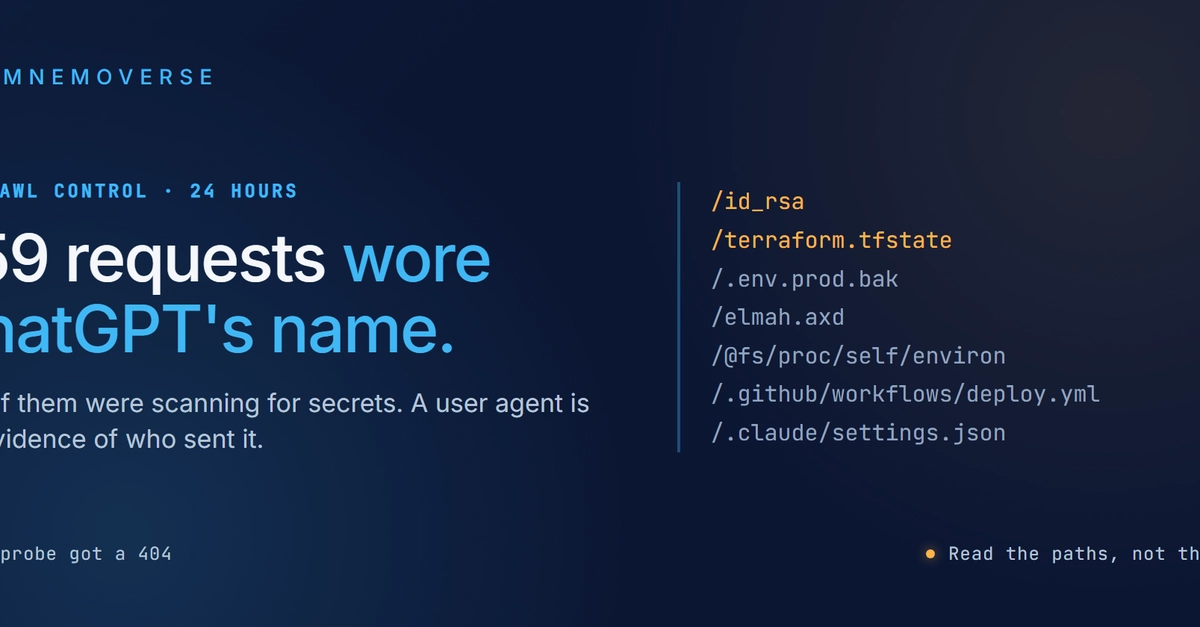
AI Crawl Control Reveals Malicious Intent
Last week, Cloudflare's AI Crawl Control, a tool designed to identify and manage AI bot traffic, provided a stark look into the nature of automated requests. For one security researcher, the initial findings were not just surprising but deeply concerning. Over a 24-hour period, the tool logged 1,890 requests from AI agents. Of these, a significant 483 failed, marking a 63% increase in failures compared to the previous day. This surge in failed requests signaled an anomaly that demanded closer inspection.
The agent of primary interest was 'ChatGPT-User,' which OpenAI designates for user-initiated queries. When a user asks ChatGPT or a Custom GPT a question, this agent is supposed to visit the relevant page. It accounted for a substantial 859 requests within the observed window. However, only 412 of these requests returned a successful '200 OK' status. This initial observation led the researcher to suspect a simple redirect issue, perhaps due to recent documentation slug migrations. The hypothesis was that stale URLs were causing the bounces, a problem easily fixable with a comprehensive redirect map.

Unmasking the Scans
Further investigation into the actual paths requested by the 'ChatGPT-User' agent revealed a more sinister truth. The requests were not merely hitting old URLs. Instead, they were systematically probing for specific vulnerabilities. The paths targeted included common exploit vectors such as '/.git/', '/.env', and API endpoints known to be susceptible to injection attacks or unauthorized access. These are not typical paths a genuine user interacting with a chatbot would ever request. A user asking a question about a product would expect to see product pages, documentation, or blog posts, not sensitive configuration files or version control repositories.
The pattern of requests strongly suggested automated scanning for security weaknesses. The 'ChatGPT-User' agent was being impersonated, or more accurately, its user-agent string was being spoofed by malicious bots. These bots were leveraging the perceived legitimacy of an OpenAI-associated agent to bypass security measures or to appear as benign traffic. This tactic exploits the trust often placed in requests originating from well-known AI services.
The Broader Implications for Web Security
This discovery has significant implications for how we monitor and secure web applications in the age of advanced AI. The sophisticated nature of these scans means that traditional bot detection methods, which often rely on user-agent strings or basic request patterns, may become insufficient. Malicious actors can now disguise their activities behind seemingly legitimate AI traffic, making it harder to distinguish between genuine users, legitimate AI crawlers (like search engine bots), and malicious scanners.
The prevalence of such activity highlights a critical arms race in cybersecurity. As AI tools become more powerful and accessible, they are inevitably weaponized for malicious purposes. The ability to mimic legitimate traffic at scale poses a significant challenge for site administrators and security teams. It necessitates a shift towards more advanced behavioral analysis and anomaly detection systems. Relying solely on the reported user-agent string is no longer a viable security posture. Instead, systems must analyze the sequence of requests, the types of resources accessed, and the overall behavior to identify malicious intent.
Adapting Defenses in the AI Era
For developers and site owners, this situation calls for a multi-layered defense strategy. Firstly, implementing robust Web Application Firewalls (WAFs) with advanced bot management capabilities is crucial. These WAFs should go beyond simple user-agent blocking and employ techniques like behavioral analysis, CAPTCHA challenges for suspicious traffic, and IP reputation scoring. Secondly, regularly auditing access logs for unusual patterns, such as requests to sensitive files or API endpoints, is essential. The findings from AI Crawl Control underscore the need to actively monitor for requests that deviate from expected user behavior, regardless of the reported agent.
Furthermore, the practice of migrating documentation or application slugs without a comprehensive, long-term redirect strategy can inadvertently create blind spots that malicious actors can exploit. While the initial assumption of a redirect issue was incorrect, it points to the importance of meticulous URL management. Every change, no matter how small, can have security implications if not handled with care.
The incident also raises questions about the responsibility of AI providers. While OpenAI likely has no direct hand in these spoofed requests, the widespread adoption of tools like ChatGPT means that their associated user-agent strings become valuable commodities for attackers. This situation might eventually lead to more stringent controls or unique identifiers for different types of AI agents to prevent such impersonation. Until then, vigilance and advanced security tooling are the primary defenses.